
NEWARE Battery Cycler
NEWARE battery cyclers deliver precision charge-discharge testing with integrated Electrochemical Impedance Spectroscopy (EIS) capabilities for comprehensive battery analysis. Engineered for research, development, and quality assurance across lithium-ion, solid-state, pouch, and cylindrical battery formats, these advanced cyclers provide high-accuracy measurements down to ±0.02% full scale with multi-channel configurations. From coin cell research to electric vehicle battery pack validation, NEWARE systems offer automated cycling, real-time data logging, and dynamic simulation capabilities that replicate real-world conditions. With support for various battery chemistries, SMBUS/I2C communication protocols, and modular scalability, NEWARE cyclers accelerate innovation while ensuring rigorous quality standards across the entire battery development lifecycle.
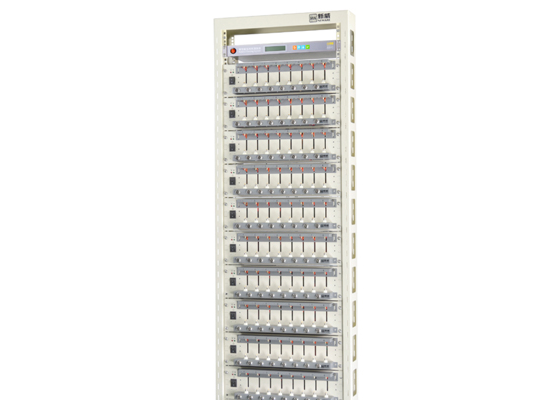
NEWARE CT-4000 Series
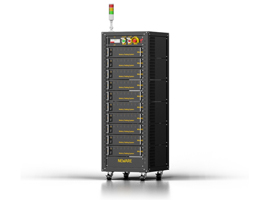
NEWARE CT/CTE-5000 Series
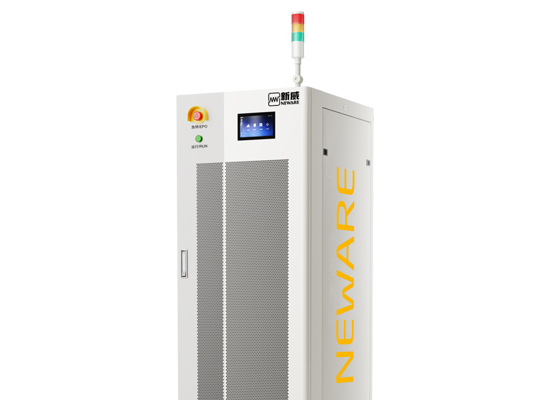
NEWARE CE-6000 Series
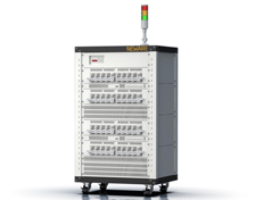
NEWARE CT/CTE-8000 & 9000 Series Battery Simulation Testers
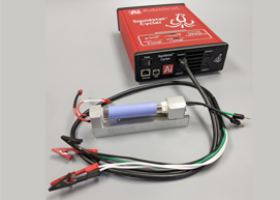
EIS Battery Cycler Series
What Is a NEWARE Battery Cycler?
A NEWARE battery cycler is a sophisticated testing instrument designed to repeatedly charge and discharge battery cells while precisely measuring and recording critical performance parameters. These systems serve as the backbone of battery research and quality control, enabling engineers and scientists to evaluate capacity, efficiency, internal resistance, cycle life, and degradation mechanisms under controlled conditions.
NEWARE battery cyclers stand out in the industry for their exceptional precision, with current accuracy reaching ±0.02% of full scale and voltage resolution down to 100 µV. This level of accuracy makes them indispensable for detecting subtle performance differences between battery materials and designs, supporting everything from fundamental electrochemical research to high-volume production quality control.
Comprehensive NEWARE Battery Cycler Series
NEWARE CT-4000 Series: Precision for Lab-Scale Research
The CT-4000 Battery Cycler Series represents the ideal entry point for coin cell, supercapacitor, and three-electrode system testing. With multiple models offering current ranges from 50mA to 12A across triple-range configurations, these cyclers deliver exceptional measurement control for laboratory-scale research. The triple-range design enables automatic switching between current ranges, providing optimal accuracy across the entire testing spectrum without manual intervention.
Key applications include electrode material research, battery performance evaluation, and small-scale formation testing. The CT-4000 series features independent constant-current and constant-voltage sources for each channel, with data recording frequencies up to 10Hz and response times as fast as 1ms.
CT-4000 Series:
CT-4000 – 5/10V 50mA (3 ranges) || CT-4000 5V100mA (4 ranges) || CT-4000 5V 6A/12A (3 ranges) || CT-4000 Super Capacitor Testing System (3 ranges)
NEWARE CT/CTE-5000 Series: Smart Battery Integration
Engineered specifically for consumer electronics applications, the CT/CTE-5000 Battery Cycler Series excels at testing laptop, tablet, and smartphone battery packs. The defining feature of this series is SMBUS/I2C communication capability, enabling direct integration with Battery Management Systems (BMS) for comprehensive smart battery diagnostics.
With measurement accuracy reaching 0.02% full scale and response times under 10ms, these cyclers capture rapid transient behaviors critical for consumer electronics validation. The series incorporates advanced four-quadrant energy feedback technology, efficiently converting electrical energy generated during testing and feeding it back to the power grid, significantly reducing operational costs.
CT/CTE-5000 Series:
CE-5000 Laptop Battery Testing System || CT-5000 5V6A & 5V12A (3 ranges) || CTE-5016 5V75A DSP
NEWARE Battery Cycler CE-6000 Series: Automotive & Industrial Power Testing
The CE-6000 Battery Cycler Series provides robust solutions for testing high-power cells, modules, and complete battery packs in automotive and industrial applications. Supporting maximum voltages up to 3000V, this modular platform handles the demanding requirements of electric vehicle battery development.
This series combines regenerative energy technology with high-precision measurement capabilities, making it ideal for both R&D and production environments. The CE-6000's modular architecture allows for flexible channel configurations and scalability to meet evolving testing demands.
NEWARE CT/CTE-8000 Series: Dynamic EV Load Simulation
The CT/CTE-8000 Series delivers advanced simulation of real-world usage patterns for electric vehicle and portable device batteries. These cyclers can replicate actual road-driving loads with dynamic current and power waveform simulation, enabling engineers to evaluate battery performance under authentic operating conditions.
By loading drive profile data from CSV or text files containing millions of data points with intervals as fast as 10ms, the 8000 Series provides effortless implementation of complex drive cycle simulations. This capability proves essential for validating EV battery pack performance, range prediction, and thermal management strategies.
NEWARE CT-9000 Series: Ultra-Precision Research Platform
The CT-9000 Series represents NEWARE's pinnacle achievement in battery testing technology. Characterized by 1000Hz data recording frequency, four automatic-switch output ranges, 0.005% accuracy, and minimum 400µs pulse width capability, the BTS9000 stands as one of the most advanced battery testers available globally.
This series excels at transient performance analysis and detecting minute differences in battery materials, making it the preferred choice for cutting-edge electrochemical research. Battery experts from LG Chem, Samsung SDI, General Motors, and leading universities have highly evaluated and recommended the BTS9000 for its exceptional capabilities.
EIS Battery Cycler Series: Integrated Impedance Analysis
The EIS Battery Cycler Series integrates Electrochemical Impedance Spectroscopy directly into the cycling platform, eliminating the need for separate testing stations. This integration enables automated switching between DC charge-discharge and AC impedance measurements without repeatedly mounting and unmounting batteries.
EIS functionality provides detailed battery state-of-health analysis, internal resistance profiling, and predictive diagnostics across frequency ranges from 10 mHz to 100 kHz with ±0.5% impedance accuracy. A single EIS-equipped tester can support up to 72 channels with flexible test programming that allows simultaneous impedance measurements during DC testing.
Key Features & Competitive Advantages
High-Precision Measurement & Multi-Range Control
NEWARE cyclers achieve industry-leading current accuracy of ±0.02% full scale with 16-bit AD/DA resolution. The automatic multi-range switching feature optimizes measurement accuracy across the entire current spectrum, from microamperes to hundreds of amperes, without manual intervention.
True Bipolar Circuitry for Dynamic Testing
True bipolar circuit design enables seamless transitions between charge and discharge modes without switching delays or current spikes. This capability proves critical for dynamic drive cycle simulations and pulse testing applications where rapid current direction changes occur.
Advanced Communication & Integration
Support for SMBUS/I2C protocols enables direct communication with Battery Management Systems for smart battery validation. USB and Ethernet interfaces facilitate data export in CSV and JSON formats, while optional LabVIEW and Python APIs support custom automation and real-time monitoring dashboards.
Comprehensive Safety & Compliance
NEWARE systems meet CE and UL certification requirements for laboratory and industrial use. Built-in protections include over-current, over-voltage, and thermal cutoffs, with optional explosion-proof enclosures for testing volatile electrolytes or gas-evolving experiments.
User-Friendly Software & Data Management
Dedicated software suites provide intuitive programming interfaces for creating complex test profiles with up to 65,535 cycles and 254 steps per program. Real-time data visualization, exportable formats, and integration with analysis software streamline workflow efficiency.
Applications Across the Battery Lifecycle
Research & Development
NEWARE cyclers accelerate battery material research by enabling rapid iteration and testing of new designs with customizable profiles and instant feedback. High-precision measurements reveal subtle performance differences between electrode materials, electrolyte formulations, and cell architectures.
Quality Control & Production Testing
Automated capacity testing, formation cycling, and grading operations ensure battery quality meets desired standards during manufacturing. Multi-channel configurations dramatically increase testing throughput while maintaining measurement accuracy.
Electric Vehicle Battery Development
Dynamic drive cycle simulation capabilities replicate real-world EV operating conditions, supporting range optimization, thermal management validation, and BMS integration testing. Temperature-controlled testing environments enable evaluation of battery performance across extreme climatic conditions.
Academic & Industrial Research
From fundamental electrochemical studies using three-electrode configurations to advanced degradation mechanism analysis, NEWARE systems support diverse research applications. Integration with environmental chambers and supplementary instrumentation expands experimental capabilities.
Why Electrochemical Impedance Spectroscopy (EIS) Matters
EIS represents a sophisticated non-destructive diagnostic technique that examines battery internal chemistry by measuring electrical impedance across multiple frequencies. This analysis reveals critical information about ohmic resistance, solid electrolyte interphase (SEI) layer formation, charge-transfer kinetics, and lithium-ion diffusion processes.
EIS measurements enable state-of-health estimation, degradation forecasting, and performance optimization without disassembling batteries or interrupting normal operation. The technique proves especially valuable for identifying subtle changes in battery internal resistance that precede capacity fade and failure.
By integrating EIS directly into battery cyclers, NEWARE systems eliminate labor-intensive manual transfers between equipment, reduce measurement errors caused by varying electrical contacts, and enable continuous monitoring throughout charge-discharge cycling.
Selecting the Right NEWARE Battery Cycler
Choosing the optimal battery cycler depends on several key factors including battery format, chemistry, voltage and current requirements, testing objectives, and throughput needs.
For laboratory research with coin cells and small-format batteries, the CT-4000 Series provides excellent precision and value. Consumer electronics manufacturers testing smart battery packs benefit from the CT/CTE-5000 Series' BMS communication capabilities. Automotive applications requiring high-power testing demand the CE-6000 Series' voltage and current capacity.
Research institutions pursuing cutting-edge electrochemical studies should consider the CT-9000 Series for its exceptional accuracy and transient measurement capabilities. Organizations requiring comprehensive battery diagnostics gain significant advantages from EIS-integrated models.
Technical Support & Custom Solutions
NEWARE's commitment extends beyond hardware to comprehensive technical support, application guidance, and custom configuration services. Expert teams assist with system selection, installation, training, and ongoing operational support to maximize testing efficiency and results quality.
Custom channel configurations, specialized fixtures for unique battery formats, and integration with third-party environmental chambers provide tailored solutions for specific testing requirements. Software customization and API development support enable seamless integration with existing laboratory information management systems.
Advancing Battery Technology Through Precision Testing
As global demand for energy storage solutions accelerates across electric vehicles, grid-scale systems, and portable electronics, rigorous battery testing becomes increasingly critical. NEWARE battery cyclers empower researchers, manufacturers, and quality control professionals to develop safer, longer-lasting, and more efficient battery technologies.
From fundamental materials research to high-volume production quality assurance, NEWARE systems deliver the precision, reliability, and versatility required to advance battery innovation. Whether evaluating next-generation solid-state batteries, optimizing lithium-ion formulations, or validating EV battery pack performance, NEWARE cyclers provide the trusted foundation for rigorous battery analysis.
Frequently Asked Questions
What battery chemistries can NEWARE cyclers test?
NEWARE battery cyclers support comprehensive testing across lithium-ion, sodium-ion, solid-state, lithium-metal, nickel-metal hydride, and other battery chemistries. The systems accommodate various formats including coin cells, cylindrical cells, pouch cells, prismatic cells, and complete battery packs.
How does EIS integration improve battery testing?
Integrated EIS eliminates repeated battery mounting and unmounting between DC cycling and impedance analysis equipment, reducing labor demands and measurement errors. This enables automated impedance tracking throughout charge-discharge cycling for comprehensive state-of-health monitoring and degradation analysis.
What data formats do NEWARE cyclers export?
NEWARE systems support data export in CSV, JSON, and other standard formats compatible with analysis software. Optional LabVIEW and Python APIs enable custom data acquisition and real-time monitoring dashboard integration.
Can NEWARE cyclers simulate EV driving conditions?
Yes, the CT/CTE-8000 Series specifically enables dynamic drive cycle simulation by loading time-versus-current or time-versus-power profiles with millions of data points at 10ms intervals. This replicates authentic road-driving loads for comprehensive EV battery validation.
What safety features are included?
NEWARE cyclers incorporate over-current, over-voltage, and thermal protection mechanisms with power-off data protection and user-defined safety condition settings. Systems meet CE and UL certification standards with optional explosion-proof enclosures available for specialized applications.
How many channels can be configured per system?
Channel configurations vary by series and model, ranging from 8 channels in compact laboratory systems to 72 channels in EIS-integrated platforms. Multi-channel systems enable simultaneous testing of multiple batteries while maintaining independent control and measurement for each channel.
What measurement accuracy can be expected?
Standard NEWARE models achieve ±0.02% full scale accuracy for voltage and current measurements with 16-bit resolution. Premium models like the CT-9000 Series reach exceptional 0.005% accuracy levels for ultra-precise research applications.
Do NEWARE cyclers integrate with temperature chambers?
Yes, NEWARE systems interface with major third-party temperature chamber controllers worldwide, enabling automated temperature adjustment during testing. This supports evaluation of battery performance across extreme environmental conditions from -30°C to 85°C and beyond.
Get Started with NEWARE Battery Cyclers
Contact our expert team at sales@sciencegears.com.au to discuss your specific battery testing requirements. We provide comprehensive consultation, system configuration recommendations, installation support, and ongoing technical assistance to ensure optimal testing outcomes for your research, development, or quality assurance objectives development, or quality assurance objectives.