

Faraday Cage for Electrochemical Measurements
Faraday Cage for Electrochemical Measurements
What a Faraday cage does in electrochemistry
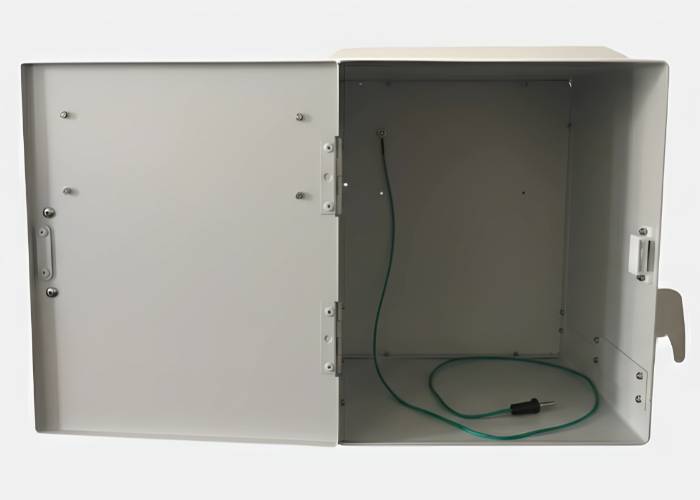
A Faraday cage is a conductive enclosure that reduces electromagnetic interference (EMI) coupling into your electrochemical cell, electrode leads, and other high-impedance measurement points. This is critical in modern labs where mains wiring, monitors, switching power supplies, pumps, and nearby instruments can inject noise that appears as 50 Hz hum, drifting baselines, or unstable current traces. By shielding the experiment, the cage helps your potentiostat measure the true electrochemical response rather than environmental interference.
Principle of operation
When external electric fields (and many radio-frequency disturbances) strike a continuous metal enclosure or fine conductive mesh, charges redistribute on the cage surface. This creates an equipotential boundary that strongly reduces electric-field penetration into the enclosed volume. In electrochemistry, the practical benefit is reduced capacitive pickup on leads and reduced noise at the cell, which improves the signal-to-noise ratio for low-current and high-impedance experiments. Correct grounding and careful lead routing are essential to maximise performance and avoid unintended ground-loop artefacts.
Key features (research-lab focused)
- Bench-friendly footprint: standard cage size 24 × 23 × 30 cm
- Customisable design: custom sizes and cable-entry/feedthrough styles to suit your cell and lead configuration
- Designed for real electrochemical setups: accommodates the cell plus lead routing, because leads can behave like antennas in noisy environments
- Ground connection provision: supports consistent grounding practices to stabilise measurements
- Improves measurement repeatability: reduces noise-related variability across runs and users
Compatibility
A Faraday cage is broadly compatible with most potentiostats/galvanostats, EIS analysers, and common cell formats (beakers, H-cells, corrosion cells, microelectrode rigs). It also integrates well with multi-instrument workflows such as battery testing and spectroelectrochemistry, where multiple powered devices can increase lab EMI.
Typical applications
- Electrochemical impedance spectroscopy (EIS): improved spectral stability and fewer interference artefacts
- Low-current measurements (nA–µA): sensors, microelectrode voltammetry, corrosion monitoring, coating studies
- High-impedance systems: non-aqueous electrochemistry, small-area electrodes, weak faradaic signals
- Long-duration experiments: reduced baseline drift and cleaner time-series data
Why choose ScienceGears (Australia & New Zealand)
ScienceGears supplies lab-ready Faraday cages with a standard size option plus customisation to match your experimental geometry (cell size, cable routing, gas purge lines, temperature probes, illumination requirements). We also support researchers in selecting complementary hardware—such as potentiostats, electrochemical cells, reference electrodes, and spectroelectrochemistry accessories—so your complete setup delivers stable, publishable data.
FAQs
1) Do I need a Faraday cage for electrochemistry?
If you measure low currents, run high-impedance cells, or perform EIS in a typical lab environment, a Faraday cage is one of the most effective ways to reduce EMI-related noise and improve repeatability.
2) What problems does a Faraday cage solve?
It helps reduce mains hum, noisy current signals, baseline instability, and interference artefacts caused by environmental electromagnetic fields and nearby powered equipment.
3) Should the Faraday cage be grounded?
In most electrochemical setups, grounding the cage to the potentiostat/instrument ground improves shielding effectiveness. A consistent grounding approach is important for stable results.
4) Can incorrect grounding make the noise worse?
Yes. Poor grounding and unintended ground loops can introduce extra noise or instability. Keep grounding consistent and avoid multiple competing ground paths.
5) Will a Faraday cage improve EIS measurements?
Often, yes—especially if your EIS spectra show high-frequency noise, unstable phase/magnitude, or spurious features linked to EMI pickup.
6) Does a Faraday cage block magnetic fields too?
A Faraday cage is primarily effective against electric-field interference and many RF disturbances. Low-frequency magnetic interference may require additional strategies and specialised materials.
7) Do I need to enclose the cables as well as the cell?
Ideally, yes. Leads and loops are common EMI entry points. Enclosing the cell and managing lead routing inside the cage usually delivers the best improvement.
8) What size Faraday cage should I choose?
Select a cage that fits your entire assembly (cell, holder, stirrer clearance, gas lines, probes) and still allows tidy lead routing. The standard option is 24 × 23 × 30 cm, and custom sizes can be provided.
9) Can the cage be customised for my cell type?
Yes. A Faraday cage can be customised to suit different cell sizes and cable-entry requirements, including specialised feedthrough approaches for complex experimental setups.
10) What else can I do to reduce electrochemical noise?
Alongside a Faraday cage, good practices include neat cable routing, minimising loop area, avoiding running signal leads parallel to power cables, using stable reference electrodes, and following instrument grounding recommendations.
Resources & Downloads
Everything you need to get started

Electrochemical Impedance Spectroscopy (EIS): Core Concepts for Confident Understanding
Squidstat - Admiral
Customer Reviews
Related Product
Explore our precision instruments designed for electrochemical research and energy applications
Still Wondering About Something?
Explore our FAQ for fast, clear answers to the most common questions—available 24/7.