
Battery tabs / consumables / packaging
Battery consumables and packaging determine build quality, sealing reliability and experimental repeatability. This subcategory covers common lab formats such as coin cell cases and cylindrical/prismatic housings plus tabs and supporting consumables used during electrode stacking, sealing and cell assembly for lithium-ion, sodium-ion and supercapacitor research.

ALF-113 Aluminium Laminated Film
Electrolyte
KLS High Temperature Polyimide Tape
Overview
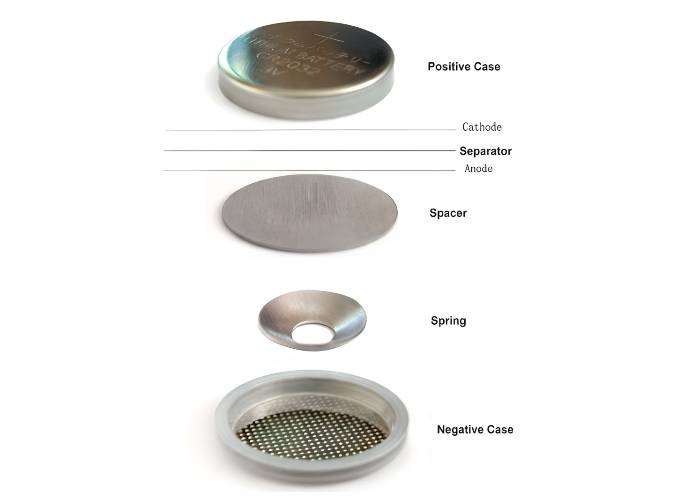
In battery R&D, consumables are not “just hardware”—they directly affect leakage risk, contact resistance, stack pressure and sample reproducibility. Coin cell components (cases, spacers, springs, gaskets) define compression and sealing, while cylindrical and prismatic housings enable larger electrode areas and more realistic thermal/current distributions. Tabs and interconnect consumables influence resistance and weld quality, and packaging choices affect moisture exposure and mechanical integrity.
What You Can Measure / Control (Key Capabilities)
- Seal integrity and electrolyte leakage resistance
- Stack pressure/compression repeatability (coin cell geometry)
- Contact resistance at terminals and tabs
- Cell format scaling (coin → cylindrical → prismatic)
- Mechanical robustness under cycling and temperature changes
- Compatibility with glovebox assembly workflows
- Quality control via standardised consumable selection
- Safety margin via consistent housing and sealing choices
Typical Applications
- Coin cell screening for cathode/anode/electrolyte studies
- Scaling promising chemistries to cylindrical/prismatic prototypes
- Repeatable formation and cycling protocols with controlled compression
- Tab/weld optimisation for low resistance connections
- Supercapacitor can assembly for high-power devices
- Academic reproducibility improvements via standardised builds
Integration & Compatibility
Consumables must match electrode size, separator diameter, electrolyte volume and formation protocol. Pair your cell format with /battery-test-systems for formation and cycling, and use /potentiostats-galvanostats when you need mechanistic diagnostics. Consistent consumables reduce the risk that “performance differences” are caused by compression or sealing artefacts.
Why Choose ScienceGears (AU & NZ)
ScienceGears supports AU/NZ labs with practical advice on choosing cell formats and consumables for your study goals, helping you standardise builds, reduce leakage failures, and improve repeatability across students and projects.
PRODUCT FAMILIES & MODELS
Coin cell cases and components
Standard lab screening format with controlled geometry.
- Coin cell cases (e.g., CR-type families) — housing for coin cell assembly
- Coin cell accessories — spacers, springs and sealing components (format dependent)
Cylindrical battery cases
For larger prototypes and more application-relevant builds.
-
Cylindrical battery case formats — selected by diameter/length (e.g., 18-series)
Prismatic cell cases
For flat-format prototypes and stack-style evaluation.
-
Prismatic cell case formats — selected by internal dimensions and sealing design
Supercapacitor cans
For high-power device builds and component testing.
-
Supercapacitor can formats — selected by diameter, cap type and sealing method
Tabs, tapes and assembly consumables (selection support)
Used for electrical connection, insulation and packaging consistency.
- Battery tabs / metal strips — low resistance connections (material dependent)
- Battery tape / insulation consumables — assembly and safety support
- Buckles / fixtures (format dependent) — mechanical support during builds
HOW TO CHOOSE (MICRO-SELECTION GUIDE)
Choose consumables based on cell format and study goal. For rapid screening and high throughput, coin cells are efficient—but control compression and sealing carefully. For more realistic thermal and current behaviour, cylindrical or prismatic cases may be better, especially when translating promising materials. Select tab materials and thickness to minimise resistance and support reliable welding/crimping. Standardise consumable types within a project to reduce variability between builds and between operators.
FAQs
Q1: Why do consumables matter so much in battery research?
Consumables control sealing, compression, contact resistance and mechanical alignment—factors that directly change measured capacity, impedance and failure rates. Inconsistent cases, gaskets or tabs can introduce variability that looks like “chemistry effects.” Standardising consumables is one of the fastest ways to improve reproducibility and reduce wasted builds.
Q2: Should I use coin cells or cylindrical/prismatic cases?
Coin cells are ideal for fast screening because they’re compact and consistent when assembled well. Cylindrical and prismatic cases allow larger electrodes and can better represent real-device behaviour. Many labs use coin cells for selection, then scale the best formulations to larger formats to confirm performance under more realistic conditions.
Q3: What causes coin cell leakage or inconsistent results?
Common causes include damaged gaskets, contamination, incorrect electrolyte volume, misalignment, and inconsistent crimp pressure. Moisture exposure can also change electrolyte and interphase behaviour. Using consistent consumables and a controlled assembly workflow is often more important than changing the active materials.
Q4: How do tabs affect electrochemical performance?
Tabs and interconnects contribute resistance and can create local heating under high current. Poor tab welding or inconsistent contact increases impedance and noise in cycling data. Choose tab material compatible with your current collector and sealing method, and validate resistance with repeatable weld/crimp parameters.
Q5: How should I integrate consumable choices with testing?
Keep consumables constant while comparing materials, then use /battery-test-systems for formation and cycling under controlled conditions. If you’re diagnosing impedance or contact issues, /potentiostats-galvanostats can help quantify resistance changes via EIS and rate tests. Document build parameters so results are traceable.
Q6: Do you support battery consumables supply in AU & NZ?
Yes. ScienceGears supports AU/NZ labs with consumable selection aligned with your cell format and research goals, and can help standardise build workflows to improve repeatability and reduce failure rates.
CLOSING SUMMARY
Battery consumables are the foundation of reproducible data. ScienceGears supports AU/NZ researchers with cell cases, housings and assembly items plus practical guidance to standardise builds—so your performance trends reflect chemistry and design, not assembly variability.