

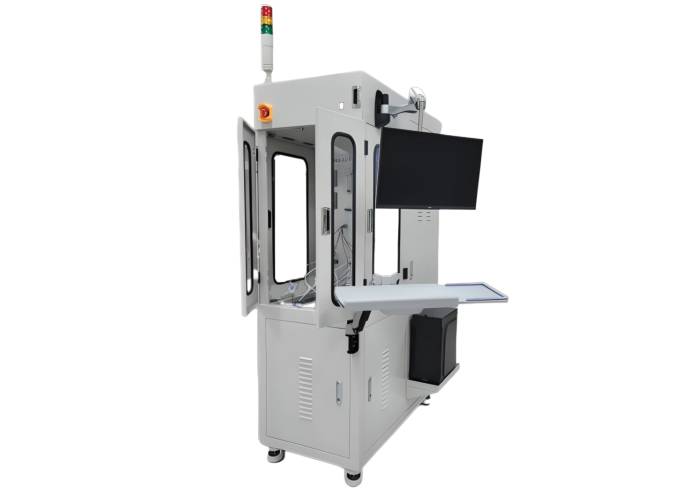


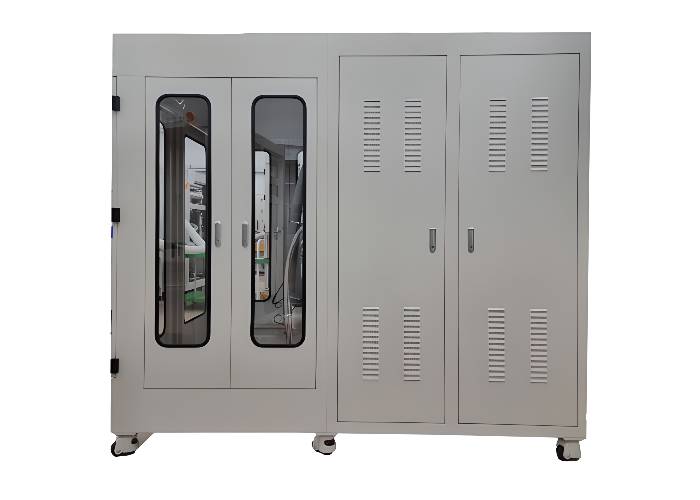
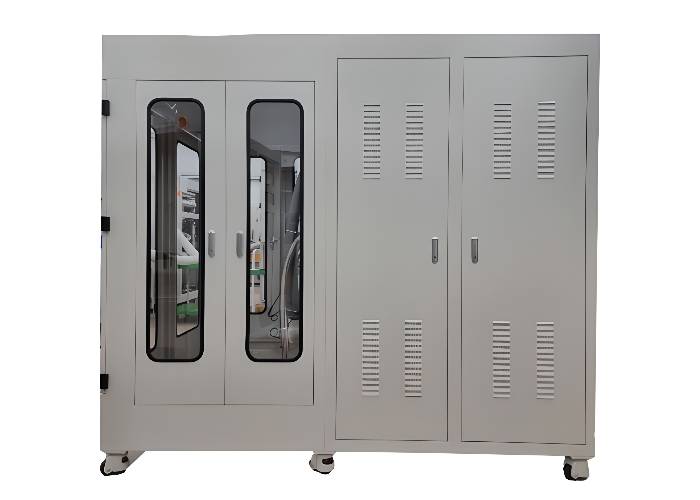
Overview
PEM water electrolysis uses a proton exchange membrane to conduct protons from the anode to cathode while separating product gases. In a PEM water electrolyser, deionised (DI) water is supplied to the anode where oxygen is generated; protons migrate through the membrane and hydrogen is produced at the cathode. Because PEM systems can operate at high current density and respond quickly to load changes, researchers commonly use them for catalyst screening, materials validation, durability testing and stack development.
A PEMWE test station provides the balance-of-plant required to run cells or stacks under repeatable conditions. Typical capabilities include controlled water circulation and temperature, regulated flow and back pressure, purge sequences, gas handling and data acquisition—so performance trends can be compared across materials, operating points and test protocols.
What You Can Measure / Control
- DC power control for polarisation and durability protocols
- DI water circulation with temperature, level control and alarms
- Water conductivity monitoring to track feedwater quality
- Flow control and filtration to protect the cell/stack hardware
- Gas cooling/condensate management for stable measurements
- Back pressure control for pressurised operation (with upgrade options)
- Cross-over monitoring (H₂-in-O₂ and O₂-in-H₂) for safety and validation
- Multi-channel cell voltage monitoring for diagnostics (where applicable)
Typical Applications
- PEM catalyst and membrane screening under defined load profiles
- Single-cell performance mapping (polarisation, efficiency, stability)
- Stack commissioning and validation across kW-to-100 kW class systems
- Hydrogen production R&D with controlled pressure and purge conditions
- Balance-of-plant tuning (water management, cooling, gas handling)
- Long-duration durability and start–stop cycling studies
Integration & Compatibility
PEMWE test stations often sit alongside electrochemical characterisation and gas-handling workflows. Many labs pair test stations with EIS/potentiostat tools for diagnostics and mechanistic insight, and with gas analysis for purity/crossover verification. Where relevant, consider linking to:
Relevant categories (link only where useful):
Why Choose ScienceGears (AU & NZ)
ScienceGears supports PEMWE testing programs across Australia and New Zealand with practical, research-led guidance—helping you scope the right power range, sensor set and safety approach for your cell or stack. We assist with commissioning readiness, operating procedures, troubleshooting and training so your team can generate reliable, defensible datasets from early-stage experiments through to pilot-scale validation.
Product families and Model
University Test Station
Designed for academic and early-stage R&D where compact footprint and controlled PEMWE operation are needed. Ideal for feasibility studies, method development and repeatable single-station testing without the overhead of larger floor-standing systems. Best suited to lower-power PEM electrolysis work while still supporting core water management, gas handling and automated monitoring.
-
SE300U-PE — Where it fits: compact university-oriented station for up to ~300 W class PEMWE testing.
Single Cell Test Station
Built for structured single-cell research and validation with enhanced balance-of-plant compared with benchtop concepts. Suitable for catalyst/membrane screening, controlled operating condition studies, and repeatable protocols that require stable water management, purge control and measurement logging.
- SE300-PE — Where it fits: single-cell PEMWE testing up to ~300 W class.
- SE500-PE — Where it fits: single-cell PEMWE testing up to ~500 W class when higher power headroom is required.
Stack Test Station (1–3 kW)
Entry stack platform for moving beyond single cells into small multi-cell stacks. Appropriate for stack assembly validation, early commissioning and controlled performance/durability testing where kW-scale operation is required with automated monitoring and safety controls.
- SE1K-PE — Where it fits: small stack testing up to ~1 kW class.
- SE3K-PE — Where it fits: small stack testing up to ~3 kW class for broader operating envelopes.
Stack Test Station (5–10 kW)
For serious stack development programs and pilot-relevant testing. Suits labs scaling protocols, validating stack hardware changes, and running longer campaigns where robust water/gas management and data logging are essential.
- SE5K-PE — Where it fits: mid-scale stack testing up to ~5 kW class.
- SE10K-PE — Where it fits: mid-scale stack testing up to ~10 kW class for expanded capacity and higher throughput.
Stack Test Station (30–50 kW)
Pilot-scale stack testing for industrial R&D and demonstration environments. Suitable for validating control strategies, balance-of-plant behaviour and safety systems under higher throughput hydrogen generation conditions.
- SE30K-PE — Where it fits: pilot-class stack testing up to ~30 kW.
- SE50K-PE — Where it fits: pilot-class stack testing up to ~50 kW for higher-capacity campaigns.
Stack Test Station (100 kW)
High-capacity platform for advanced pilot testing and industrial validation. Intended for programs needing higher hydrogen output, rigorous monitoring, and stable automated operation under demanding test schedules.
-
SE100K-PE — Where it fits: large stack testing up to ~100 kW class.
Stack Test Station (200 kW)
Top-end test capability for large stack validation and pre-deployment demonstration work. Suitable where facility-scale power, safety monitoring and automated control are required to generate representative pilot datasets.
-
SE200K-PE — Where it fits: large stack testing up to ~200 kW class.
How to Choose (micro-selection guide)
Start by matching the station power range to your target cell/stack and operating current density—leave headroom for transients and future scale-up. Next, decide whether you are testing a single cell (materials screening, mechanistic studies) or a stack (commissioning, durability, pilot validation). Confirm pressure requirements and whether you need crossover monitoring (H₂-in-O₂ / O₂-in-H₂) for safety and data credibility. For diagnostics-heavy work, consider the impedance (EIS) option and multi-channel voltage monitoring. Finally, check footprint, cooling approach and software/data export requirements for your lab workflow.
FAQs
1) What is a PEM water electrolyser test station?
A PEM water electrolyser (PEMWE) test station is a controlled platform used to operate PEM electrolysis cells or stacks under repeatable conditions. It manages key balance-of-plant functions such as DI water circulation, temperature, flow, pressure and purge sequences while recording electrical and process data. This makes it possible to compare performance, efficiency and durability across materials, cell builds and operating protocols.
2) How does PEM water electrolysis work in simple terms?
In PEM water electrolysis, water is split into hydrogen and oxygen using electricity and a proton-conducting membrane. Oxygen is produced at the anode, while protons move through the membrane to the cathode where hydrogen is generated. The membrane helps keep gases separated, which supports higher current density operation and fast dynamic response compared with some other electrolysis approaches.
3) How do I choose between a single-cell station and a stack station?
Choose a single-cell station for catalyst/membrane screening, controlled mechanistic studies and early validation where you want fast turnaround and lower gas output. Choose a stack station when you need to validate multi-cell hardware, commissioning procedures, balance-of-plant behaviour and durability at kW-to-100 kW class power. Your decision should follow your scale, safety requirements and whether results must represent pilot operation.
4) What operating parameters are most important to control for PEMWE testing?
Key parameters include power/current profile, DI water quality (conductivity), water flow and temperature, back pressure, purge strategy and gas handling/condensation management. Stable control of these factors improves repeatability and makes it easier to interpret changes caused by materials, cell design or test protocol. For advanced studies, cell voltage monitoring and impedance/EIS diagnostics can also be valuable.
5) What safety features matter for PEM electrolyser testing?
Hydrogen and oxygen handling requires careful monitoring and control. Important safeguards include purge sequences (often using inert gas), pressure control, alarms for water level/quality and sensors that detect crossover (hydrogen in oxygen and oxygen in hydrogen). Good condensate management and ventilation planning also matter. If your program involves pressurised operation, confirm the pressure rating and any available upgrade options.
6) Can I integrate PEMWE testing with electrochemical diagnostics like EIS?
Yes—many PEMWE programs benefit from impedance (EIS) to separate ohmic, kinetic and mass-transport contributions and to monitor degradation mechanisms over time. Some test stations offer integrated impedance capability as an option; alternatively, workflows may combine station operation with external electrochemical instrumentation depending on the measurement approach and electrical configuration. See /potentiostats-galvanostats where relevant.
7) Do I need gas analysis when running a PEM electrolyser test station?
Gas analysis can be useful for verifying purity, detecting crossover, and validating safety-critical behaviour—especially during transients, start–stop cycles or pressurised operation. Even when the station includes crossover sensors, external gas analysis may provide additional confidence for publications, QA documentation or pilot reports. See /gas-analysis if you are planning deeper gas verification workflows.
8) Do you provide support in Australia and New Zealand for commissioning and training?
Yes. ScienceGears supports PEMWE test station projects across AU & NZ with selection guidance, commissioning readiness planning, operating workflow advice and troubleshooting support. For research groups, we can also help align station capabilities to the intended experiments—single-cell screening vs stack validation—so your team can generate reliable datasets with fewer setup delays and less rework.
Summary
PEMWE test stations help researchers and engineers run PEM water electrolysis cells and stacks under controlled, repeatable conditions—supporting everything from single-cell materials screening to pilot-scale stack validation. By selecting the right power range, sensor set and safety approach, you can streamline experiments and improve data quality. ScienceGears supports teams across Australia and New Zealand with practical commissioning guidance, training and ongoing technical help.