

PEM Water Electrolyser Stack Test Station (5–10 kW) – SE5K-PE / SE10K-PE
Stack Test Station (5–10 kW) – SE5K-PE / SE10K-PE
Overview
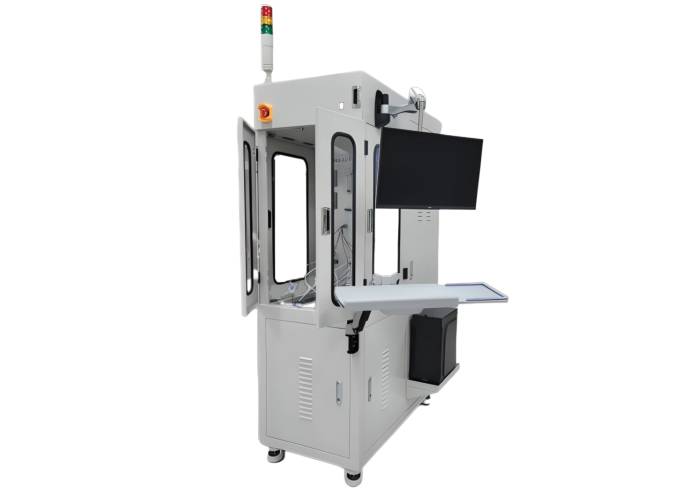
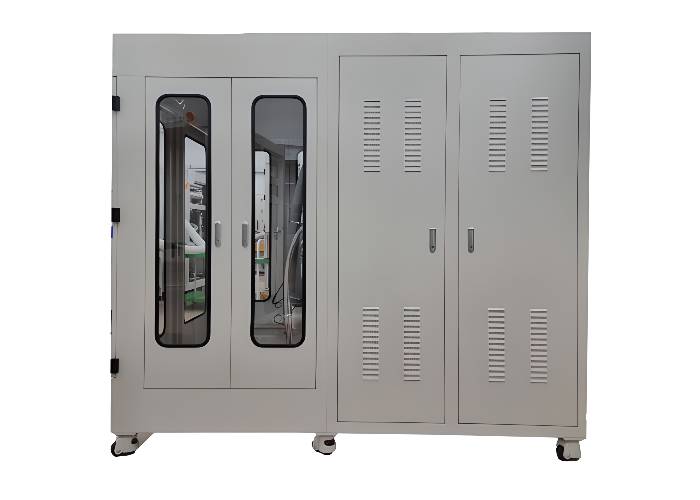
The SE5K-PE / SE10K-PE Stack Test Station is an integrated PEM water electrolyser (PEMWE) test platform for controlled multi-kilowatt stack evaluation up to 10 kW (1100 W × 1800 D × 2000 H mm). It combines high-current DC power delivery, DI-water management, gas handling, safety interlocks, and automated data logging into a single R&D-grade system suitable for durability testing, performance mapping, and protocol standardisation.
Principle of operation (PEMWE)
Deionised water is supplied to the anode side of the PEM electrolyser stack. Under programmed current or voltage, water is split to oxygen, protons, and electrons. Protons migrate through the membrane to the cathode where hydrogen forms, while electrons flow through the external circuit. The station controls the operating envelope (flow/temperature/pressure) and records key signals to quantify efficiency and stability.
Key capabilities (typical)
- Gas flow measurement (turndown 100:1): up to 25 slpm H₂ / 12 slpm O₂ (SE5K) or 50 slpm H₂ / 25 slpm O₂ (SE10K)
- Back-pressure control: automated control up to 10 bar (up to 30 bar optional) with high stability
- DI-water loop: temperature control (RT to ~95 °C), level control & alarm, auto-fill, micro/ion filtration and water–gas separation
- Safety & quality monitoring: automatic N₂ purge (anode/cathode), gas cooling/trap, dryer with dewpoint monitoring, and crossover sensing (H₂-in-O₂ / O₂-in-H₂)
- Optional diagnostics: integrated AC impedance / HFR capability (10 mHz–10 kHz, configuration-dependent)
Compatibility & applications
Designed for PEMWE stacks and balance-of-plant workflows: polarisation curves, endurance/durability protocols, pressure/temperature sensitivity studies, and validation of membranes, catalysts, PTLs, and stack hardware. For deeper electrochemical or gas-quality workflows, teams often pair these stations with potentiostat/EIS tools, gas analysis, and complementary fuel-cell or energy test-station infrastructure through ScienceGears.
Why ScienceGears
ScienceGears supports researchers and engineers across Australia and New Zealand with local product guidance, configuration support, and system-level integration across electrochemistry, gas handling, and hydrogen energy testing
Customer Reviews
Related Product
Explore our precision instruments designed for electrochemical research and energy applications



Still Wondering About Something?
Explore our FAQ for fast, clear answers to the most common questions—available 24/7.