

PEM Water Electrolyser Stack Test Station (1–3 kW) – SE1K-PE / SE3K-PE
Stack Test Station (1–3 kW) – SE1K-PE / SE3K-PE
Overview
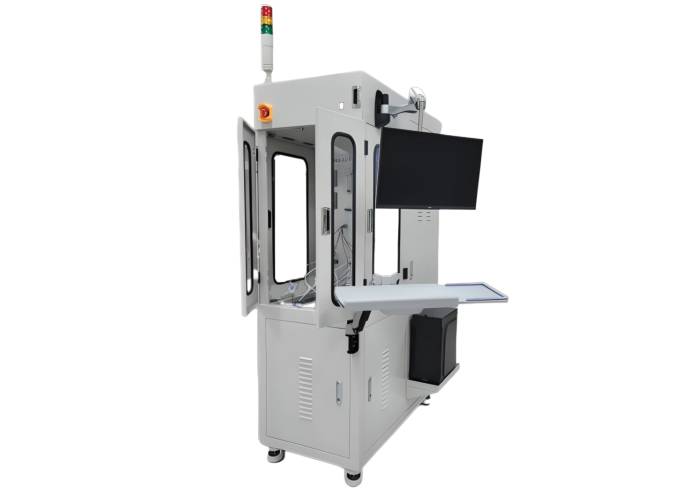
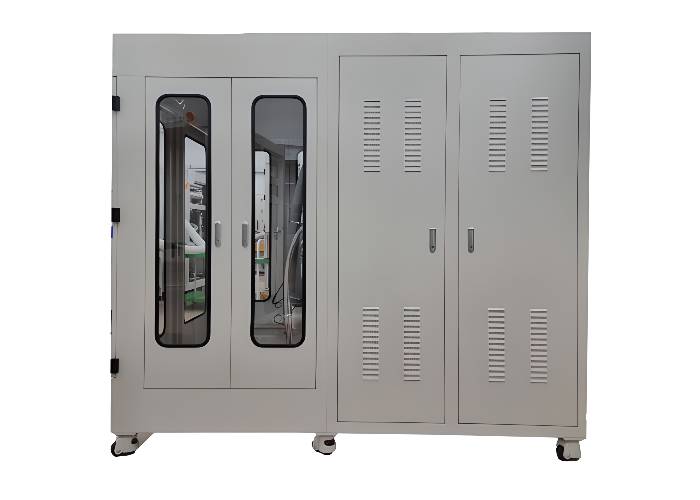
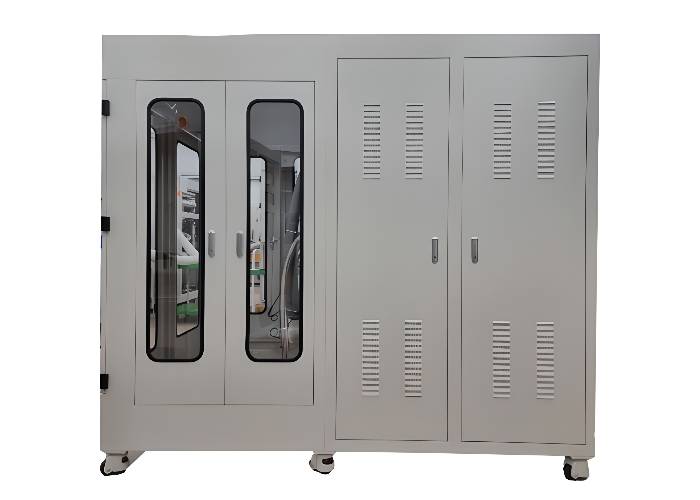
The SE1K-PE and SE3K-PE are compact PEM water electrolyser stack test stations designed for controlled laboratory evaluation of short stacks and small demonstrator systems up to 3 kW in a fully integrated cabinet (800 (W) × 1300 (D) × 2000 (H) mm). The platform combines power delivery, DI-water management, gas handling, safety logic and automated data logging in one enclosure for repeatable PEMWE performance and durability testing.
Principle of operation
Deionised water is circulated to the anode side of a PEM electrolyser stack. Under programmed current or voltage operation, water is oxidised to oxygen, protons and electrons. Protons migrate through the polymer electrolyte membrane to the cathode to form hydrogen, while electrons travel through the external circuit. The station monitors electrical, thermal, hydraulic and gas parameters to quantify efficiency, stability and crossover behaviour.
Key hardware and specifications
- Test capacity: SE1K-PE (up to ~1 kW class), SE3K-PE (up to 3 kW)
- Product gas flow measurement: suitable for ~5 slpm H₂ / 2.5 slpm O₂ (1 kW) and ~15 slpm H₂ / 7.5 slpm O₂ (3 kW) operation
- DI-water circulation: temperature control (ambient to ~95 °C), level control and alarm, auto-fill, conductivity monitoring, micro + ion filtration, flow control
- Gas conditioning and safety: gas cooling + condensate trap, optional drying and dew-point monitoring, crossover sensors (H₂-in-O₂ / O₂-in-H₂ ranges)
- Pressure capability: automated back-pressure control up to 10 bar (higher-pressure options available)
- Electrical monitoring: stack voltage monitoring (multi-channel options), automated test sequencing and logging software
Typical applications
- PEMWE short-stack polarisation curves and performance mapping
- Durability protocols (steady-state, cycling, start/stop)
- Materials and MEA optimisation under realistic operating conditions
- Balance-of-plant method development (water quality, thermal control, pressure effects)
Why ScienceGears
ScienceGears supports Australian and New Zealand labs with local technical guidance, commissioning support, and integration with related research tools such as potentiostats/impedance systems, electrochemical accessories, and complementary spectroscopy or in-situ diagnostic solutions used in hydrogen R&D workflows.
Customer Reviews
Related Product
Explore our precision instruments designed for electrochemical research and energy applications



Still Wondering About Something?
Explore our FAQ for fast, clear answers to the most common questions—available 24/7.