
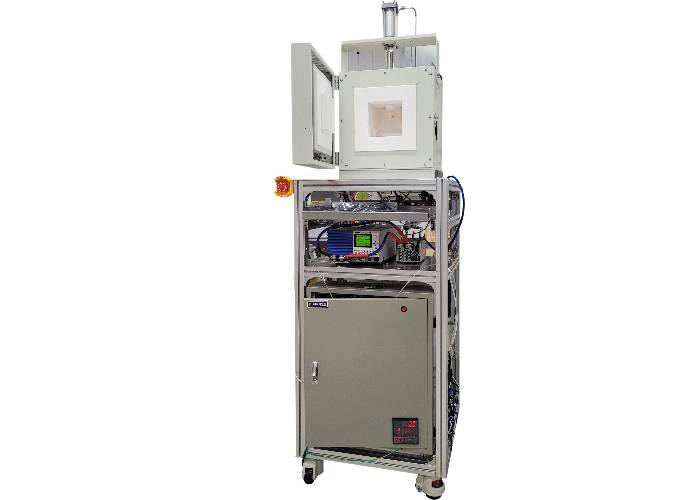
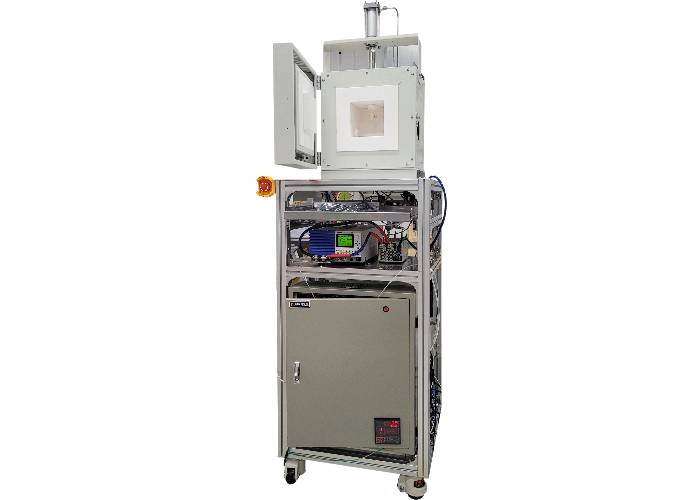


Overview
Solid Oxide Water Electrolysis (SOEC) uses a dense ceramic electrolyte (oxygen-ion conducting) at elevated temperature to split steam into hydrogen and oxygen. Steam is supplied to the fuel electrode where it is electrochemically reduced to H₂; oxygen ions migrate through the electrolyte and form O₂ at the oxygen electrode. Because kinetics and conductivity improve at high temperature, SOEC is widely used for research into high-efficiency hydrogen production, stack scale-up, and durability under realistic thermal/steam conditions.
SciTech Korea’s SOEC test stations are designed to stabilise the key variables that govern performance and degradation: furnace temperature (box furnace up to 900 °C), steam/humidity generation (including evaporator and heated chamber), and repeatable gas handling with automated control and monitoring software.
What You Can Measure / Control (Key Capabilities)
- Furnace control for SOEC operation (up to 900 °C, depending on configuration)
- Steam/humidity generation and delivery (evaporator + heated chamber up to 200 °C)
- Precision gas flow control with high turndown and purge logic (e.g., turndown 100:1; auto N₂ purge)
- Gas line temperature conditioning (line heating as required for stable delivery)
- Back-pressure control options (up to ~3.5 bar where specified)
- Optional cell/stack loading pressure control (automated compression control, where specified)
- Condensation management, drying and dewpoint-style conditioning for reliable gas measurement (system dependent)
- Automated DAQ, alarms/interlocks and repeatable test recipes via software control
Typical Applications
- SOEC single-cell screening (materials, seals, interconnects, electrodes)
- Stack development and scale-up validation from sub-kW to multi-kW class
- Durability and degradation studies (thermal cycling, steam utilisation, start/stop protocols)
- Balance-of-plant validation (steam delivery stability, pressure control, purge strategies)
- Hydrogen production characterisation under controlled steam/temperature conditions
- R&D for reversible operation concepts (SOEC/SOFC research workflows)
Integration & Compatibility
SOEC programmes rarely run in isolation—data quality depends on tight integration with gas conditioning and measurement, electrical power delivery, and test analytics. ScienceGears can help you connect SOEC stations into a broader lab workflow, for example:
Relevant categories (link only where useful):
- potentiostats-galvanostats
- electrochemistry-accessories
- fuel-cell-test-stations
Why Choose ScienceGears
ScienceGears supports SOEC teams across Australia and New Zealand with practical commissioning guidance, selection support (cell vs stack, steam delivery strategy, safety interlocks), and troubleshooting for repeatable R&D runs. We work with researchers and engineers to align the station configuration to your test plan—so your results are comparable across campaigns and scalable as your programme moves from single cells to stacks.
PRODUCT FAMILIES & MODELS
Single Cell Test Station
Built for controlled SOEC single-cell evaluation where repeatable steam delivery, furnace stability, and automated monitoring are critical. This format suits early-stage materials screening, operating-condition mapping, and durability testing before committing to stack hardware.
-
SE100-SO — where it fits: single-cell programmes prioritising controlled high-temperature/steam testing in a compact station format
-
SE300-SO — where it fits: single-cell work needing additional headroom for extended operating windows and instrumentation options
Stack Test Station (500W – 1kW)
Designed for entry stack testing where you need stack-relevant control (steam, furnace conditions, flow/pressure management) while keeping system complexity manageable. Useful for validating early stack builds and operating procedures.
-
SE1K-SO — where it fits: initial stack testing in the ~kW class with practical SOEC control features
-
SE3K-SO — where it fits: higher stack power within this family for broader load sweeps and longer endurance runs
Stack Test Station (5–10kW)
A mid-power stack platform for teams moving beyond proof-of-concept into sustained durability testing, performance benchmarking, and balance-of-plant refinement under controlled steam and temperature.
-
SE5K-SO — where it fits: mid-power SOEC stack validation and controlled durability protocols
-
SE10K-SO — where it fits: higher mid-power testing for more demanding duty cycles and programme scale-up
Stack Test Station (30kW)
A higher-power stack system category intended for pilot-style stack evaluation where automation, repeatability, and safety logic become increasingly important as flow rates and energy throughput rise.
-
SE30K-SO — where it fits: advanced stack testing and pilot-scale validation in the ~30 kW class
HOW TO CHOOSE (MICRO-SELECTION GUIDE)
Start by deciding single cell vs stack: single-cell stations are best for materials screening and mechanistic studies, while stack stations suit scale-up and durability validation. Next, size the system by power class (sub-kW, kW, 5–10 kW, or ~30 kW) to match your target current density and active area. Confirm the thermal/steam architecture you need (furnace capability, steam/humidity generation and line heating), then specify measurement and control (mass flow control range, dewpoint/drying strategy, pressure/back-pressure requirements, and data logging). Finally, review safety and automation (purge logic, alarms/interlocks, shutdown behaviour) to suit unattended endurance testing.
FAQ SECTION
1) What is an SOEC test station, and what does it do?An SOEC test station is an integrated platform used to operate and measure solid oxide electrolysis cells (single cells or stacks) under controlled high-temperature and steam conditions. It typically combines a furnace, steam/humidity generation, gas flow control, and automated monitoring so researchers can run repeatable performance maps, degradation studies, and durability protocols with consistent thermal and gas-handling conditions.
2) How does SOEC water electrolysis work (in simple terms)?
SOEC splits steam into hydrogen and oxygen using a ceramic electrolyte at elevated temperature. Steam is supplied to the fuel electrode and reduced to hydrogen; oxygen ions move through the electrolyte and release oxygen at the other electrode. The high operating temperature improves electrochemical kinetics and can reduce electrical energy demand, making SOEC valuable for high-efficiency hydrogen research.
3) How do I choose between single-cell and stack SOEC stations?
Choose a single-cell station when your focus is materials screening, seal development, or fundamental performance relationships—this keeps testing efficient and cost-effective. Choose a stack station when you need system-relevant validation: flow distribution, stack thermal behaviour, endurance protocols, and scale-up decisions. Your choice should also reflect required steam control, measurement depth, and whether you plan long unattended durability runs.
4) What operating parameters should I prioritise for SOEC testing?
Most SOEC studies depend on stable control of furnace temperature, steam utilisation (humidity/steam rate), and gas flow accuracy. Next priorities are pressure/back-pressure targets, gas conditioning (drying/condensation handling), and instrumentation that supports your research questions (e.g., cell/stack voltage monitoring, optional additional diagnostics). The goal is not “more sensors,” but the right controls for repeatability and comparability across test campaigns.
5) Can SOEC test stations integrate with gas analysis equipment?
Yes. Many teams integrate hydrogen/oxygen measurement, moisture management, and sampling interfaces to support mass balance and safety monitoring. If your programme includes gas composition verification or downstream analytics, plan the sampling points, drying/conditioning approach, and data synchronisation early. ScienceGears can help align SOEC station outputs with your broader workflow via /gas-analysis.
6) What safety considerations are common in SOEC test setups?
SOEC testing combines hot surfaces/furnaces, steam lines, and hydrogen/oxygen handling—so purge logic, interlocks, and alarm/shutdown behaviour matter. Typical planning includes safe venting, inert purge capability, leak detection strategy, temperature limits, and procedures for start/stop and thermal cycling. For longer durability tests, automation and clear fault responses reduce risk and improve data continuity.
7) What local support does ScienceGears provide in Australia & New Zealand?
ScienceGears supports selection, configuration and commissioning guidance for SOEC programmes, including aligning the station to your cell/stack format, steam delivery approach, and measurement plan. We also assist with integration planning and practical troubleshooting to keep test runs repeatable—especially important for durability campaigns and multi-variable studies where small control drifts can distort results.
8) Which SOEC models are available in this product family?
SciTech Korea’s SOEC range on the reference page includes single-cell stations (SE100-SO, SE300-SO) and stack stations across multiple power classes: 500 W–1 kW (SE1K-SO, SE3K-SO), 5–10 kW (SE5K-SO, SE10K-SO), and ~30 kW (SE30K-SO). For model grouping and options, see /fuel-cell-test-stations for related lab workflows and the SOEC reference page for the listed systems.
CLOSING SUMMARY
SOEC testing is fundamentally about repeatability under high-temperature steam electrolysis conditions—stable thermal control, reliable gas handling, and automation that lets you compare results across campaigns. ScienceGears supports SOEC single-cell and stack test stations for research and pilot validation, helping teams across Australia and New Zealand select the right power class, instrumentation, and integration pathway for credible, publishable and scalable outcomes.