
Electrolytes & salts
Electrolytes provide ionic conduction between electrodes and form stabilising interphases that govern cycle life and safety. This subcategory covers liquid electrolytes (solvent + salt + additives) and solid-state electrolyte powders used in lithium-ion, sodium-ion and next-generation battery research, enabling controlled comparisons of conductivity, voltage stability and interfacial behaviour.
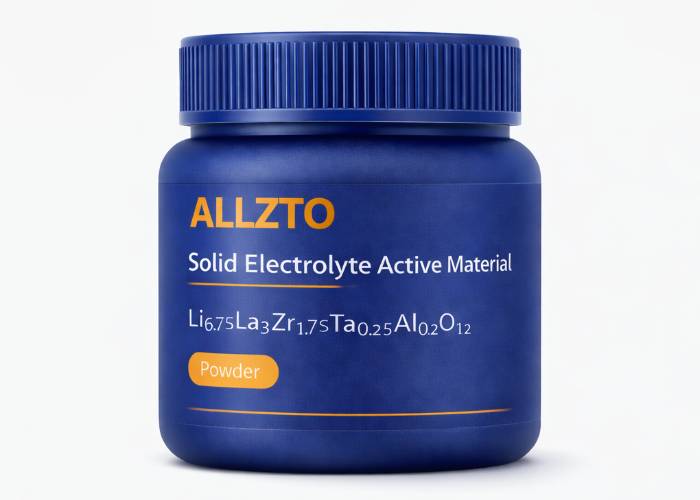
ALLZTO Tantalum and Aluminum added the Lithium Lanthanum Zirconium Oxide
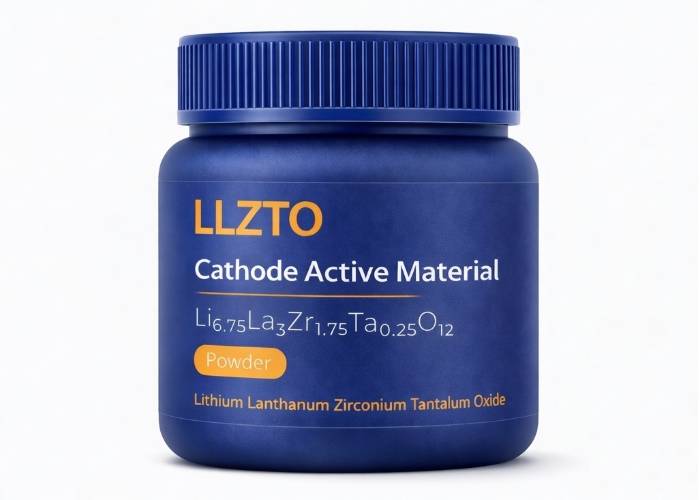
LLZTO Lithium Lanthanum Zirconium Tantalum Oxide

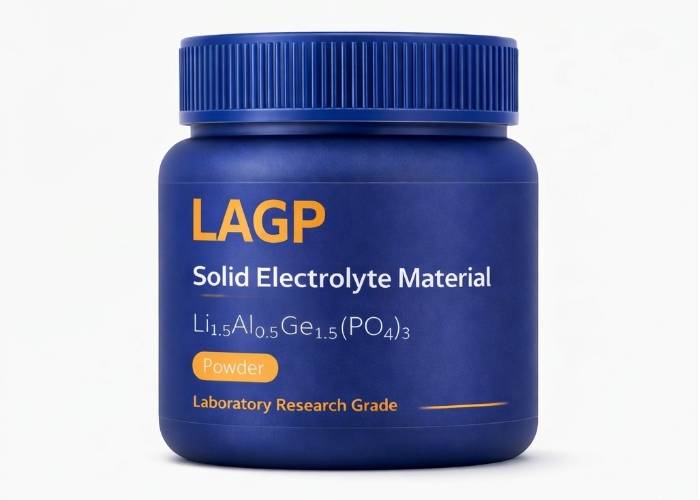
Lithium Aluminum Germanium Phosphate Material

Overview
A battery electrolyte is the ion-conducting medium that transports Li⁺ (or Na⁺) between anode and cathode. In liquid systems, the electrolyte is typically a salt dissolved in a solvent blend with additives that tune SEI/CEI formation, low-temperature performance and high-voltage stability. In solid-state systems, ceramic or glass electrolytes provide ionic conduction while offering potential safety benefits and different interfacial challenges. Electrolyte choice often dominates early failure modes (gas evolution, impedance rise, lithium plating, transition-metal dissolution).
What You Can Measure / Control (Key Capabilities)
- Ionic conductivity vs temperature
- Electrochemical stability window and high-voltage tolerance
- SEI/CEI formation and impedance evolution
- Gas generation and parasitic reactions under stress tests
- Moisture sensitivity and hydrolysis risk (salt dependent)
- Compatibility with cathode chemistry (Ni-rich vs phosphate)
- Compatibility with anode type (graphite vs silicon vs LTO)
- Interfacial resistance in solid-state architectures
Typical Applications
- Screening salt/solvent/additive packages for lithium-ion cells
- High-voltage electrolyte development for Ni-rich cathodes
- Fast-charge optimisation to reduce lithium plating risk
- Sodium-ion electrolyte evaluation and stability studies
- Solid-state electrolyte research (LLZO/LAGP/LATP families)
- Academic work on interphase chemistry using EIS/CV
Integration & Compatibility
Electrolytes must be chosen alongside separator, electrode chemistry and formation protocol. Practical evaluation typically uses /battery-test-systems for controlled formation and cycling, while /potentiostats-galvanostats support mechanistic studies (EIS, CV, stability windows). Electrode and cell fixtures should be selected to minimise contamination and moisture exposure during assembly.
Why Choose ScienceGears (AU & NZ)
ScienceGears helps AU/NZ researchers choose electrolyte strategies that match their cathode/anode chemistry, voltage window, temperature range, and safety constraints, including advice on handling sensitivity, storage and experimental design to obtain defensible comparisons.
2) PRODUCT FAMILIES & MODELS
Solid-state electrolyte powders (ceramic / glass)
For solid-state and hybrid research; focus on ionic conductivity and interface engineering.
- LLZO (Lithium lanthanum zirconium oxide material) — garnet-type platform
- LLZTO (Lithium lanthanum zirconium tantalum oxide) — doped garnet variant
- AL-LZTO (Ta/Al-doped LLZTO) — tailored dopants for conductivity/structure
- LAGP (Lithium aluminium germanium phosphate) — NASICON-type platform
- LATP (Lithium aluminium titanium phosphate) — NASICON-type platform
Liquid electrolytes and salts (selection support)
Liquid electrolyte supply is typically specified by salt type, solvent blend, concentration, water content, and additive package.
- Lithium-ion salts (e.g., LiPF₆/LiFSI/LiTFSI — application dependent)
- Sodium-ion salts (platform dependent)
- Additives for SEI/CEI control, high-voltage stability and fast-charge performance
HOW TO CHOOSE (MICRO-SELECTION GUIDE)
Start with your electrode chemistry and voltage window (e.g., Ni-rich cathodes demand stronger high-voltage stability than LFP). Then choose salt type and purity to control moisture sensitivity and interphase formation. For low-temperature operation, prioritise conductivity and solvent selection; for fast-charge, prioritise SEI stability and lithium plating resistance. If exploring solid-state, select an electrolyte family (LLZO vs LAGP/LATP) based on your intended processing route, target conductivity, and interface strategy with electrodes.
FAQs
Q1: What is the role of electrolyte salt in a battery?
The salt supplies mobile ions (Li⁺/Na⁺) and strongly influences conductivity, interphase chemistry, moisture sensitivity and long-term stability. Salt choice affects SEI/CEI formation, gas generation tendencies and compatibility with high-voltage cathodes. In practice, performance depends on the salt plus the solvent blend and additives working together.
Q2: How do I choose an electrolyte for Ni-rich cathodes vs LFP?
Ni-rich cathodes often require improved oxidative stability and interphase control at higher voltage, making additive selection and formation critical. LFP generally operates at lower voltage and is often more forgiving, but still demands stable SEI behaviour on the anode. Choose based on voltage window, temperature range, and whether you prioritise energy density, power or cycle life.
Q3: What are solid-state electrolytes and why use them?
Solid-state electrolytes are ion-conducting ceramics or glasses that replace flammable liquid electrolytes. They can improve safety and enable different cell architectures, but introduce new challenges such as interfacial resistance, mechanical contact stability and processing sensitivity. Selection typically focuses on ionic conductivity, chemical stability and how you will engineer electrode interfaces.
Q4: How do I test electrolyte stability and performance?
Combine controlled cycling in /battery-test-systems with diagnostic measurements such as EIS and cyclic voltammetry using /potentiostats-galvanostats. Use consistent cell assembly and formation protocols, control moisture exposure, and compare electrolytes under matched electrode loadings and voltage windows to isolate real differences.
Q5: Are there safety considerations when handling electrolyte salts and solutions?
Yes. Many salts and solvents are moisture sensitive, can generate corrosive species on hydrolysis, and may be flammable or irritant. Handle in appropriate ventilation and, where required, in controlled-humidity environments. Follow SDS guidance, use compatible gloves and storage containers, and minimise exposure to water.
Q6: Can ScienceGears help with electrolyte selection and supply in AU & NZ?
Yes. We support AU/NZ labs with electrolyte strategy selection, compatibility checks against electrode chemistries, and practical testing guidance to improve repeatability and accelerate optimisation.
CLOSING SUMMARY
Electrolytes and salts define how ions move and how stable the key interfaces become over time. ScienceGears supports AU/NZ battery researchers with liquid and solid-state electrolyte options plus practical guidance to design fair comparisons and translate results into robust cell performance.