
Fuel Cell Test Stations
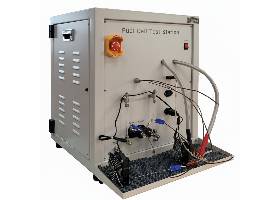
Fuel cell test stations provide a controlled platform to evaluate single cells and short stacks under realistic operating conditions. These systems regulate reactant gas flow, humidity, temperature and back-pressure while applying a programmable electrical load to generate polarisation curves, efficiency metrics and durability data. Ideal for hydrogen energy R&D, they support repeatable benchmarking of materials, MEAs and balance-of-plant components across lab and pilot-scale testing.
PEMFC – Proton Exchange Membrane Fuel Cell
Overview
Fuel cell test stations are integrated “balance-of-plant” platforms that supply and condition reactant gases, manage thermal and pressure conditions, and apply controlled electrical loading so researchers can quantify performance and durability with high repeatability. By stabilising gas stoichiometry, humidification and back-pressure, the station helps separate true electrochemical behaviour from system artefacts—supporting reliable polarisation curves, power maps and long-term stress testing for hydrogen fuel cell development.
Key Features
- Wide power scalability from benchtop testing through to higher-power stack validation (model-dependent).
- High-precision gas flow control using mass flow controllers (MFCs) for anode/cathode feeds and purge logic.
- Humidity and dewpoint management to match real operating environments and study membrane hydration effects.
- Line heating and thermal control for gas delivery, cell/stack temperature stability, and condensation prevention.
- Automated back-pressure control for realistic pressure operation and stable differential pressure conditions.
- Exhaust handling including cooling, water trapping and safe vent management (configuration dependent).
- Advanced monitoring options such as multi-channel voltage sensing and optional AC-impedance capability for diagnostic insights.
Applications
- PEM fuel cell benchmarking: MEA screening, catalyst evaluation, GDL comparison, and water-management studies.
- Stack development and scale-up: power mapping, stability runs, and fault detection under dynamic loads.
- Materials and component validation: bipolar plates, seals, humidifiers, heat exchangers and sensors.
- Durability and stress testing: start–stop cycling, load cycling, and long-duration endurance protocols.
- System integration R&D: optimisation of balance-of-plant strategies for pilot and field-relevant conditions.
Integration & Compatibility
Fuel cell test stations can be configured to integrate with external instrumentation and workflows, including data logging, safety interlocks, and diagnostic tools. For electrochemical diagnostics, ScienceGears can help align the station with measurement requirements and complementary platforms (see potentiostats and electrochemical-cells).
Why Choose ScienceGears
ScienceGears supports fuel cell researchers and engineers across Australia and New Zealand with practical configuration guidance, commissioning support, and application-focused know-how. Our goal is to deliver a test platform that matches your cell type, power range and experimental protocol—so your results are reproducible, comparable and publication- or qualification-ready.
FAQ Section
Q1. What does a fuel cell test station measure and control?
A fuel cell test station controls reactant gas flow, humidification, temperature and back-pressure while applying a programmable electrical load. It measures voltage, current, power output and operating conditions to produce polarisation curves, efficiency calculations and durability trends. This controlled environment helps researchers compare MEAs, catalysts and stack designs with better repeatability than ad-hoc setups.
Q2. Can one test station support both single cells and stacks?
Yes—many platforms are configurable for single-cell fixtures and short-stack testing, depending on the required power range, flow rates and thermal management. The key is matching the station’s gas delivery capacity, humidification approach, cooling method and load capability to your target cell area and expected current density. ScienceGears can help specify the right configuration for your setup.
Q3. Do I always need humidification for fuel cell testing?
For many low-temperature fuel cells (especially PEM-based systems), humidification is important because membrane hydration strongly impacts conductivity and performance. A controlled humidifier and heated lines help maintain stable dewpoint and reduce condensation artefacts. For other chemistries or operating regimes, humidity needs differ—so the station should be configured to match your cell type and test protocol.
Q4. How do I choose the right power range for a fuel cell test station?
Start with your target operating current density and active area (or number of cells in the stack), then estimate maximum power at realistic voltages. Allow headroom for transient testing and future scale-up. Also consider gas flow requirements, cooling load and pressure operation—these often drive configuration just as much as the headline kW rating.
Q5. What safety features are typically included in a fuel cell test station?
Fuel cell stations commonly include automated shutdown logic, purge sequences, pressure relief/controls, and gas-handling safeguards. For hydrogen operation, detection and interlocks are typically part of the safety architecture, alongside ventilation and alarm integration (site-dependent). Safety configuration should always be aligned with your lab risk assessment and relevant local requirements.
Closing Summary
Fuel cell test stations enable rigorous, repeatable evaluation of fuel cell performance by tightly controlling gas flow, humidification, temperature, pressure and electrical loading. Whether you are screening MEAs at lab scale or validating stacks for pilot systems, ScienceGears Australia and New Zealand can help you configure a research-grade platform, integrate diagnostics, and establish test protocols that produce reliable, defensible data.