
PEMFC – Proton Exchange Membrane Fuel Cell
PEMFC (proton exchange membrane fuel cell) test stations provide controlled gas delivery, humidification, temperature management and electronic loading to characterise single cells and full stacks under realistic operating conditions. These systems support repeatable polarisation testing, durability protocols and balance-of-plant validation with integrated monitoring and automated control. ScienceGears supports selection, commissioning and ongoing troubleshooting across Australia and New Zealand.
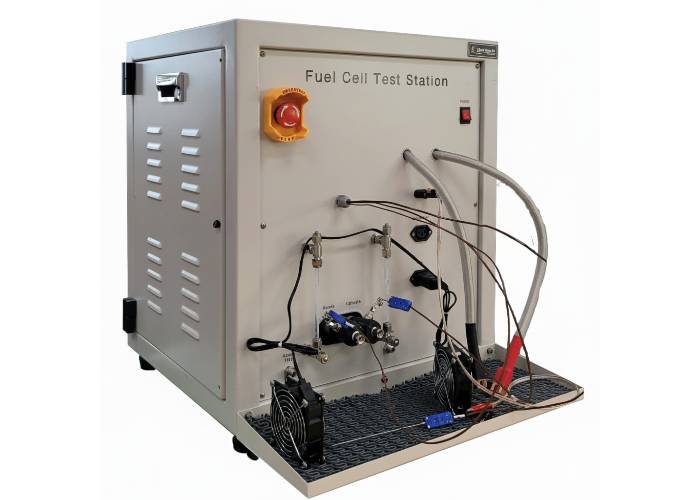
University Fuel Cell Test Station (PEMFC) – SF100U-PE (100 W)
Overview
PEMFC test stations are integrated platforms used to operate proton exchange membrane fuel cells under controlled and repeatable conditions. A PEMFC converts the chemical energy of hydrogen and oxygen into electricity via electrochemical reactions across a polymer electrolyte membrane. Because performance is highly sensitive to humidity, temperature, reactant flow and back-pressure, research-grade test stations combine mass flow control, humidification and thermal management with an electronic load and data acquisition.
In laboratories, these systems are used for materials screening (membranes, catalysts, GDLs), MEA optimisation, protocol validation and pilot-scale stack evaluation. Automated recipes and monitoring help improve repeatability across I–V curves, activation procedures and long-duration durability testing.
What You Can Measure / Control
- Hydrogen/air (or oxygen) mass flow control with stable mixing capability
- Humidification & dewpoint control for anode/cathode gas conditioning
- Cell/stack temperature control (air or liquid circulation heating/cooling, by configuration)
- Back-pressure control for realistic operating points and transient studies
- Electronic loading for polarisation curves, step tests and protocol sequences
- Voltage monitoring for single cells and multi-channel stack diagnostics
- Optional impedance/HFR measurements for kinetic and ohmic separation
- Automated data logging (DAQ) and safety interlocks to support unattended runs
Typical Applications
- MEA performance benchmarking (activation, polarisation, power mapping)
- Durability protocols (load cycling, start–stop, high-humidity operation)
- Water management studies (flooding/drying, dewpoint optimisation)
- Stack validation for pilot systems (kW to 100+ kW class)
- Balance-of-plant component evaluation (humidifiers, heaters, blowers, pressure devices)
- Validation of control strategies for hydrogen energy R&D programs
Integration & Compatibility
PEMFC test stations commonly integrate with:
- Gas analysis for exhaust composition and diagnostics
- Electrochemical instrumentation for complementary methods (e.g., EIS workflows)
- Fuel cell category navigation and related platforms:
Where required, the station can be specified with sensor packs (temperature/pressure/flow), multi-channel cell voltage monitoring and optional impedance modules to match your research method.
Why Choose ScienceGears (AU & NZ)
ScienceGears supports PEMFC teams with model selection, configuration review, commissioning guidance, test protocol setup, and practical troubleshooting (humidity/condensation management, leak checking, sensor calibration and repeatability). We work closely with universities, R&D labs and pilot facilities across Australia and New Zealand to align the station specification with your cell area, stack power range and safety requirements.
PRODUCT FAMILIES & MODELS
PEMFC Common Specification (platform-level)
Core PEMFC station capabilities typically include controlled gas flow and mixing, humidification and heated lines, cell/stack temperature management, exhaust cooling/condensate handling, automated back-pressure control (up to 3.5 bar class), DAQ with automated control software, and optional impedance/HFR plus multi-channel cell voltage monitoring.
University Test Station (bench-top)
Designed for teaching labs and early-stage PEMFC R&D where footprint, simplicity and fast setup matter. Bench-top format supports controlled flow, humidity and loading for single cells or small stacks, with optional impedance/HFR and protocol-based testing for repeatable demonstrations and baseline research.
-
SF100U-PE — where it fits: compact bench-top PEMFC testing up to 100 W for education and entry-level R&D
Laboratory Test Station (floor-standing, lab-scale)
A lab-scale platform suited to research groups running repeatable protocols across multiple projects. Supports broader configuration choices (flows, sensors, automation) and longer-duration testing than bench-top systems, while remaining appropriate for standard laboratory utilities and safety practices.
-
SF100L-PE — where it fits: lab-grade PEMFC testing up to 100 W with expanded configuration options
-
SF300L-PE — where it fits: higher-capacity lab testing up to 300 W for more demanding single-cell workloads
Single Cell Test Station (research single-cell focus)
Built for controlled PEMFC single-cell characterisation where water management and repeatability are critical. Suitable for routine polarisation curves, activation protocols, and durability runs with optional impedance/HFR and multi-point diagnostics depending on configuration.
-
SF100-PE — where it fits: single-cell testing up to 100 W for MEA screening and baseline protocols
-
SF300-PE — where it fits: single-cell testing up to 300 W for higher-current operation and extended protocols
-
SF600-PE — where it fits: single-cell testing up to 600 W for demanding operating envelopes and development work
Stack Test Station (1–3 kW)
Entry stack platforms for short stacks and early pilot work. Useful for validating stack assembly quality, cell-to-cell behaviour (with monitoring options), and protocol development before scaling.
-
SF1K-PE — where it fits: short-stack PEMFC work up to 1 kW
-
SF2K-PE — where it fits: short-stack validation up to 2 kW with broader operating range
-
SF3K-PE — where it fits: stack evaluation up to 3 kW for lab-to-pilot transition
Stack Test Station (5–10 kW)
For pilot-relevant stacks where stable control of flow, humidity, temperature and pressure becomes more demanding. Suitable for extended durability protocols and balance-of-plant validation at meaningful power levels.
-
SF5K-PE — where it fits: pilot-relevant PEMFC stacks up to 5 kW
-
SF7K-PE — where it fits: mid-range stack testing up to 7 kW
-
SF10K-PE — where it fits: pilot stacks up to 10 kW for protocol and control validation
Stack Test Station (20 kW)
A step into higher-power pilot testing where utilities, thermal management and safety design are central. Suitable for long-run validation and system integration work.
-
SF20K-PE — where it fits: PEMFC stack testing up to 20 kW for advanced pilot programs
Stack Test Station (25–30 kW)
For larger pilot stacks and program-scale validation. Typically chosen when you need stable operating control under sustained loads and stronger integration with BOP components.
-
SF25K-PE — where it fits: pilot stack testing up to 25 kW
-
SF30K-PE — where it fits: higher pilot power up to 30 kW for extended validation
Stack Test Station (50–100 kW)
For full-scale pilot stacks where repeatability, safety, thermal control and diagnostics are essential. Suitable for rigorous performance mapping and long-duration programmes.
-
SF50K-PE — where it fits: large pilot stacks up to 50 kW
-
SF100K-PE — where it fits: full pilot-scale stacks up to 100 kW
Stack Test Station (150–200 kW)
High-power testing for near-commercial stack platforms. Typically used where BOP integration and robust safety architecture are required.
-
SF150K-PE — where it fits: high-power PEMFC stacks up to 150 kW
-
SF200K-PE — where it fits: high-power stacks up to 200 kW for program-scale validation
Stack Test Station (250–300 kW)
Highest power range listed for PEMFC stack validation and integration-scale testing. Suitable for large pilot demonstrations where controlled utilities, monitoring depth and operational stability are critical.
-
SF250K-PE — where it fits: very high-power stack testing up to 250 kW
-
SF300K-PE — where it fits: very high-power stack testing up to 300 kW
HOW TO CHOOSE
Start by matching the power range to your target: single-cell (100–600 W class) versus stacks (kW to 300 kW class). Then define your required operating envelope: flow capacity, humidity/dewpoint control range, temperature control method (air vs liquid circulation) and back-pressure class. If you are diagnosing stack non-uniformity, prioritise cell voltage monitoring channel count and data logging depth. For mechanistic studies, consider optional impedance/HFR. Finally, confirm integration needs (gas analysis, extra sensors, BOP component testing) and safety requirements for hydrogen handling in your facility.
FAQ SECTION
1) What is a PEMFC fuel cell test station?
A PEMFC test station is an integrated system that supplies controlled reactant gases (hydrogen and air/oxygen), manages humidification and temperature, and applies an electronic load so you can measure fuel cell performance reliably. It enables repeatable polarisation curves, activation protocols and long-duration durability testing while logging key parameters such as flow, pressure, temperature and voltage.
2) How does humidification affect PEMFC performance testing?
Humidification controls membrane water content, which strongly affects ionic conductivity and mass transport. Too dry and resistance rises; too wet and flooding can limit oxygen access. A test station stabilises dewpoint and heated line conditions so researchers can reproduce operating points and study water-management behaviour under steady-state and transient protocols.
3) How do I choose between a single-cell and stack test station?
Choose a single-cell station when you are screening MEAs, materials, flow-field designs or operating protocols at research scale. Choose a stack station when you need to validate scale-up, assess cell-to-cell variation, and test balance-of-plant interactions under higher power. Your decision should primarily follow required power range, diagnostics depth (e.g., voltage monitoring), and facility utilities/safety constraints.
4) What measurements are typically available beyond basic I–V curves?
Beyond polarisation and power curves, many PEMFC setups support multi-channel voltage monitoring for stack diagnostics and optional impedance/HFR methods to separate ohmic and kinetic contributions. You can also log and control flow, humidity, temperature and pressure to support protocol-based durability studies and reproducible benchmarking across campaigns.
5) Can these test stations integrate with gas analysis or other lab tools?
Yes. Many users integrate exhaust gas analysis for composition and diagnostic workflows, especially during durability and transient studies. If you plan to add gas analytics or additional sensors, it’s best to specify ports, signal integration and DAQ requirements upfront.
6) What safety and operating considerations apply for PEMFC hydrogen testing?
Hydrogen handling requires appropriate ventilation, leak checking, suitable regulators, and an operating procedure that includes purge routines and interlocks. Condensation management is also important due to humidified gas streams; proper exhaust cooling and water traps reduce measurement drift and protect downstream components. Your facility’s safety officer requirements should be mapped into the station configuration early.
7) Do I need back-pressure control for PEMFC research?
Back-pressure control is valuable when you want to simulate realistic stack conditions, improve mass transport at higher currents, or compare results across labs using standardised protocols. It also helps stabilise operating points during transient testing. The need depends on your target operating envelope and whether your work involves pilot-relevant conditions.
8) What support does ScienceGears provide in Australia and New Zealand?
ScienceGears supports model selection, configuration reviews, commissioning guidance and test protocol setup for PEMFC labs and pilot facilities across AU & NZ. We can help align the station to your cell area, stack power, diagnostics needs and integration plan. See the broader category overview here: /fuel-cell-test-stations.
CLOSING SUMMARY
PEMFC fuel cell test stations enable controlled, repeatable evaluation of single cells and stacks by stabilising flow, humidity, temperature, pressure and loading while capturing high-quality data. Whether you are screening MEAs in a university lab or validating pilot-scale stacks, ScienceGears can help you select the right SF-series platform and configure it for reliable research outcomes across Australia and New Zealand.