
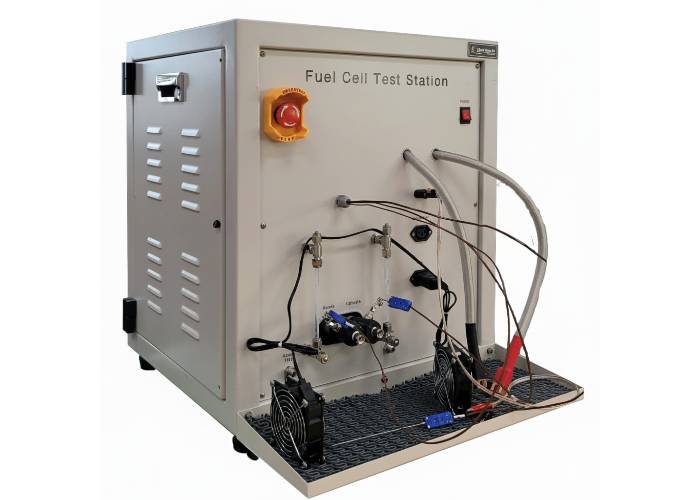
University Fuel Cell Test Station (PEMFC) – SF100U-PE (100 W)
University Fuel Cell Test Station (PEMFC) – SF100U-PE
Overview
The SF100U-PE University Fuel Cell Test Station is a compact, benchtop PEMFC platform designed for controlled single-cell fuel cell testing up to 100 W. It integrates mass flow control, humidification, temperature conditioning, back-pressure regulation and an electronic load into a single chassis, enabling reproducible polarisation, durability and impedance workflows in teaching and research laboratories.
Principle of operation
Reactant gases are delivered to the anode/cathode through MFC-controlled flow paths with N₂ purge capability. Gas conditions are stabilised using humidifier dewpoint control and line heating, while the cell environment is managed via automatic back-pressure control. The cell output is directed to a precision DC electronic load for I–V and power characterisation, with optional impedance functionality for mechanistic diagnostics.
Key features and specifications
- Test range: up to 100 W (SF100U-PE)
- Dimensions: 550 (W) × 650 (D) × 600 (H) mm
- Gas flow control (typical for SF100 class): anode up to 1 slpm, cathode up to 5 slpm
- Humidification: wet/dry (bypass) automatic control, dewpoint control RT to ~95 °C (±1 °C)
- Gas temperature conditioning: line heater with direct gas temperature control (RT to ~95 °C)
- Back pressure: automatic control up to ~3.5 bar, high stability control
- Exhaust management: exhaust cooling and condensation trap (water trap & gas split)
- Optional diagnostics: single-cell EIS/HFR (typ. 10 mHz to 10 kHz) and optional multi-cell voltage monitoring (e.g., 5 or 10 cells)
Compatibility and applications
- PEMFC single cells and small stacks (configurable for related chemistries on request)
- Catalyst/MEA screening, hydration and water-management studies, start-stop protocols, durability testing
- Combined I–V, power, and impedance workflows for kinetic and transport analysis
Why ScienceGears
ScienceGears supports Australian & New Zealand researchers with local application guidance, commissioning help, and integration with related tools such as potentiostats/galvanostats, electrochemical cells, and in-situ spectroscopy solutions (e.g., Raman-SEC), ensuring your fuel cell test data is both high quality and publishable.
Customer Reviews
Still Wondering About Something?
Explore our FAQ for fast, clear answers to the most common questions—available 24/7.