
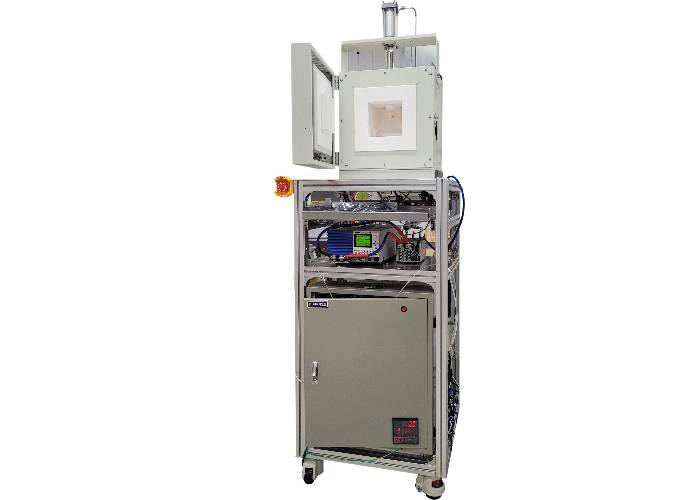
SOEC Single Cell Test Station (SE100-SO / SE300-SO)
SOEC Single Cell Test Station (SE100-SO / SE300-SO)
Principle and operation
The SE100-SO and SE300-SO are compact, single-cell SOEC (solid oxide electrolysis cell) test stations designed to run controlled high-temperature steam electrolysis experiments with automated data acquisition. A programmable DC supply drives the cell while the station regulates temperature, reactant delivery and safety interlocks. Under operating conditions, steam is reduced to hydrogen at the fuel electrode, oxygen ions migrate through the ceramic electrolyte, and oxygen is evolved at the air electrode.
Key features and specifications
- Models: SE100-SO (up to 100 W class) and SE300-SO (up to 300 W class)
- Footprint: 550 (W) × 650 (D) × 600 (H) mm benchtop cabinet
- High-temperature capability: box furnace (up to 900 °C) with heated gas handling
- Steam generation: DI-water evaporator with pump and flow metering; heated chamber (to ~200 °C) for stable vapour delivery
- Heated lines: high-temperature line heater (up to 600 °C) to reduce condensation and thermal shock
- Gas management: mass-flow control (turndown up to 100:1), N₂ purge, optional multi-gas mixing
- Product monitoring: H₂/O₂ flow measurement, optional crossover concentration monitoring, gas drying and dewpoint monitoring
- Pressure and safety: optional automated back-pressure control (up to ~3.5 bar), leak alarms and automated shutdown logic
- Electrochemical options: optional integrated AC-impedance/HFR capability and Excel-ready logging via LabVIEW-based control software
Compatibility and applications
Suitable for planar or button-type SOEC single cells and custom fixtures, with configuration options for steam electrolysis, durability cycling and temperature-dependent I–V/EIS studies. Typical users include groups developing electrolyte/electrode materials, sealants and interconnect coatings, or validating operating protocols for reversible SOC and co-electrolysis.
Why choose ScienceGears
ScienceGears supports Australian and New Zealand laboratories with configuration guidance, commissioning support and integration with complementary research instruments such as potentiostats, EIS analysers, gas analysers and in-situ spectroscopy or electrochemical cell hardware.
Customer Reviews
Related Product
Explore our precision instruments designed for electrochemical research and energy applications


Still Wondering About Something?
Explore our FAQ for fast, clear answers to the most common questions—available 24/7.