
Digital Power Meters
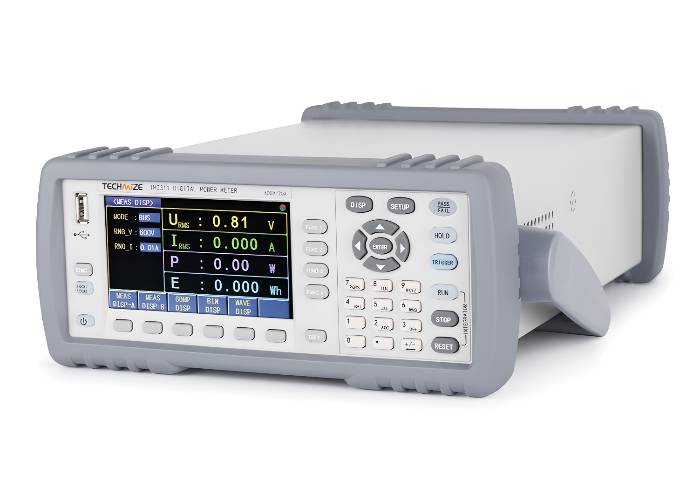
Digital power meters measure voltage, current, real power, apparent power, power factor, frequency and energy consumption in electrical and electronic systems. They are used in research, product development, quality control and education laboratories where accurate AC/DC power measurement is required for efficiency testing, device validation and performance reporting.
Overview
Digital power meters are precision instruments used to measure electrical power and related parameters in AC, DC and mixed power systems. Unlike a basic multimeter, which typically measures voltage or current separately, a power meter calculates how electrical energy is consumed, converted or delivered by a device under test.
In laboratory and engineering workflows, digital power meters are used to measure voltage, current, real power, apparent power, reactive power, power factor, frequency and energy consumption. This information is important when testing power supplies, chargers, adapters, inverters, appliances, LED drivers, battery systems and embedded power modules.
Single-channel digital power meters are especially useful for straightforward input or output power measurement. They are suitable for R&D benches, teaching laboratories, quality-control stations and production environments where reliable, repeatable power data is needed without unnecessary multi-channel complexity.
Key Capabilities
- Measurement of voltage, current, power, frequency and energy.
- Real power, apparent power and power factor evaluation.
- Useful for AC/DC device testing depending on model capability.
- Suitable for input or output power measurement of power devices.
- Supports efficiency studies when paired with source and load instruments.
- Useful for standby power, charger, adapter and appliance validation.
- Practical for R&D, education, quality control and production screening.
Typical Applications
- Power supply, charger and adapter testing.
- Appliance and consumer electronics validation.
- LED driver and embedded power-module testing.
- Battery charger efficiency measurement.
- Standby power and energy-consumption checks.
- Education laboratories and electrical engineering practicals.
- Quality-control and production-line verification.
Integration & Compatibility
Digital power meters can be integrated with programmable DC power supplies, AC power supplies, DC electronic loads, bidirectional DC systems and automated test benches. They can also support ScienceGears workflows involving /battery-test-systems, /fuel-cell-test-stations and clean-energy validation platforms where accurate electrical measurement is required.
Why Choose ScienceGears (AU & NZ)
ScienceGears helps researchers and engineers choose digital power meters based on voltage range, current range, accuracy, frequency range, measurement functions, communication interface and test workflow. We support Australian and New Zealand laboratories with practical selection guidance for R&D, production and quality-control environments.
PRODUCT FAMILIES & MODELS
TH3300 Series — Single-Channel Digital Power Meters
The TH3300 Series is suitable for single-channel AC/DC electrical power measurement in research, development, teaching and production-test environments. It is a practical choice when one input or output channel must be measured accurately for voltage, current, power, frequency and energy-related parameters.
Available Products:
- TH3300 Series — Single-channel digital power meter for measuring voltage, current, power, frequency and energy in laboratory, production and quality-control workflows.
→ Suggested product page: /th3300-series-single-channel-digital-power-meter
HOW TO CHOOSE
Choose a digital power meter by first defining whether you need single-channel or multi-channel measurement. For basic input or output testing, a single-channel meter may be sufficient. Check voltage range, current range, accuracy, frequency range, power range, AC/DC capability, energy integration and communication interface. If you need three-phase measurement, harmonic analysis, waveform display or synchronised multi-channel efficiency testing, a multi-channel power analyser may be more suitable.
FAQs
Q1. What is a digital power meter?
A digital power meter is an instrument used to measure electrical power and related parameters such as voltage, current, frequency, real power, apparent power, power factor and energy. It helps researchers and engineers understand how much power a device consumes, converts or delivers during operation.
Q2. How is a power meter different from a multimeter?
A multimeter is useful for general voltage, current and resistance measurements, but it does not usually provide complete power analysis. A digital power meter is designed to calculate power, energy, power factor and related electrical parameters. This makes it more suitable for efficiency testing, charger validation and power-electronics evaluation.
Q3. When is a single-channel digital power meter enough?
A single-channel power meter is suitable when you only need to measure one electrical input or output path. Examples include testing an adapter input, checking charger output power, measuring appliance consumption or validating a power supply. For multi-phase systems or input/output efficiency studies, a multi-channel power analyser may be better.
Q4. Can a digital power meter be used with electronic loads?
Yes. A common setup uses a power supply as the source, a DC electronic load as the controlled load and a digital power meter to measure electrical behaviour. This is useful for converter testing, battery charger evaluation, power supply validation and efficiency studies in R&D and quality-control laboratories.
Q5. What specifications should I check before choosing a power meter?
Check voltage range, current range, power range, measurement accuracy, frequency range, AC/DC capability, update speed, energy integration and available communication interfaces. The selected meter should comfortably cover the device under test and provide the parameters needed for your report, validation workflow or automated test system.
Q6. Can digital power meters support battery and clean-energy testing?
Yes. Digital power meters can support battery charger testing, DC source evaluation, fuel-cell auxiliary power monitoring and renewable-energy device validation. For more complex battery or clean-energy systems, they may be integrated with /battery-test-systems, electronic loads, power supplies and data acquisition tools.
Q7. Can ScienceGears help with power meter selection in AU & NZ?
Yes. ScienceGears can help Australian and New Zealand laboratories choose a digital power meter based on voltage, current, accuracy, channel count, AC/DC measurement needs and integration requirements. This helps ensure the meter suits the actual test workflow rather than only the headline specifications.
CLOSING SUMMARY
Digital power meters provide accurate electrical measurement for research, product development, quality control and education laboratories. ScienceGears supports Australian and New Zealand customers with practical guidance for selecting and integrating power meters into power supply, charger, battery, electronics and clean-energy test workflows.