
Programmable DC Electronic Loads
Programmable DC electronic loads absorb controlled current or power from a device under test, allowing researchers and engineers to simulate repeatable load conditions. They are used for battery discharge, power supply validation, charger testing, converter development, solar module evaluation, fuel-cell loading and automated power-electronics test workflows.
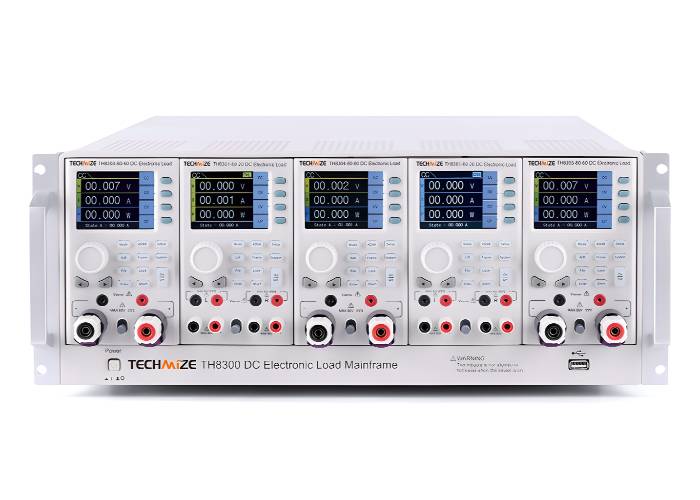
Overview
Programmable DC electronic loads are instruments designed to draw a controlled electrical load from a DC source. They allow researchers and engineers to test how a power supply, battery, charger, converter, solar module or fuel-cell system behaves under defined operating conditions.
Unlike a fixed resistor, a programmable electronic load can operate in multiple control modes, such as constant current, constant voltage, constant resistance and constant power. Dynamic loading allows the load to switch between setpoints, helping users evaluate transient response, regulation stability, protection behaviour and real-world performance under changing demand.
In practical laboratory testing, electronic loads are often paired with programmable power supplies and power meters. The power supply controls the input, the electronic load simulates the output demand, and the power meter measures efficiency or power-flow behaviour. This makes programmable DC loads important tools for R&D, validation, quality control and teaching laboratories.
Key Capabilities
- Constant current, constant voltage, constant resistance and constant power operation.
- Dynamic load testing for transient response and regulation studies.
- Controlled battery discharge and power-source validation.
- Useful for converters, chargers, DC supplies, solar modules and fuel-cell systems.
- Repeatable test profiles for R&D and quality-control workflows.
- Benchtop configuration suitable for laboratory and teaching environments.
- Integration with programmable DC supplies, power meters and automated test software.
Typical Applications
- Battery cell and module discharge testing.
- DC power supply and charger validation.
- DC-DC converter and adapter testing.
- Fuel-cell and solar module loading.
- LED driver and embedded power-module testing.
- Production screening, burn-in and reliability testing.
Integration & Compatibility
Programmable DC electronic loads can be used with programmable DC power supplies, /battery-test-systems, power meters, /fuel-cell-test-stations and custom ScienceGears fixtures. They are also useful in test benches involving oscilloscopes, data loggers, environmental chambers and automation software.
Why Choose ScienceGears (AU & NZ)
ScienceGears helps laboratories select programmable DC electronic loads based on voltage range, current range, power rating, dynamic response, operating modes and automation requirements. We support Australian and New Zealand researchers with practical guidance for battery, power-electronics, renewable-energy and quality-control testing.
PRODUCT FAMILIES & MODELS
TH8300 Series — Programmable DC Electronic Loads
The TH8300 Series is suitable for compact programmable DC load testing in research, teaching and validation laboratories. It is appropriate for batteries, power supplies, converters, chargers and low-to-medium power DC devices where controlled loading and dynamic test capability are required.
Available Products:
- TH8300 Series — Programmable DC electronic load for controlled current, voltage, resistance and power loading in benchtop R&D, battery and power-electronics workflows.
→ Suggested product page: /th8300-series-programmable-dc-electronic-load
HOW TO CHOOSE
Choose a programmable DC electronic load by first defining the maximum voltage, current and power required by the device under test. Then consider the required operating mode, such as constant current for battery discharge or constant power for converter testing. For transient studies, check dynamic response and sampling capability. Also consider automation interface, input protection, cooling, test duration and whether a regenerative load is needed for high-power or long-duration discharge.
FAQs
Q1. What is a programmable DC electronic load?
A programmable DC electronic load is an instrument that draws controlled current or power from a DC source. It simulates an electrical load so researchers can test power supplies, batteries, converters, chargers, solar modules and fuel-cell systems under repeatable conditions. Unlike a fixed resistor, it can operate in multiple control modes and support automated test profiles.
Q2. What operating modes are available in DC electronic loads?
Common operating modes include constant current, constant voltage, constant resistance and constant power. Constant current is often used for battery discharge, while constant power is useful for power-conversion studies. Dynamic loading allows the load to change rapidly between setpoints, helping evaluate transient response, protection limits and regulation behaviour.
Q3. How do I choose the right programmable DC load?
Start by checking the maximum voltage, current and power required by your device under test. Then consider the required load modes, dynamic response, sampling speed, cooling, software control and safety protection. If the test involves high power or long discharge periods, a regenerative electronic load may be more suitable than a standard dissipative load.
Q4. Can a programmable DC load be used for battery discharge testing?
Yes. A programmable DC load can discharge batteries under controlled current, resistance or power conditions. This is useful for capacity checks, comparative studies, protection testing and basic performance evaluation. For full charge/discharge cycling, it may be paired with a programmable DC supply, bidirectional DC supply or /battery-test-systems.
Q5. Can electronic loads be integrated with power supplies and meters?
Yes. A common setup uses a programmable DC power supply as the source, an electronic load as the controlled load and a power meter for measurement. This configuration is widely used for converter testing, charger validation, power-supply characterisation and efficiency studies in R&D and quality-control laboratories.
Q6. What safety considerations are important?
Users should ensure the load rating covers the maximum voltage, current and power of the test. Proper cabling, ventilation, connector rating, polarity checks and protection limits are important. Long-duration discharge tests can generate significant heat, so laboratory airflow and safe operating limits should be considered before running unattended tests.
Q7. Can ScienceGears support Australian and New Zealand laboratories?
Yes. ScienceGears can help identify a suitable programmable DC electronic load for battery, power-electronics, fuel-cell, solar and quality-control applications. We assist with model selection, integration planning and practical test configuration for laboratories across Australia and New Zealand.
CLOSING SUMMARY
Programmable DC electronic loads provide controlled load simulation for batteries, power supplies, converters and clean-energy devices. ScienceGears supports Australian and New Zealand laboratories with technical guidance for selecting and integrating electronic loads into reliable R&D, validation and quality-control workflows.