
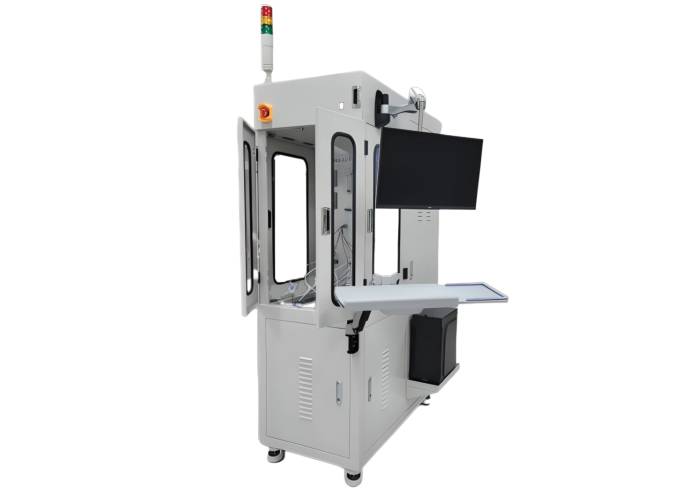
PEM Water Electrolyser Single-Cell Test Station (SE300-PE / SE500-PE)
PEM Water Electrolyser Single-Cell Test Station (SE300-PE / SE500-PE)
Overview
The SE300-PE and SE500-PE Single Cell Test Stations are integrated PEM water electrolysis (PEMWE) platforms designed to run controlled, repeatable single-cell experiments for MEA development, performance mapping and durability testing. The system combines a precision DC power supply, DI-water circulation, gas handling and automated control into a lab-ready cabinet footprint (600 W × 1100 D × 2000 H mm).
Principle of operation
In a PEM electrolyser, deionised water is fed to the anode where it is electrochemically split to oxygen, protons and electrons. Protons migrate through the proton-exchange membrane to the cathode and combine with electrons to form hydrogen. The test station stabilises operating conditions (water flow, temperature and pressure) while monitoring electrical performance and product-gas behaviour.
Core features and specifications
- Power capability: SE300-PE up to 300 W class; SE500-PE up to 500 W class
- Water loop control: RT to 95 °C temperature control, level control with alarms and auto-fill
- Water quality support: conductivity monitoring plus micro and ion filtration for DI-water conditioning
- Gas management: gas cooling and condensate trap for water knock-out and gas–liquid separation
- Flow measurement: H₂ and O₂ flow monitoring suitable for low-flow single-cell work
- Safety diagnostics: H₂-in-O₂ and O₂-in-H₂ concentration monitoring, plus automated shutdown logic
- Pressure operation: automated back-pressure control (with higher-pressure configuration available)
- Optional electrochemical diagnostics: integrated AC impedance / HFR capability for resistance and transport studies
Compatibility and typical applications
Suitable for PEM single cells and early-stage small-stack prototypes within the 500 W envelope, including:
- catalyst-coated membrane and porous transport layer screening
- polarisation curves, efficiency and stability testing
- water management studies (hydration, conductivity drift, gas crossover indicators)
- materials and hardware comparisons under controlled temperature and pressure
Why ScienceGears
ScienceGears supports researchers across Australia and New Zealand with instrument selection, configuration guidance, commissioning support and integration with related research tools such as potentiostats, EIS-capable electrochemical workstations, gas analysis, and in-situ spectroscopy accessories where appropriate.
Customer Reviews
Related Product
Explore our precision instruments designed for electrochemical research and energy applications


Still Wondering About Something?
Explore our FAQ for fast, clear answers to the most common questions—available 24/7.