

Introduction: Your Electrochemistry Lab Doesn’t Need a Fortune
Staring at a five-figure quote for a commercial potentiostat? Feeling overwhelmed by complex diagrams of three-electrode cells? If you’re a student, hobbyist, or researcher in a budget-conscious lab, these barriers can feel insurmountable. The world of electrochemistry is vital for battery development, corrosion studies, and sensor creation, but it often seems locked behind a wall of high costs and steep technical complexity.
This guide is your key to unlocking it. We’ll walk through how to build a capable, reliable electrochemistry setup without draining your funds. From affordable potentiostat alternatives to homemade cells and simple troubleshooting, you’ll learn that great science isn’t about the price tag on your equipment, but about smart, practical solutions.
Taming Cost – Smart Paths to Your Core Equipment
The potentiostat is the brain of any electrochemical setup, but a new commercial one can easily cost over $10,000. For many, this is a non-starter. Let’s break down your realistic alternatives.
The Open-Source Revolution: Kits and Community Projects
Thankfully, a vibrant DIY and open-source movement has emerged. Projects like DummyStat, CheapStat, and OSPoty offer circuit designs, firmware, and software often for free. You can source the components yourself for often less than $100-$200.
- The Benefit: Beyond massive savings, you gain a deep understanding of how your instrument works.
- The Consideration: It requires comfort with soldering and basic electronics assembly. Many online forums, like Sciencemadness and dedicated GitHub repositories, provide community support.
The "Middle Ground": Entry-Level & Used Equipment
If building isn’t for you, consider:
- Entry-Level Commercial Units: Companies like ScienceGears, PalmSens, or Ivium offer entry-level potentiostats at a lower cost than high-end models (depending on the configuration).
- The Used Market: Sites like eBay or LabX often have older, functional potentiostats. Ensure you can get the necessary software and cables, or that it’s compatible with modern open-source data acquisition software.
Can You Just Use a Power Supply?
For strictly controlling voltage between two points (like electroplating), a simple DC power supply can work. However, it cannot function as a true potentiostat. A potentiostat precisely controls the potential of a working electrode relative to a reference electrode, regardless of the current. A power supply cannot do this. For any research-grade experiment like cyclic voltammetry, a true potentiostat is generally required for reliable, controlled measurements.
Building Your Affordable Toolkit – Cells, Electrodes & Data
With your control system figured out, you need the physical setup. This is where creativity shines.
Crafting an Inexpensive Electrochemical Cell
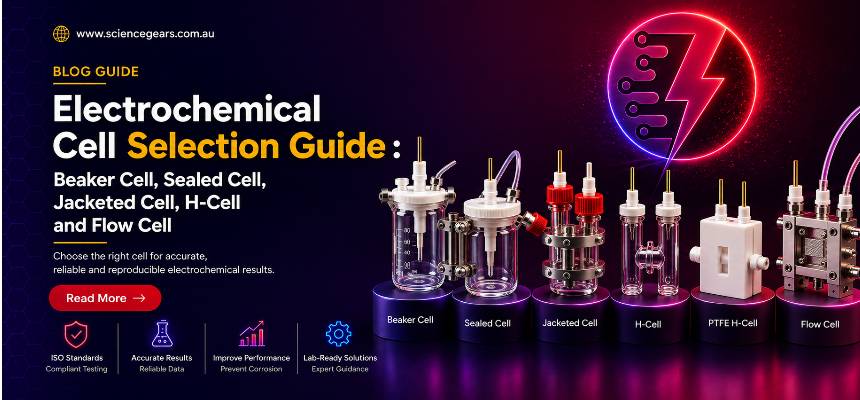
You don’t need a custom-machined, branded cell to start. Many experiments can be performed in:
- Standard Lab Glassware: A simple beaker or small flask works as a basic cell.
- Creative Containers: Small glass jars or vials with airtight lids can be adapted. The key is chemical compatibility (ensure your electrolyte won’t degrade the container) and having ports for your electrodes.
- The 3D-Printing Advantage: If you have access to a 3D printer, you can design and print custom cell bodies that perfectly fit your electrodes, often using chemically resistant filaments.
Sourcing Electrodes Without the Markup
- Working Electrodes: Small graphite rods (or clean graphite “pencil leads” for low-current demonstrations), platinum wire (buy thin gauge for less), or glassy carbon sheets can be sourced from specialty metal or ceramics suppliers at much lower cost than from big science catalogues.
- Reference Electrodes: A DIY Ag/AgCl electrode is a classic and reliable project. It involves coating a silver wire with silver chloride and placing it in a tube with a KCl solution. It’s effective and costs very little.
- Counter Electrodes: A coiled platinum wire is typically recommended for inert behaviour. Stainless steel should be used only if it is compatible with your electrolyte and potential window, and does not corrode or introduce contamination. The counter electrode is usually designed with a large surface area so it does not become the limiting electrode.
The Data Link: Getting Results to Your Computer
Open-source potentiostats usually come with simple software. For other setups, a low-cost USB Data Acquisition (DAQ) module can digitize analog signals from your experiment. Software like Python (with libraries like PySerial or SciPy) or even a well-configured spreadsheet can be used to record and visualise your data.
The Troubleshooting Corner Solving Common Headaches
Even with perfect equipment, things go wrong. Here’s a quick-reference guide to diagnosing frequent issues in budget setups.
| Problem Symptom | Likely Cause (The "Why") | Budget-Friendly Solution |
|---|---|---|
| Noisy, jumpy, or unstable current readings. | Electrical "noise" from nearby equipment, loose connections, or an unstable reference electrode. | Use shielded cables, clean all electrode contacts (light sanding can help), and ensure your reference electrode has a stable, clog-free junction. |
| Potential readings drift over time or seem incorrect. | The reference electrode is contaminated, drying out, or placed too far from the working electrode. | Check and refill your reference electrode's filling solution. Ensure the porous junction isn't blocked. Position it as close as possible to the working electrode. |
| Your cell gets hot, or reactions are inexplicably slow. | Poor cell design leading to high resistance, or inadequate mixing of the electrolyte. | Optimise electrode placement—keep them parallel and close. Add a simple magnetic stirrer (a cheap hotplate stirrer works) to ensure solution homogeneity. |
| You can't reproduce a result from a paper or prior run. | Uncontrolled variables! Differences in electrode surface preparation, electrolyte purity, or even temperature. | Document everything meticulously. Polish electrodes the same way each time. Use the same reagent grades. Note the room temperature. Consistency is key. |
Proving Your Setup Works – A Simple Validation Experiment
The best way to build confidence is to run a standard, well-understood experiment. A classic choice is performing Cyclic Voltammetry (CV) on a solution of Potassium Ferricyanide.
- Prepare: Make a known concentration (e.g., 1 mM) of potassium ferricyanide in a supporting electrolyte (like 1 M KCl).
- Setup: Use a polished glassy carbon or platinum working electrode, your reference electrode (Ag/AgCl), and a platinum wire counter electrode in your homemade cell.
- Run: Perform a CV scan at a moderate rate (e.g., 50 mV/s).
- Analyse: You should see the classic, symmetric peaks expected for a reversible redox reaction. For an ideally reversible one-electron couple at ~25 °C, the peak-to-peak separation is ~59 mV; in practice it can be larger depending on uncompensated resistance, electrode condition, and scan rate. A clean, repeatable voltammogram is a strong practical check that your potentiostat, cell, electrodes, and software are functioning as intended.
Conclusion: Start Experimenting, Not Just Spending
Building an affordable electrochemistry lab is an exercise in resourcefulness, not compromise. By leveraging open-source designs, repurposing common materials, and understanding fundamental principles, you can generate valid, interpretable data (with appropriate validation for your application).
The journey might involve more initial learning soldering a board or polishing an electrode by hand but the deep understanding you gain is invaluable. Your most important tool isn’t the most expensive instrument; it’s your own curiosity and willingness to solve problems.
Tired of troubleshooting alone? What if your equipment supplier had already fought and solved the same battles at the lab bench?
This firsthand understanding is the foundation of ScienceGears. The company was founded by research scientists who transformed their own experimental frustrations into practical solutions for the community. While the DIY approach in our guide is empowering, partnering with these experts can help you bypass common pitfalls and accelerate your progress.
Guidance Forged from Research Experience
The team at ScienceGears isn't just technical salespeople; they are practicing scientists who have personally navigated the complexities you face:
- Dr. Siva Arumugam (Ph.D. in Electrochemistry) brings over 20 years of international research in electrochemistry, biosensors, and advanced analysis, with deep firsthand knowledge of configuring complex potentiostat setups. Google Scholar | linkedIn
- Dr. Kalai Govindasamy (Ph.D. in Raman Spectroscopy & Spectroelectrochemistry) is a materials chemistry specialised with over 15 years of cross-disciplinary work integrating electrochemistry with spectroscopic techniques. Google Scholar | ResaerchGate
This means their product curation and advice stem from genuine problem-solving experience. They don't just sell equipment; they provide efficient pathways to reliable data.
From Expert Knowledge to Your Lab Bench
This translates into direct, practical support for setting up your affordable lab:
- Informed Product Selection: Get application-appropriate guidance on potentiostats, cells, and accessories that are correctly specified for applications like corrosion, battery testing, or sensor development.
- Curated Starter Kits: Access reliable, high-value bundles that eliminate the trial and error of sourcing disparate components.
- Expert Troubleshooting Support: Leverage their deep technical knowledge to overcome specific setup and measurement challenges quickly.
Ready to build your setup with a partner who understands the science? Explore solutions developed from a researcher's perspective at ScienceGears.
Final Thought: The right tools, coupled with guidance from those who've used them, can transform frustration into discovery. We wish you success in your experiments.