
Understanding Real-Time Materials Analysis: In-Situ XRD vs Operando XRD
When researchers need to monitor structural changes in materials as they undergo chemical reactions or phase transitions, two powerful techniques emerge as powerful tools: in-situ X-ray diffraction (XRD) and operando XRD. While these terms are often used interchangeably in scientific literature, they represent distinct methodological approaches that fundamentally differ in how they simulate real-world operating conditions. Understanding these differences is crucial for materials scientists, electrochemists, and battery researchers seeking to unlock mechanistic insights into catalysis, energy storage, and corrosion processes.
What Is In-Situ XRD? Understanding the Fundamentals
In-situ XRD refers to X-ray diffraction analysis performed while a material is subjected to controlled laboratory conditions that simulate but do not exactly replicate real-world operating environments. The technique employs specialised electrochemical cells with X-ray transparent windows (typically Kapton® film or quartz) that allow synchrotron or laboratory XRD beams to penetrate the sample while electrochemical control is maintained.
For compatible electrochemical hardware, refer In-Situ XRD / XRD Cells.
During in-situ XRD experiments, researchers can observe crystallographic changes, phase transitions, and lattice parameter variations as a material is electrochemically cycled. For instance, battery researchers use in-situ XRD to track lithium-ion intercalation and structural evolution in cathode materials during charge-discharge cycles. The technique excels at providing:
- Real-time crystallographic phase identification
- Lattice parameter refinement under applied potential
- Detection of intermediate phases during electrochemical reactions
- Quantitative analysis of structural distortion and strain
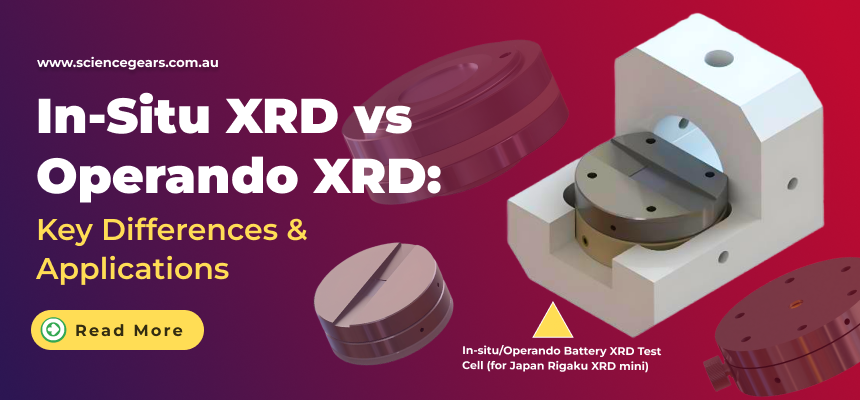
ScienceGears In-Situ Battery XRD Test Cells address this need with precision-engineered solutions compatible with industry-leading XRD instruments: Rigaku XRD mini, Bruker D2, and Rigaku XRD full systems. These cells feature Kapton® X-ray windows, multiple electrode configurations, and hermetic sealing to maintain electrolyte integrity throughout extended measurement periods.
Operando XRD: Operating Under True Reaction Conditions
Operando XRD elevates the analysis beyond controlled simulation. The term "operando" derives from Latin, meaning "while working" and that is precisely what this technique achieves. Operando measurements monitor materials while they function under genuine operating conditions, such as high temperature, applied load, flowing gases, or full electrochemical cycling at realistic current densities and potentials.
The fundamental distinction lies in fidelity to real-world conditions. An operando XRD experiment on a battery would monitor the cathode material's structure during actual discharge at practical current rates within a fully functional cell design. An operando study of an electrocatalyst would track structural changes during oxygen evolution reaction (OER) or hydrogen evolution reaction (HER) at the exact potentials and current densities where catalytic activity occurs.
Operando XRD provides critical advantages:
- Material structural evolution under actual operating parameters
- Detection of dynamic, transient phases that exist only during operation
- Correlation between structure and electrochemical performance in real-time
- Quantification of degradation mechanisms as they occur
Key Differences: In-Situ vs Operando XRD
| Parameter | In-Situ XRD | Operando XRD |
|---|---|---|
| Conditions | Controlled lab environment, simplified cell geometry | Realistic operation, full device simulation |
| Electrochemical Control | Potential/current applied, but not at performance-relevant rates | Actual working conditions (current density, temperature, gas flow) |
| Cell Design | Optimised for X-ray transmission, often with simplified electrode setup | Replica of functional device with full operating compatibility |
| Time Resolution | Depends on instrument/beam intensity (from seconds to hours per pattern) | Continuous or time-resolved monitoring during realistic operation (instrument-dependent) |
| Transient Phases | May not capture short-lived intermediates | Captures dynamic species and degradation pathways |
| Practical Example | Battery studied at a low rate (e.g., ~0.1 C) in an XRD-optimised cell | Battery cycled at a practical rate (e.g., ~1 C) in a device-representative cell |
| Data Interpretation | Structural snapshots at specific potentials | Continuous structural evolution correlated to electrochemical response |
Understanding these distinctions guides researchers toward the optimal technique for their specific questions. If your research requires mechanistic understanding of stable phases and reversible structural changes, in-situ XRD offers excellent temporal resolution with simpler experimental setup. If you need to understand why degradation occurs during actual use or identify transient intermediates under operating stress, operando XRD delivers high-value insights.
Applications Where Each Technique Excels
In-Situ XRD Applications
In-situ XRD remains the widely used approach for foundational materials research where operational realism is secondary to mechanistic clarity. Primary applications include:
Battery & Energy Storage Research — Tracking lithium-ion intercalation mechanisms, identifying crystal structure evolution across charge-discharge cycles, and measuring volume changes in anode materials. Researchers use in-situ XRD to establish baseline understanding before advancing to operando studies.
Catalysis Mechanism Studies — Monitoring structural changes in catalysts at specific applied potentials, identifying active phases, and ruling out reaction mechanisms based on crystallographic evidence.
Phase Transition Mapping — Studying temperature-dependent or potential-dependent phase boundaries, documenting intermediate phases, and refining structural models.
Corrosion Mechanism Analysis — Tracking oxide film growth and structural evolution on corroding metals under controlled electrochemical conditions.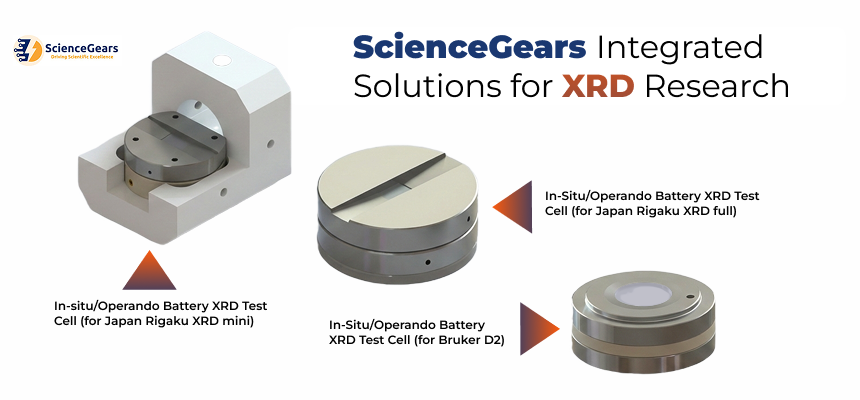
Operando XRD Applications
Operando XRD addresses the critical gap between laboratory observation and real-world device performance:
Battery Degradation Studies — Understanding why performance fades during actual use, identifying structural irreversibility pathways, and correlating degradation to specific electrochemical signatures.
Electrocatalyst Performance Mapping — Monitoring structural changes in oxygen-evolution and hydrogen-evolution catalysts during continuous operation, identifying the true active phase under working conditions, and tracking deactivation mechanisms.
Full-Device Testing — Monitoring structural evolution in complete battery cells or fuel-cell components operating at realistic power outputs and current densities.
Operando Gas-Phase Analysis — Combining XRD with mass spectrometry (like ScienceGears' In-Situ/Operando Mass Spectrometry Flow Electrochemical Cell) to simultaneously track structural changes and detect gas products during CO₂ reduction or electrochemical synthesis.
ScienceGears' Integrated Solutions for XRD Research
ScienceGears offers a comprehensive portfolio of in-situ and operando electrochemical cells engineered for simultaneous spectroscopic and electrochemical measurements:
In-Situ XAS & XRD Cell Series (XAFC)
- XAFC-1: Single-cell reactor with Kapton® window for synchrotron beamlines
- XAFC-2: Dual-compartment H-cell for anode/cathode isolation
- XAFC-3: Gas-phase variant for operando XAS under flowing reactive gases
These cells support multiple electrode configurations, maintain electrolyte integrity, and integrate seamlessly with both laboratory XRD instruments and synchrotron beamlines.
Battery-Specific XRD Cells
- In-Situ Battery XRD Test Cell (Rigaku mini) — Compact, high-throughput screening
- In-Situ Battery XRD Test Cell (Bruker D2) — Laboratory XRD compatibility
- In-Situ Battery XRD Test Cell (Rigaku full) — Full synchrotron-grade capabilities
Operando Multi-Technique Coupling
- In-Situ Mass Spectrometry Flow Electrochemical Cell — Real-time gas detection during XRD measurements, enabling simultaneous structural and compositional analysis
- In-Situ Raman Spectroelectrochemical Cells (REC series) — Coupled XRD-Raman studies to correlate crystallographic structure with vibrational chemistry
Selecting the Right Technique for Your Research
Choose In-Situ XRD when:
- Your primary objective is mechanistic understanding of reversible structural changes
- You need high temporal resolution with straightforward cell design
- Budget and beamtime availability favor simplified experimental setups
- Your research targets foundational material properties rather than device performance
Choose Operando XRD when:
- Degradation mechanisms and device longevity are your primary concerns
- You need to correlate structure with actual performance under realistic conditions
- Transient intermediates or dynamic phases are suspected
- Your findings must translate directly to commercial device optimisation
Integrating Multi-Technique Operando Studies
The future of materials research lies in coupling XRD with complementary techniques. ScienceGears' modular electrochemical cell designs enable simultaneous measurement of:
- XRD + Raman Spectroscopy — Crystallographic structure + vibrational chemistry
- XRD + Mass Spectrometry — Phase evolution + product detection during electrocatalysis
- XRD + UV–Vis Spectroscopy — Structural changes + electronic property evolution
These integrated approaches provide holistic mechanistic understanding impossible with single-technique analysis.
Frequently Asked Questions (FAQs)
Q1: Does operando XRD require a synchrotron, or can it be done on a lab diffractometer?
Operando XRD does not strictly require a synchrotron. It can be performed on many laboratory diffractometers if the experiment is designed around the available X-ray flux, detector speed, and geometry. However, synchrotron beamlines are often preferred when you need very fast time resolution, weak-signal detection (low active mass, thick housings, dilute phases), high signal-to-background, or advanced modes such as high-energy transmission and micro-focused mapping. In practice, lab operando XRD is most feasible when you use an XRD-optimised electrochemical cell, minimise scattering from windows/housing/electrolyte, and accept time resolution that is instrument-dependent (often slower than synchrotron for the same sample).
Q2: What window materials (Kapton, Be, quartz) minimise background scattering in electrochemical XRD cells?
Window choice is a trade-off between X-ray transparency, background/scattering, chemical compatibility, and mechanical stability:
- Kapton® (polyimide film): widely used because it is easy to seal, chemically robust in many electrolytes, and reasonably transparent for many lab XRD energies. It can add a broad amorphous background, which may matter for weak peaks.
- Beryllium (Be): excellent X-ray transmission with low background for certain geometries, but it is highly regulated/toxic as dust, requires strict handling and compliant supply chains, and is not suitable for all users or facilities.
- Quartz / glassy windows: mechanically stable and chemically resistant, but can increase background depending on thickness and geometry, and may limit transmission at lower energies.
In most electrochemical XRD cells, the best “low background” outcome comes less from a single magic window material and more from minimising window thickness, keeping the beam path through electrolyte short, and using an XRD-optimised cell geometry.
Q3: How do I align an electrochemical cell for XRD to reduce electrolyte and housing contributions?
To reduce unwanted scattering from electrolyte and cell hardware, alignment should prioritise beam path control and geometry repeatability:
- Minimise electrolyte in the beam path: design/fill the cell so the beam intersects the electrode region with the shortest possible path through liquid.
- Keep high-scattering parts out of the beam: avoid beam overlap with thick housings, current collectors, clamps, and seals.
- Use consistent sample height/tilt: set the cell at a reproducible position (Z-height) and ensure the window is not tilted relative to the beam more than necessary.
- Run background references: collect a pattern for (i) empty cell, (ii) cell + electrolyte, and (iii) cell + electrode without cycling to identify and subtract/ignore non-sample features.
- Verify with a quick diagnostic scan: before cycling, check whether expected peaks are visible and whether broad backgrounds dominate—adjust geometry, beam size, or fill level accordingly.
Q4: What scan strategies improve time resolution (quick scans, fixed-angle, energy-dispersive XRD)?
Time resolution is usually improved by collecting less angular information per time point or using faster acquisition modes:
- Shortened range / fewer steps: scan only the 2θ region where key peaks occur (phase markers), rather than a full wide-range scan.
- Continuous / “quick” scans (fast detectors): use continuous scanning with modern 1D/2D detectors to reduce overhead and improve temporal sampling.
- Fixed-angle (single-peak monitoring): track intensity/position of one or a few peaks at fixed angles to capture rapid transitions (highest time resolution, lowest structural completeness).
- Energy-dispersive XRD (EDXRD): collects diffraction information by energy at fixed geometry and can be powerful for fast processes, but requires suitable instrumentation and data interpretation workflows.
- Stroboscopic / repeatable cycling: if the process repeats, you can synchronise data collection across cycles to reconstruct time-resolved behaviour.
A good practical approach is to start wide-range to identify peaks, then switch to targeted peak regions for kinetics.
Q5: How can I correlate XRD phase changes with electrochemical features (dQ/dV peaks, impedance changes)?
Correlation works best when you build a shared timeline and focus on interpretable markers:
- Synchronise timestamps: ensure XRD patterns and electrochemical data (V, I, Q, dQ/dV, EIS spectra) share a common time base.
- Choose phase markers: select a small set of diffraction peaks that uniquely represent relevant phases; track peak position (lattice change), intensity (phase fraction/texture), and width (strain/size).
- Map against electrochemical signatures:
- dQ/dV peaks often align with phase transitions or staging reactions; compare their timing with emergence/shift of diffraction peaks.
- Impedance changes can reflect interfacial/transport changes; compare Rct/Warburg trends with structural evolution (e.g., phase boundary formation, lattice expansion).
- Use consistent cycling protocols: step changes (current, potential holds) make cause-and-effect easier to interpret than continuously varying profiles.
- Report limitations clearly: XRD probes crystalline order; amorphous/interfacial changes may drive electrochemistry without obvious diffraction changes, so interpret correlations cautiously.
Q6: Common failure modes in in-situ/operando cells (leaks, window bowing, parasitic scattering) and how to prevent them
Common issues and practical prevention steps:
-
Leaks (electrolyte seepage at seals/fittings):
Causes: uneven compression, incompatible gasket material, overtightening/undertightening, swelling.
Prevention: use chemically compatible gaskets, tighten gradually in a cross-pattern, pressure-test with inert liquid before experiments, and avoid repeated re-use of deformed seals.
-
Window bowing / deformation (changes beam path, peak drift, increased background):
Causes: pressure differentials, thermal changes, thin films under stress.
Prevention: support the window mechanically where possible, minimise internal pressure, avoid overfilling, and use robust window frames or appropriate thickness/material.
-
Parasitic scattering (housing/current collectors dominate):
Causes: beam intersects metal parts, thick walls, textured collectors, or large electrolyte volume.
Prevention: use XRD-optimised geometry, reduce beam size, reposition/realign, and collect background references (cell-only, electrolyte-only).
-
Bubble formation (gas evolution blocks beam, adds noise):
Causes: electrolysis, poor wetting, trapped gas pockets.
Prevention: degas electrolyte if appropriate, design for bubble escape, use flow/venting where safe, and avoid operating regimes that generate excessive gas unless it is the target reaction.
-
Electrical artefacts (unstable contact, noisy electrochemistry):
Causes: loose tabs, corrosion at contacts, electrolyte creep.
Prevention: use stable current collectors, protect contacts from wetting, confirm low contact resistance before XRD acquisition.
Conclusion: Operando XRD as the Ultimate Research Frontier
While in-situ XRD provides essential foundational knowledge through controlled laboratory analysis, operando XRD represents the ultimate research frontier where structure meets function. The distinction between these techniques is not academic it directly impacts the quality of mechanistic conclusions, the reliability of performance predictions, and ultimately, the success of commercialising advanced materials.
For researchers designing next-generation batteries, developing superior electrocatalysts, or solving critical corrosion challenges, the strategic choice between in-situ and operando XRD or ideally, combining both approaches—determines whether you observe what materials could do or witness what they actually do under real-world stress.
ScienceGears precision-engineered electrochemical cell solutions bridge this gap, enabling seamless transition from in-situ discovery to operando validation, ensuring your research delivers insights that matter.