
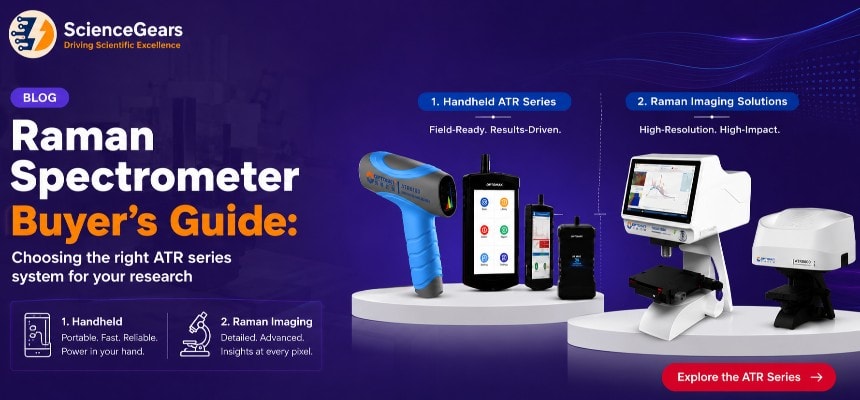
By the end of this guide, you will be able to match your sample type, spatial resolution requirement, and working environment to a specific ScienceGears ATR series Raman platform, and know exactly which questions to answer before requesting a quote.
Micro-Raman spectroscopy can provide chemical, phase/structural and strain information with little sample preparation and is often non-destructive when laser power and exposure are appropriately controlled. That nondestructive, label-free character is exactly why the technique has spread from core spectroscopy laboratories into pharmaceutical quality control, forensic science, battery research, food safety screening, and reaction monitoring. The challenge is often determining which Raman instrument category best fits the sample, required resolution and measurement environment. It is which category of instrument actually fits the sample, the required spatial or spectral resolution and the environment the measurement has to happen in. A confocal microscope built for submicrometre chemical imaging solves a completely different problem to a rugged handheld unit built for a warehouse floor, even though both instruments are, at heart, Raman spectrometers.
This guide works through ScienceGears' current ATR series Raman range by application category, so a PhD researcher, postdoc or lab manager weighing up options can go straight to the section that matches their sample and working environment.
1. Confocal Raman microscopes for high resolution lab research
Anyone trying to resolve chemical or structural information at the micrometre scale runs into a hard physical limit before they run into a budget limit. Lateral spatial resolution in a confocal Raman microscope is diffraction limited and depends on excitation wavelength, numerical aperture and optical configuration; shorter excitation wavelengths and higher-NA objectives generally improve lateral resolution. That is why the choice of laser wavelength is not just a fluorescence question in microscopy. It is a resolution question too, since shorter excitation wavelengths such as 532 nm resolve finer features than 785 nm or 1064 nm on the same optics.
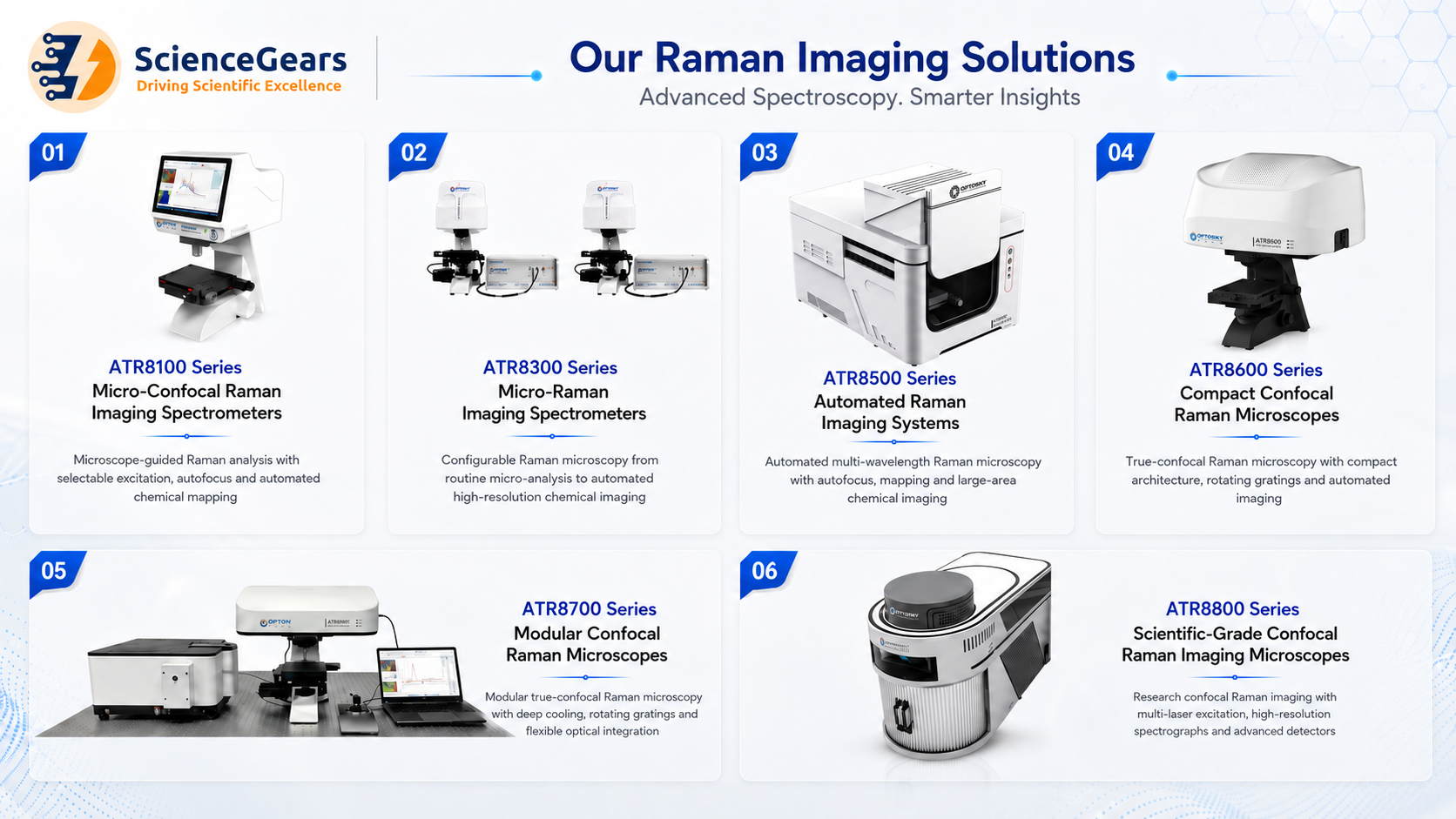
ScienceGears' confocal Raman microscope range spans six series, from an entry micro confocal platform through to a fully configurable research-grade system:
- ATR8100 Series Micro Confocal Raman Imaging Spectrometers: microscope-guided Raman analysis with selectable excitation, autofocus and automated chemical mapping, aimed at routine micro Raman work.
- ATR8300 Series Micro Raman Imaging Spectrometers: configurable Raman microscopy spanning routine micro analysis through to automated high-resolution chemical imaging.
- ATR8500 Series Automated Raman Imaging Systems: automated multiwavelength Raman microscopy with autofocus, mapping and large area chemical imaging, built for higher sample throughput.
- ATR8600 Series Compact Confocal Raman Microscopes: true confocal microscopy in a compact architecture with rotating gratings and automated imaging.
- ATR8700 Series Modular Confocal Raman Microscopes: modular true confocal microscopy with deep cooling and flexible optical integration for laboratories that need to build the instrument around other equipment.
- ATR8800 Series Scientific Grade Confocal Raman Imaging Microscopes: the research flagship, with multi-laser excitation from ultraviolet through near infrared, three spectrograph focal lengths (350, 510 and 810 mm) and detector options extending to deep-cooled and EMCCD configurations.
The ATR8800's own configuration guide illustrates the resolution versus focal length trade-off directly: at 532 nm excitation, moving from a 350 mm to an 810 mm spectrograph tightens resolution from roughly 1.4 cm⁻¹ to 0.45 cm⁻¹, with a corresponding improvement at 785 nm. That is a genuine research decision, not a marketing one. The highest-resolution configuration is not automatically correct for every project, because higher resolution can involve trade-offs in acquisition speed, optical throughput and spectral coverage depending on the grating, slit, detector and optical configuration. A researcher mapping stress in a 2D material at the submicrometre scale has a different requirement to one running routine polymorph screening across a tray of pharmaceutical samples, and the ATR8100 through ATR8700 platforms exist precisely to avoid overspecifying instruments for the latter case.
Detector choice deserves the same scrutiny as focal length. A cooled CCD is a common starting point for many visible and shorter-wavelength near-infrared Raman applications, giving low-noise detection without unnecessary cost. Where the Raman signal is genuinely weak, for example, thin films, trace surface species, or short integration mapping of beam-sensitive samples, a deep-cooled or EMCCD configuration reduces detector-limited noise at the expense of a more complex and costlier system. Autofocus (AF) and mapping (MP) configuration suffixes matter most for automated multipoint acquisition across an uneven or large area sample; a single point measurement on a flat, polished specimen rarely needs them. Low wavenumber configurations, which extend measurement closer to the excitation line than a conventional fingerprint region setup, are a specialist requirement relevant to lattice mode and phonon research rather than routine identification work, and should only be specified where the target vibrational modes actually fall in that range.
A practical way to work through the ATR8xxx range is to start with the measurement, not the instrument. First, identify which excitation wavelength avoids fluorescence in your sample class. Second, define the Raman shift range the experiment actually needs to cover. A narrow high-resolution window is a very different specification to a broad survey scan. Third, work out the spectral resolution required to separate the bands of interest; some demanding polymorph, strain or closely spaced-band studies may require resolution around 1 cm⁻¹ or finer, while routine identification rarely does. Only once those three answers are fixed should focal length, detector cooling and objective magnification be chosen. Skipping straight to the highest specification configuration is the most common and most expensive mistake in confocal Raman procurement, because throughput and acquisition time both fall as resolution rises, and a system overspecified for the actual scientific question wastes both budget and bench time.
two-dimensional materials, semiconductor stress mapping, pharmaceutical polymorph identification, nanomaterials, battery and energy material research, biological microstructures.
Key considerationsConfocal microscopes require dedicated lab space and a bench free of vibration; resolution should be selected from the scientific question backwards, not maximised by default; multi-laser and multi-detector configurations add cost and complexity that only some projects need. Pricing is configuration dependent and supplied on request, so request a quote once the excitation wavelength, Raman range and mapping requirements are defined.
2. Portable and benchtop Raman spectrometers for flexible research work
Not every measurement happens at a fixed microscope station. A large group of academic and industrial researchers needs a Raman spectrometer that can sit on a bench, move between labs, or couple to a fibre probe for a reaction vessel, without the cost or footprint of a full confocal microscope. ScienceGears' portable and benchtop range covers this middle ground with five series:
- ATR2500 Series Compact Raman Spectrometers: compact laboratory Raman with low noise detection and a configurable Raman shift range, suited to routine bench identification work.
- ATR3000 Series Portable Raman Spectrometers: case-based portable Raman with visible, 785 nm and low-fluorescence 1064 nm configurations for labs that move between sites.
- ATR3020 Series Differential Raman Spectrometers: shifted-excitation Raman difference spectroscopy, a technique used to suppress broadband fluorescence computationally rather than only by choosing a longer wavelength.
- ATR3100 & ATR3110 Scientific Portable Raman Spectrometers: cooled research-grade systems with fibre probe sampling and, on the ATR3110 platform, excitation options spanning 473 nm through to 1064 nm, plus long integration (LT) and enhanced (PS) detector configurations.
- ATR3200 Series Dual Wavelength Raman Spectrometers: two-laser Raman spectroscopy that lets a single platform switch excitation wavelength within one research programme, useful where sample fluorescence behaviour is not known in advance.
The ATR3100 and ATR3110 illustrate why wavelength choice deserves as much attention as any other specification. 532 nm can deliver strong Raman scattering and works well for resonant, oxide, and carbon systems, but often drives up fluorescence in organic samples. 785 nm remains the general-purpose research default for a reason: it balances scattering efficiency against fluorescence for a wide range of materials. Moving further to 830 nm or 1064 nm trades signal strength for fluorescence suppression, which matters for coloured, biological or strongly fluorescent organic samples. On the ATR3110 platform, this is a documented reference configuration, with detector cooling to around −15 °C on the enhanced option and a standard fibre probe working distance of 6 mm at 0.3 numerical aperture. These are figures worth confirming against your sampling geometry before ordering.
This flexibility is what makes the ATR3xxx range particularly relevant for university laboratories running several different sample types through one shared instrument, and for teams progressing a project from proof-of-concept spectra towards a defined analytical method.
academic laboratories running mixed sample types, materials characterisation (carbon materials, oxides, semiconductors), pharmaceutical and polymer research, SERS research, general molecular identification.
Key considerationsCooled detector and multi-wavelength configurations require some familiarity to set up correctly; probe optics, connector type, and working distance need confirming against your sampling method before quotation.
3. Handheld and miniature Raman analysers for field and QC identification
Once a measurement moves off the bench, to a warehouse, a customs checkpoint, a production floor or a field site, portability, ruggedness and rapid identification against a spectral library become the priorities, and raw spectral resolution becomes secondary to reliable, fast material identification. ScienceGears offers four handheld and miniature Raman series, differentiated primarily by excitation wavelength and form factor:
- ATR1600 Series Ultra Miniature Raman Analysers: pocket-sized 785 nm Raman identification with smartphone-based operation and configurable spectral libraries.
- ATR6100 Series Compact Handheld Raman Analysers: compact material-identification instruments available in 532, 785 or 1064 nm configurations with mobile control, allowing the excitation wavelength to be selected for the intended sample class.
- ATR6500 Series Handheld Raman Analysers: integrated 532 nm and 785 nm identification with an onboard touchscreen, camera and spectral libraries for standalone field use.
- ATR6600 Series 1064 nm Handheld Raman Analysers: 1064 nm handheld identification purpose built for fluorescent, coloured and optically difficult samples.
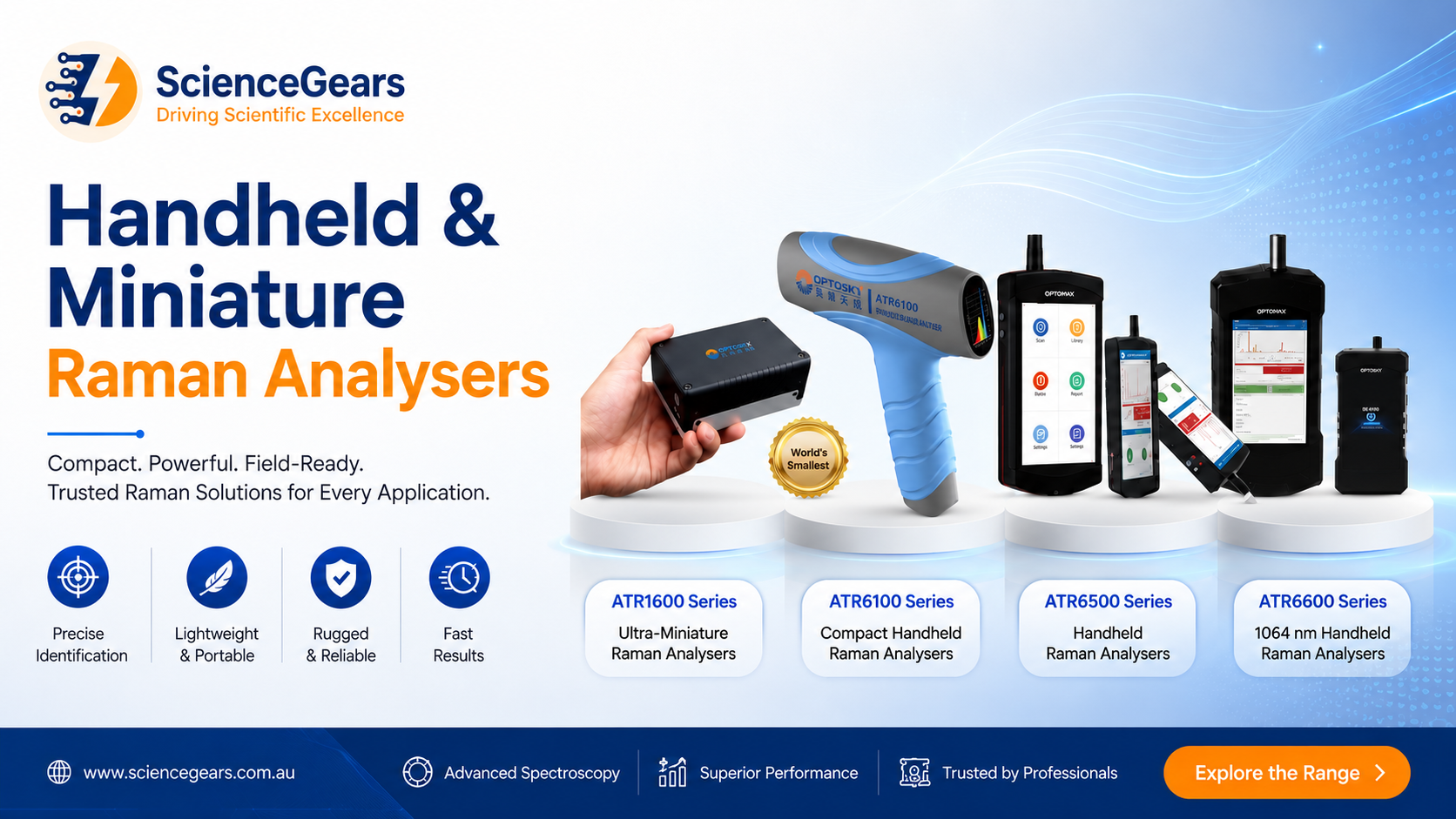
Fluorescence is the single biggest reason a handheld Raman measurement fails, and it is well documented in the peer-reviewed literature that fluorescence background falls off sharply as excitation wavelength lengthens, even though Raman scattering efficiency itself also decreases at longer wavelengths.[1][2] That trade off is exactly why the ATR6600 series exists alongside the 785 nm capable ATR1600 and ATR6500 series rather than replacing them: for a non fluorescent sample, a 785 nm instrument can often return a stronger and faster measurement, while a 1064 nm instrument earns its place on coloured plastics, oils, pigments, pharmaceutical raw materials and other samples where 785 nm returns mostly fluorescence background rather than resolvable Raman peaks. The current ATR6600Pro reference configuration documents a 5.5 inch touchscreen, onboard 13 megapixel camera, four to six hour battery operation, IP67 protection and 4G/Bluetooth/Wi-Fi connectivity, alongside user expandable spectral libraries. These are features aimed squarely at unsupervised field use rather than laboratory bench work.
Spectral library management is worth planning before an instrument arrives, not after. ATR-series identification instruments are available with reference-library capability, with supported configurations also allowing users to add their own reference spectra, but real world identification confidence improves considerably once a lab adds its own reference spectra for the specific raw materials, formulations or contaminants it actually encounters. A user expandable library also protects against the common failure mode where a genuine sample match sits just outside the factory library's coverage. Building even a modest in house reference set for your ten or twenty most frequently tested materials tends to deliver a bigger improvement in day to day reliability than moving to a longer excitation wavelength.
field material identification, forensic and hazardous material screening, pharmaceutical raw material verification, coloured or fluorescent polymer and pigment identification, quality control screening of packaged goods.
Key considerationsHandheld analysers trade spectral resolution for portability and speed; 1064 nm should be selected because the sample genuinely fluoresces under shorter wavelengths, not by default; for full research grade spectra rather than library matched identification, a portable ATR3xxx or confocal ATR8xxx platform is the more appropriate tool.
4. Process and in situ Raman analysers (PAT)
Some of the most valuable Raman measurements never happen in a spectroscopy lab at all. They happen inside a reactor, a crystalliser or a production line, where composition needs to be followed as the process runs rather than reconstructed afterward from manual samples. This is Process Analytical Technology (PAT): using in process measurement to understand and control what is happening in real time. Raman is well suited to this role because a fibre optic probe can often measure directly in a process stream, and unlike mid infrared absorption spectroscopy, water is typically a weak Raman scatterer, so aqueous reaction mixtures are not automatically swamped by solvent signal.
ScienceGears' ATR7000 Series Process Raman Analysers covers this territory across three related models:
| Model | Primary function |
|---|---|
| ATR7000 | Real time online Raman process analysis |
| ATR7010 | In situ reaction process Raman / PAT, with 532, 638, 785 and 1064 nm probe configurations |
| ATR7020 | Portable Raman quantitative analyser, also available in 532, 638, 785 and 1064 nm configurations |
The current ATR7010 process probe reference documents a standard fibre length of 1.5 m (customisable), a 12.7 mm probe outer diameter, an 8.5 mm aperture, a 6 mm working distance and FC/PC laser and SMA905 signal fibre connectors. These are details that matter enormously once the probe has to be sealed into an actual reactor port under real temperature and pressure.
It is worth being precise about what process Raman does and does not deliver out of the box: a Raman spectrum on its own identifies chemical species and can track relative peak changes, but it does not automatically report a concentration. Quantitative concentration monitoring generally requires a validated calibration model, which may be univariate or multivariate/chemometric depending on the application; PLS is one commonly used approach, trained against a reference analytical method such as HPLC, and validated before it is trusted for process control.[3] This is standard practice in the peer reviewed PAT literature, not a ScienceGears specific caveat, and it is a common point of confusion for teams moving from qualitative to quantitative Raman use.
Building a usable quantitative model is not a one step exercise. It typically starts with collecting Raman spectra across a representative range of process conditions alongside reference measurements from an established analytical method, then applying a multivariate regression technique to relate the two datasets, and finally validating the resulting model against an independent set of samples the model has not seen before. A model built from a narrow calibration range will extrapolate poorly outside that range, which is why the calibration set needs to span the full concentration and process condition window the instrument will actually see in production, not just the conditions that were convenient to sample in the lab.
crystallisation and polymorph transformation monitoring, reaction endpoint detection, continuous manufacturing, bioprocess and fermentation monitoring, pilot scale process optimisation.
Key considerationsprocess Raman must be specified around the process connection first. Chemical compatibility, temperature, pressure, probe insertion geometry and hazardous area requirements all shape which ATR7000 series configuration is appropriate, and quantitative concentration output requires a validated chemometric model, not just an installed probe.
5. Specialised and automated Raman systems
A smaller group of applications sit outside the routine microscope/portable/handheld/process categories entirely, and ScienceGears carries four dedicated platforms for them:
- ATR8000 Automated High Throughput Raman Spectrometer: automated multisample Raman screening with programmable sample trays and single or dual laser configurations, aimed at labs that need to process many samples with minimal manual handling.
- ATR3000FD Raman Food Safety Analyser: portable SERS Raman screening configured for trace residues, additives and food contaminants.
- ATR3700 Underwater Raman Spectrometer: a specialised platform for submerged and in water scientific measurement.
- ATR1200 Teaching Raman Spectrometer: a university teaching system built around spectroscopy fundamentals, instrument operation and practical experiments rather than research throughput.
Surface enhanced Raman spectroscopy (SERS), the technique behind the ATR3000FD's trace residue capability, works by exploiting the strongly enhanced local electromagnetic field around suitably prepared metallic nanostructures, which can boost the Raman signal of adsorbed molecules by many orders of magnitude relative to conventional Raman scattering. That enhancement is what makes SERS based screening viable for the very low analyte concentrations typical of food contaminant and residue testing, though as with any enhancement technique, result reliability depends on substrate quality, sample preparation and appropriate reference standards. A screening result that looks strongly positive on a poorly characterised substrate is not the same as a validated finding, so it is worth confirming the substrate qualification and reference standard protocol that sits behind any SERS based method before treating a screening result as final.
high throughput sample screening (ATR8000), food safety and trace residue testing (ATR3000FD), oceanographic and submerged sample research (ATR3700), undergraduate and postgraduate spectroscopy teaching (ATR1200).
Key considerationsthese are purpose built platforms rather than general purpose instruments; confirm your specific application against the documented configuration before assuming a specialised system covers a routine use case that a portable or confocal platform would handle more simply.
Note on scope: ScienceGears also carries a dedicated Raman Spectroscopy Accessories range covering probes, calibration standards and sampling hardware, and a separate Spectroelectrochemistry Raman line for Raman measurements under controlled electrochemical potential. Both are adjacent to, but outside, the scope of this instrument selection guide.
6. Choosing your path: a decision matrix
| Application | Recommended instrument type | Specific product | Key rationale | Key constraint |
|---|---|---|---|---|
| Submicrometre chemical or stress mapping (2D materials, semiconductors) | Research confocal Raman microscope | ATR8800 | Multilaser excitation with 350/510/810 mm spectrograph options for maximum resolution | Highest cost and complexity in the range; requires dedicated lab space |
| Routine polymorph or micro Raman screening | Entry confocal Raman microscope | ATR8100 | Selectable excitation with autofocus and mapping at lower configuration complexity | Less flexible than ATR8300/8700 for advanced imaging workflows |
| High throughput automated microscopic imaging | Automated confocal Raman imaging system | ATR8500 | Automated multiwavelength mapping over large sample areas | Automation adds cost versus manual stage systems |
| Modular confocal integration with other lab equipment | Modular confocal Raman microscope | ATR8700 | Deep cooling and flexible optical integration | Requires more configuration planning than a fixed platform |
| Academic lab running mixed sample types on one instrument | Scientific portable Raman spectrometer | ATR3100 / ATR3110 | Configurations available across excitation wavelengths from 473 nm to 1064 nm | Some familiarity required to configure optimally |
| Routine bench identification, budget-constrained lab | Compact Raman spectrometer | ATR2500 | Low noise detection at lower system complexity | Narrower configuration range than ATR3100/3110 |
| Fluorescent sample research on a portable platform | Differential Raman spectrometer | ATR3020 | Shifted excitation difference spectroscopy suppresses fluorescence computationally | Adds acquisition complexity versus single shot Raman |
| Uncertain fluorescence behaviour across a sample set | Dual wavelength Raman spectrometer | ATR3200 | Two lasers on one platform allow wavelength switching per sample | Higher cost than a single wavelength ATR3000 unit |
| Pocket scale field identification | Ultra miniature handheld analyser | ATR1600 | Smartphone operated 785 nm identification in a pocket form factor | Limited to 785 nm; not suited to strongly fluorescent samples |
| General handheld identification with wavelength choice | Compact handheld Raman analyser | ATR6100 | 532, 785 or 1064 nm configurations with mobile control | Compact form factor trades some robustness versus ATR6500/6600 |
| Standalone field identification with onboard display | Handheld Raman analyser | ATR6500 | Integrated touchscreen, camera and library at 532/785 nm | No 1064 nm option on this platform |
| Coloured, biological or fluorescent field samples | 1064 nm handheld Raman analyser | ATR6600 / ATR6600Pro | 1064 nm excitation substantially reduces fluorescence background | Weaker Raman scattering than shorter wavelengths; slower on nonfluorescent samples |
| Real time reaction or crystallisation monitoring | Process Raman analyser (PAT) | ATR7000 / ATR7010 | Fibre probe measurement directly in the process stream | Quantitative output requires a validated chemometric model |
| Portable quantitative process screening | Portable process Raman analyser | ATR7020 | Same 532–1064 nm configuration range in a portable format | Still requires calibration for concentration output |
| High volume unattended sample screening | Automated high throughput Raman | ATR8000 | Programmable trays with single or dual laser configuration | Designed for throughput, not maximum spatial resolution |
| Trace residue or contaminant screening in food samples | SERS food safety analyser | ATR3000FD | SERS enhancement enables detection at low analyte concentrations | Result quality depends on substrate and sample preparation |
| University spectroscopy teaching laboratory | Teaching Raman spectrometer | ATR1200 | Built around instrument operation and practical experiments | Not intended for advanced research throughput |
7. Frequently asked questions
What is the practical difference between a Raman microscope and a portable or handheld Raman analyser?
A confocal Raman microscope, such as the ATR8xxx series, uses a research grade optical microscope to focus the laser to a diffraction limited spot, giving submicrometre spatial resolution and the ability to map chemical composition across a sample. A portable or handheld analyser trades that spatial resolution for speed, portability and automated library matching, which is what makes it useful outside a spectroscopy lab. If your question is "what is at this exact micrometre scale location", you need a microscope. If your question is "what material is this", a portable or handheld unit is usually the faster and more practical choice.
How should I choose an excitation wavelength?
Start from the sample, not the laser. Shorter wavelengths such as 532 nm generally scatter more strongly and resolve finer spatial detail on a microscope, but are more prone to fluorescence in organic and biological samples. Longer wavelengths such as 785 nm balance scattering efficiency against fluorescence for a broad range of materials, while 1064 nm substantially suppresses fluorescence at the cost of weaker Raman scattering and the need for infrared sensitive detection. If you are not certain how your sample will behave, a dual-wavelength platform such as the ATR3200 can reduce the need to commit to one excitation wavelength. For the ATR6100, the 532, 785 or 1064 nm configuration should be selected before ordering based on representative samples.
Does a higher resolution confocal configuration always give a better result?
No. Spatial and spectral resolution on a confocal Raman microscope are diffraction limited and configuration dependent. A longer spectrograph focal length improves resolution but reduces throughput and spectral coverage. The correct configuration is the one that resolves the specific bands or features your research question depends on, not the highest number on a specification sheet.
Can Raman spectroscopy measure concentration directly, or only identify materials?
A Raman spectrum can identify chemical species from characteristic peak positions and, on its own, track relative changes in a known peak. Turning that into an actual concentration value generally requires a validated calibration model, which may be univariate or multivariate depending on the analytical problem, typically built with partial least squares or classical least squares regression, trained and validated against a reference method such as HPLC. This applies to any Raman platform, including the process oriented ATR7000 series, and is a standard requirement in quantitative Raman PAT work rather than a limitation specific to one instrument.
Is a 1064 nm handheld analyser always the better choice for field identification?
Not automatically. 1064 nm excitation reduces fluorescence background substantially in coloured, biological and many organic samples, which is why the ATR6600 series exists. However, Raman scattering itself is weaker at longer excitation wavelengths, so for a nonfluorescent sample a 785 nm instrument such as the ATR1600, ATR6100 or ATR6500 will typically return a stronger signal and a faster measurement. Choose 1064 nm because fluorescence is genuinely a problem for your sample set, not as a default setting.
What should I have ready before requesting a quote on a process Raman (PAT) system?
Process Raman needs to be specified around the physical process connection as much as the spectroscopy. Before contacting ScienceGears, it helps to have your target analytes, expected concentration range, process temperature and pressure, probe insertion geometry, chemical compatibility requirements, required fibre length and hazardous area classification documented, along with whether you already have reference analytical data available to build a quantitative calibration model.
8. Expert support: how ScienceGears works alongside your research
ScienceGears is led by a PhD trained electrochemist with direct laboratory experience across spectroscopy, nanomaterials and biosensor research, and the team works daily with researchers who are specifying a Raman system for the first time as well as those replacing or expanding an existing setup.
Configuration review before you order
Send through your sample types, expected fluorescence behaviour, required spatial or spectral resolution and working environment, and the technical team will help translate that into a specific ATR series configuration, including excitation wavelength, focal length, detector and probe geometry, before you commit to a quote. Talk to our technical team
Application matching, not just spec matching
Two labs asking for "a Raman microscope" can need genuinely different instruments once sample fluorescence, required mapping speed and budget are accounted for. The team will flag where a lower complexity platform such as the ATR8100 or ATR2500 is a better fit than a flagship system, and where it genuinely is not.
Complete system supply
- Raman Microscopes & Imaging Systems
- Portable & Benchtop Raman Spectrometers
- Handheld & Miniature Raman Analysers
- Process & In-Situ Raman Analysers (PAT)
- Specialised & Automated Raman Systems
- Raman Spectroscopy Accessories
Local AU/NZ stock, same day dispatch
ScienceGears holds local stock of frequently requested consumables and accessories for Australian and New Zealand researchers, with same-day dispatch available for selected in-stock items so a probe, calibration standard or accessory does not become the reason a measurement campaign stalls.
"The right Raman platform is the one matched to your sample's fluorescence behaviour and your required resolution, not the one with the longest specification sheet." ScienceGears Technical Team
9. Further reading
- ScienceGears Blog: the full archive of ScienceGears technical guides
- Application Notes: in depth technical guides for researchers
- Publications: peer reviewed research and science articles
- Raman Spectrometers: the full ScienceGears Raman product hub
- Spectroelectrochemistry Raman: Raman measurement under controlled electrochemical potential
10. Get in touch
If you are ready to discuss a configuration, request a quote with your sample types and application, or contact ScienceGears directly to speak with the technical team before you specify a system.
References
- Laser wavelength selection in Raman spectroscopy, Analyst (Royal Society of Chemistry), 2025. DOI: 10.1039/D5AN00324E
- Evaluation of a portable Raman spectrometer with 1064 nm excitation for geological and forensic applications, ScienceDirect, 2011.
- Clifford, A.J., Lackey, H.E., Nelson, G., Bryan, S.A., Lines, A.M., "Raman Spectroscopy Coupled with Chemometric Analysis for Speciation and Quantitative Analysis of Aqueous Phosphoric Acid Systems," Analytical Chemistry, 93(14), 5890–5896, 2021.
- Confocal Raman microscopy in life sciences, ScienceDirect, 2018 (diffraction limited lateral resolution reference).