
1 Introduction: Why Electrochemical Measurement Is the Backbone of Green Hydrogen Research
Australia is not on the periphery of the global hydrogen transition — it is being positioned at its centre. The National Hydrogen Strategy identifies Australia as a future major exporter of clean hydrogen, with investment flowing into electrolyser R&D, pilot plant commissioning, and large-scale infrastructure planning at a pace that was unimaginable five years ago.
But between a promising catalyst formulation in a university laboratory and a functioning electrolyser stack producing green hydrogen at commercial scale, there is a vast and demanding measurement challenge. Every membrane electrode assembly needs to be activated correctly. Every catalyst needs to be benchmarked honestly. Every degradation mechanism needs to be understood before it becomes a field failure.
That measurement challenge is where the fuel cell potentiostat earns its place — and where the quality of your electrochemical testing protocols determines whether your research produces insight or noise.
This guide covers the complete electrochemical workflow for PEM electrolyser and fuel cell research: what PEM electrolysis conditioning potentiostatic hold voltage protocols look like in practice, how to benchmark OER and HER catalysts with precision, and what the data actually tells you at each stage of the process.
2 What Does a Fuel Cell Potentiostat Do in Hydrogen Research?
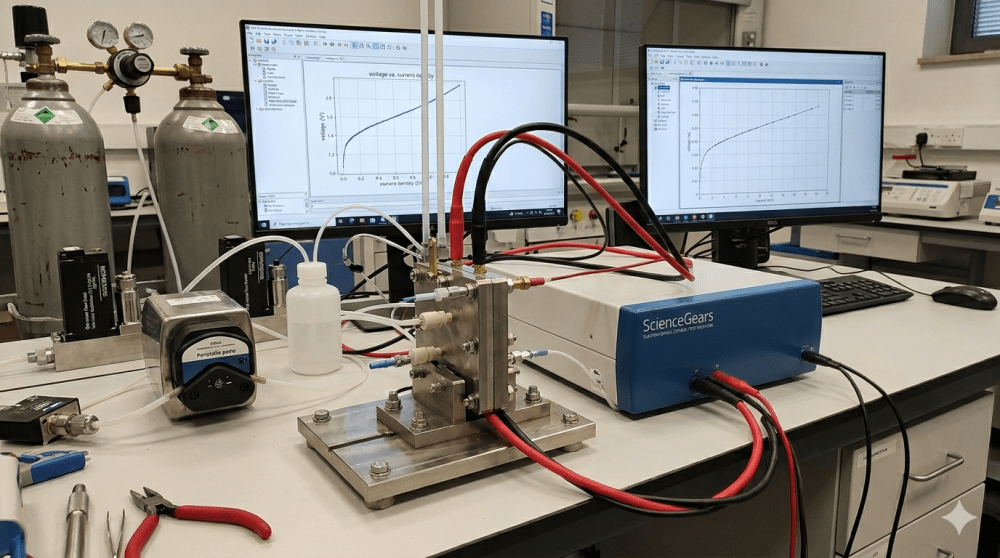
A fuel cell potentiostat — more precisely, a potentiostat/galvanostat configured for electrolyser or fuel cell testing — provides a capability that is central to hydrogen electrochemistry research: it holds the electrochemical potential of the cell or electrode at an exact, user-defined value whilst recording the resulting current with sensitivity that can extend to the microampere level, depending on the instrument range and configuration.
In the context of green hydrogen, this capability matters at every scale:
- At the catalyst screening stage, it controls the potential applied to a rotating disc electrode coated with your candidate OER or HER material, enabling direct comparison of onset potential, overpotential, and Tafel slope against benchmark catalysts.
- At the MEA characterisation stage, it applies precise conditioning voltages to activate the membrane and catalyst layers before performance testing begins. If you need higher-current or system-level operation beyond a benchtop potentiostat, see our Energy Test Stations.
- At the single-cell testing stage, it measures polarisation curves, EIS spectra, and chronoamperometric stability under real operating conditions.
- At the degradation analysis stage, it runs accelerated stress tests that compress thousands of hours of operational wear into manageable laboratory timeframes.
Each of these stages produces data that is only as reliable as the instrument and protocol generating it. A potentiostat that drifts during a conditioning hold can introduce systematic error into subsequent MEA comparisons, particularly when small performance differences are being assessed.
For researchers comparing instrument classes, explore our broader range of potentiostats and bipotentiostats.
People Also Ask: What is a fuel cell potentiostat used for?
A fuel cell potentiostat is used to control and measure the electrochemical behaviour of fuel cells and electrolysers during research and testing. It applies precise voltages for MEA conditioning, measures polarisation curves and impedance spectra, evaluates catalyst performance via techniques such as linear sweep voltammetry and chronoamperometry, and runs accelerated degradation protocols. In green hydrogen research, it is the primary instrument for characterising both the oxygen evolution reaction (OER) at the anode and the hydrogen evolution reaction (HER) at the cathode.
3 Understanding PEM Electrolysis: The Electrochemistry Behind Green Hydrogen
Before the conditioning protocols make sense, the electrochemistry they are designed to serve needs to be clear.
A PEM water electrolyser splits water into hydrogen and oxygen using electrical energy, with a proton exchange membrane — most commonly Nafion — as both the electrolyte and physical separator between the two electrode compartments.
At the anode (positive electrode) — Oxygen Evolution Reaction (OER)2H₂O → O₂ + 4H⁺ + 4e⁻At the cathode (negative electrode) — Hydrogen Evolution Reaction (HER)4H⁺ + 4e⁻ → 2H₂The thermodynamic minimum voltage for this reaction is 1.23 V. In practice, a real PEM electrolyser operates at 1.6–2.2 V per cell due to kinetic overpotentials at both electrodes, membrane resistance, and mass transport limitations. The difference between 1.23 V and the actual operating voltage represents energy that is lost as heat rather than stored as chemical fuel, which is precisely why catalyst development and MEA optimisation are so critical to the economics of green hydrogen.
The potentiostat is the instrument that measures and controls all of these voltage contributions with the precision needed to distinguish between them.

4 MEA Conditioning: Why Skipping It Costs You More Than Time
The membrane electrode assembly is the heart of a PEM electrolyser. It is also the component most frequently damaged by impatience.
A freshly assembled MEA is not ready to be tested. The Nafion membrane has not reached full hydration. The iridium oxide catalyst particles at the anode have not been electrochemically activated — many active sites are still in an oxidation state that makes them poor OER catalysts. The interfacial contact between catalyst layers and the gas diffusion layers is not yet optimised. Running a polarisation curve on an unconditioned MEA produces data that underestimates performance, misrepresents degradation, and cannot be compared meaningfully to literature benchmarks or competitor results.
The conditioning protocol is not optional preamble. It is the experiment.
5 PEM Electrolysis Conditioning: Potentiostatic Hold Voltage Protocol
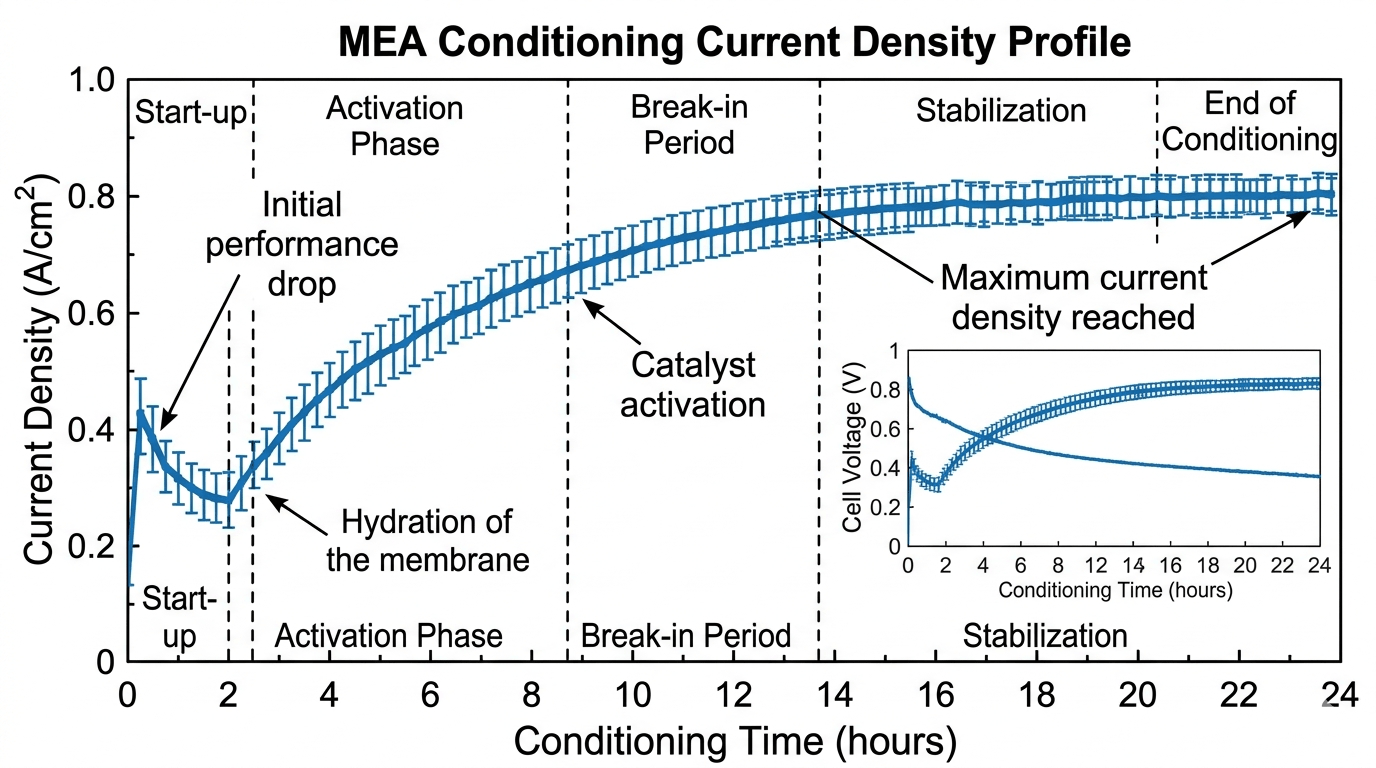
A PEM electrolysis conditioning protocol based on potentiostatic holds is a widely used MEA activation approach in PEM research. It uses the potentiostat to apply defined voltages for defined durations — progressively activating the membrane and catalyst layers in a controlled, reproducible sequence. Researchers evaluating electrolyser efficiency and operating behaviour can also refer to our guide on current density and voltage in PEM electrolysers
Stage 1 — Initial Hydration Hold (30–60 minutes)
Target voltage: typically 1.4–1.6 V Purpose: uniform membrane hydration
Apply a potentiostatic hold in this range at your target operating temperature (commonly 60–80 °C). Water is typically supplied to the anode and, depending on cell design and protocol, may also be circulated on the cathode side. At this voltage, the cell is operating near or just above the thermodynamic minimum — sufficient to drive slow electrochemical activity and water uptake into the membrane without stressing unconditioned catalyst layers.
Monitor the current density during this hold. A rising and then stabilising current response can indicate improving membrane hydration and reduced effective resistance, although the absolute current density depends strongly on MEA design and test conditions. A flat or declining current profile during Stage 1 indicates a hydration problem: check water flow rates, temperature uniformity, and membrane compression pressure before proceeding.
Stage 2 — Catalyst Activation Cycling (50–100 cycles)
Voltage range: typically open circuit to 1.8–2.2 V (step or sweep) Purpose: IrO₂ anode activation and interface optimisation
Step or sweep the cell voltage between open circuit and the target operating voltage for 50 to 100 cycles. Each cycle drives the iridium oxide through redox transitions that progressively expose more electrochemically active surface area. Simultaneously, the mechanical cycling of expansion and contraction at the catalyst-membrane interface improves adhesion and ionic contact.
Watch the current density profile across cycles. In a well-assembled MEA, you should observe a clear upward trend in peak current density over the first 20–30 cycles, plateauing by cycle 50–80 as the active surface area saturates. An MEA that shows no improvement over cycling may have a catalyst loading, dispersion, or ink formulation issue that conditioning cannot resolve — better to identify this now than after a full test programme.
Stage 3 — Steady-State Conditioning Hold (2–4 hours)
Target voltage: typically 1.8–2.0 V (or your intended operating voltage) Purpose: final stabilisation and baseline establishment
Apply the target operating voltage as a potentiostatic hold for 2 to 4 hours at operating temperature. The cell is now fully hydrated and the catalyst is active; this stage allows the gas diffusion layers to reach steady-state saturation, residual manufacturing contaminants to be electrochemically removed, and any remaining interfacial resistance to settle.
Conditioning is often considered complete once the current response has stabilised within a predefined window — for example within about ±2% over 30 minutes, depending on the protocol being used. This is your baseline — document it. Every subsequent measurement on this MEA will be compared against it, and every departure from it tells you something about what changed.
People Also Ask: What voltage should I use for PEM electrolyser conditioning?
PEM electrolyser MEA conditioning uses a three-stage potentiostatic protocol. Stage 1 applies 1.4–1.6 V for 30–60 minutes to hydrate the Nafion membrane. Stage 2 cycles between open circuit and 1.8–2.2 V for 50–100 cycles to activate the iridium oxide OER catalyst. Stage 3 holds the target operating voltage (typically 1.8–2.0 V) for 2–4 hours until current density stabilises within ±2%. Skipping or abbreviating conditioning produces MEA performance data that is systematically lower than true capability and cannot be reliably compared to literature benchmarks.
6 Post-Conditioning EIS: Reading the MEA Before You Test It
Once conditioning is complete, Electrochemical Impedance Spectroscopy (EIS) conducted at open circuit — or at a defined DC bias — provides a quantitative fingerprint of the MEA’s internal resistance architecture. This fingerprint is your baseline for all subsequent degradation tracking.
A standard post-conditioning EIS spectrum for a PEM electrolyser, measured across 100 kHz to 10 mHz, yields three diagnostic regions in the Nyquist plot:
High-Frequency Intercept (>1 kHz) The real-axis intercept at high frequency represents the ohmic resistance of the cell — membrane ionic resistance plus contact resistances at all interfaces. For a well-conditioned PEM cell, this value can fall in a relatively low range, but the absolute value depends on membrane type, thickness, compression, temperature, and cell architecture. Values above this range indicate incomplete membrane hydration, poor MEA compression, or membrane degradation.
Mid-Frequency Semicircle (1 Hz–1 kHz) The dominant semicircle in most PEM EIS spectra represents the charge-transfer resistance of the OER at the iridium oxide anode — the kinetically slowest step in the overall water splitting reaction. A smaller semicircle diameter indicates faster OER kinetics and more electrochemically active catalyst. Tracking this semicircle across ageing cycles reveals catalyst degradation before it is visible in polarisation curves.
Low-Frequency Region (<1 Hz) A second, smaller feature at low frequency often reflects transport-related limitations, including water delivery, gas removal, and other distributed mass-transport or interfacial effects, depending on the system and equivalent-circuit model. This feature grows as current density increases and becomes the dominant limitation at high operating currents.
Tracking all three features across the MEA’s lifetime provides an early warning system for membrane degradation, catalyst dissolution, and flow field flooding — well before these issues are severe enough to appear in a simple polarisation curve.
For instrument options that support EIS-based electrochemical characterisation, see our electrochemistry instrumentation range.
7 Catalyst Screening with a Potentiostat: From Powder to Performance Number
Before an MEA is ever assembled, the candidate OER and HER catalyst materials are evaluated at the rotating disc electrode (RDE) level — a faster, more material-efficient screening approach that uses milligram quantities of catalyst rather than full MEA loadings. The standard potentiostat electrochemistry workflow for catalyst screening in green hydrogen research proceeds as follows:
For RDE-compatible electrochemical workflows and potentiostat selection guidance, visit our potentiostats and bipotentiostats range.
Step 1 — Catalyst Ink Preparation and Electrode Modification
Disperse the catalyst powder in an appropriate solvent and binder or ionomer system to form a uniform ink — for example, Nafion-based binders are commonly used in acidic PEM-relevant testing, while alkaline workflows may require a different binder strategy. Deposit a defined volume (typically 5–10 µL) onto a polished glassy carbon RDE disc and allow to dry. The resulting thin film presents a reproducible, well-defined catalyst layer to the electrolyte.
Step 2 — OER Activity Measurement by Linear Sweep Voltammetry (LSV)
In N₂-saturated 0.5 M H₂SO₄ (for acidic PEM-relevant conditions) or 1.0 M KOH (for alkaline AEM-relevant conditions), sweep the potential from open circuit to beyond the OER onset at 5–10 mV s⁻¹ whilst rotating the electrode at 1600 rpm to remove O₂ bubbles. Record:
- Operational onset potential — often defined by a chosen low current-density threshold, noting that the exact criterion varies across the literature
- Overpotential at 10 mA cm⁻² (η₁₀) — the benchmark comparison metric across the literature
- Tafel slope — derived from the log(current density) vs overpotential plot; reflects the rate-determining step of the OER mechanism
Step 3 — Stability Assessment by Chronoamperometry
Hold the electrode at a fixed overpotential (e.g., η = 300 mV above equilibrium) for 2–12 hours. The percentage current retention at the end of the hold period is a first-pass stability indicator. A substantial loss of current during a short hold can indicate limited stability, but the predictive value for MEA-level performance depends on catalyst composition, support, ionomer environment, and operating conditions.
Step 4 — Accelerated Stress Testing (AST)
Cycle the potential between defined limits (e.g., 1.2–1.6 V vs RHE, 1000–10,000 cycles at 100 mV s⁻¹). Compare LSV before and after — the shift in η₁₀ and the increase in charge-transfer resistance quantify the degree of catalyst degradation under accelerated conditions.
People Also Ask: How do you test an OER catalyst with a potentiostat?
OER catalyst testing with a potentiostat follows a four-step protocol at the rotating disc electrode level. First, deposit a defined catalyst ink onto a glassy carbon RDE disc. Second, run linear sweep voltammetry in the relevant electrolyte (0.5 M H₂SO₄ for PEM conditions) to determine onset potential, overpotential at 10 mA cm⁻², and Tafel slope. Third, run chronoamperometry at fixed overpotential to assess short-term stability. Fourth, run an accelerated stress test cycling protocol to quantify degradation under simulated long-term operation. This workflow typically uses a potentiostat together with an RDE setup; EIS capability is valuable for additional mechanistic analysis but is not mandatory for every screening step.
8 ScienceGears Energy Test Stations: Built for the Full Hydrogen Research Workflow
There is a meaningful difference between a research group that owns a potentiostat and a research group that has the complete experimental infrastructure to take green hydrogen research from catalyst powder to conditioning to single-cell characterisation to stack-level insight. The potentiostat is necessary but not sufficient — the test station it sits within determines what questions you can actually answer.
ScienceGears’ Energy Test Station portfolio was assembled with exactly this workflow in mind. The range covers every major electrolyser and fuel cell technology platform currently active in Australian and New Zealand research.
For PEM, AEM, alkaline, SOEC, and related hydrogen workflows, explore our Energy Test Stations range.
Electrolyser Test Stations
- PEMWE — Proton Exchange Membrane Water Electrolyser test station, for acidic PEM research using IrO₂ anode and Pt cathode catalysts
- AEMWE — Anion Exchange Membrane Water Electrolyser, for alkaline membrane research using non-precious metal catalysts
- AlkalineWE — Traditional alkaline electrolyser testing with liquid KOH electrolyte
- PEAL — Combined PEM and alkaline electrolyser platform for comparative studies
- SOEC — Solid Oxide Electrolyser Cell test station for high-temperature steam electrolysis research
- Special Water Electrolyser Test Station — Custom configurations for non-standard cell geometries and novel membrane systems
Fuel Cell Test Stations
- PEMFC — Proton Exchange Membrane Fuel Cell test station for hydrogen fuel cell research and MEA evaluation
Beyond Electrolysis and Fuel Cells
- CO₂ Reduction Test Station — For electrochemical CO₂-to-fuel and CO₂-to-chemical conversion research
- Redox Flow Battery Test Station — For vanadium and next-generation flow battery research
- Balance of Plant and System Integration — For research groups moving from single-cell to multi-cell and pilot-scale configurations
Each test station integrates with potentiostat/galvanostat instrumentation for full electrochemical characterisation — conditioning, EIS, polarisation curves, and long-term cycling — within a single, coordinated experimental environment. For CO₂ electrolysis and electrocatalysis applications, researchers can also explore the Single Cell CO Conversion & Reduction Test Station (300 W)
When a ScienceGears researcher walks through your test station requirements with you, they are not working from a product catalogue. They are asking about your specific MEA configuration, your electrolyte system, your target current density range, and your long-term research goals — and building a recommendation from that conversation outward.
9 Common Mistakes in PEM Electrolyser Testing — and What They Cost You
Even well-equipped laboratories make systematic errors in electrolyser characterisation. These are the most consequential ones:
Mistake 1 Testing an Unconditioned MEA and Calling It a Baseline
The result can be a materially understated performance baseline, sometimes by a significant margin depending on the MEA and protocol. Every comparison made from that baseline — to literature, to competitor catalysts, to aged samples — is distorted by the same systematic error. Conditioning is not optional; it is the calibration step that makes all other data meaningful.
Mistake 2: Skipping Post-Conditioning EIS
Without an EIS baseline taken immediately after conditioning, you have no quantitative reference for interpreting changes in impedance over ageing. When the ohmic resistance increases by 20% after 100 hours of operation, you cannot determine whether it is membrane degradation or contact resistance without the baseline to compare against.
Mistake 3: Running LSV Too Fast at the RDE
Scan rates above 10 mV s⁻¹ in OER LSV include a capacitive charging current contribution that inflates the apparent activity of the catalyst — particularly at low current densities near the onset potential. Literature-standard scan rates are 1–5 mV s⁻¹ for steady-state OER measurements. Faster scans produce more impressive-looking onset potentials that do not reflect genuine catalytic activity.
Mistake 4: Ignoring the Compliance Voltage Requirement
A potentiostat used for single-cell PEM electrolyser testing should have sufficient compliance voltage to cover the expected cell voltage, overpotentials, and measurement headroom; in many practical cases, a specification around 5 V or higher is prudent, depending on the operating envelope. A potentiostat with a 3 V compliance voltage will clip the output at the compliance limit during high-current operation, producing a flat current response that looks like mass transport limitation but is actually an instrument limitation. Check compliance voltage specifications before purchasing or specifying a potentiostat for electrolyser work.
People Also Ask: What compliance voltage does a potentiostat need for PEM electrolyser testing?
For single-cell PEM electrolyser testing, a potentiostat commonly needs compliance voltage above the nominal cell operating voltage, with around 5 V or more often used as a practical starting point depending on the test conditions — sufficient to cover the thermodynamic minimum (1.23 V) plus anode and cathode overpotentials, membrane resistance, and measurement headroom. For short PEM stacks (2–5 cells), compliance voltage requirements scale proportionally and typically require a dedicated high-voltage potentiostat or current booster configuration. If you are unsure whether your application needs a standalone potentiostat, booster, or integrated test station, contact the ScienceGears team to discuss your requirements.
10 Pre-Test Checklist: PEM Electrolyser Electrochemical Characterisation
Before running any electrochemical protocol on a PEM electrolyser cell, verify the following:
- MEA assembled with correct torque on compression bolts (per cell manufacturer specification)
- Water feed lines purged and flow rates verified at both anode and cathode
- Cell temperature at the target operating value is stable (±1 °C) for a minimum of 30 minutes
- Potentiostat compliance voltage verified for the target operating voltage range
- OCV measured and within the expected range for cell temperature and membrane
- Stage 1 hydration hold complete — current density trending upward confirmed
- Stage 2 activation cycling complete — peak current density plateau confirmed
- Stage 3 steady-state hold complete — ±2% current stability over 30 minutes confirmed
- Post-conditioning EIS baseline recorded and saved with full metadata
- Gas outlet lines checked for bubble-free liquid (anode) and steady H₂ flow (cathode)
You can also browse our broader electrochemistry platform range at sciencegears.com.au/electrochemistry.
11 Working With ScienceGears on Your Hydrogen Research Programme
Green hydrogen research moves fast. The gap between a promising RDE result and a functioning MEA is not just technical — it is also an instrumentation gap, a protocol gap, and often a data interpretation gap. Having access to researchers who have navigated that gap before, across different catalyst systems and cell configurations, changes the speed at which your programme progresses.
Dr. Siva Arumugam, co-founder of ScienceGears, has spent over two decades working at the intersection of electrochemistry, electrocatalysis, and analytical instrumentation across research institutions in Germany, Poland, and Australia. That background directly informs the test station and potentiostat configurations ScienceGears recommends for hydrogen research, not as specifications from a brochure, but as choices that have been tested and validated in real experimental contexts.
When you ask ScienceGears about a PEMWE test station, the response will include questions about your MEA fabrication approach, your catalyst loading targets, your planned current density range, and your degradation testing timeline. That conversation shapes the instrument recommendation — not the other way around.
ScienceGears provides: - Test station and potentiostat selection matched to your specific electrolyser technology (PEM, AEM, alkaline, SOEC) - MEA conditioning protocol guidance tailored to your catalyst system and membrane - EIS setup and interpretation support for baseline characterisation and degradation tracking - Application notes covering electrolyser testing protocols available at sciencegears.com.au/application-notes - On-site and remote commissioning of new test stations and potentiostat systems
12 Frequently Asked Questions
These are the questions we receive most often from Australian and New Zealand researchers working on PEM electrolyser characterisation, catalyst screening, and hydrogen research instrumentation.
Q1 Can a battery cycler replace a potentiostat for PEM electrolyser testing?
A potentiostat is generally the more appropriate instrument when PEM electrolyser work requires precise control of cell or electrode potential, along with methods such as MEA conditioning, electrochemical impedance spectroscopy (EIS), polarisation measurements, chronoamperometry, and catalyst screening. In contrast, a battery cycler is usually better suited to repetitive current-voltage cycling or long-duration operational testing rather than detailed electrochemical analysis.For hydrogen research, the key question is not simply whether current can be applied, but whether the instrument can help you separate ohmic losses, charge-transfer behaviour, and transport limitations with sufficient control and resolution. That is where a potentiostat remains central. A battery cycler may be useful in a broader programme, but for PEM electrolyser development, it is usually a complementary tool rather than a direct substitute.
Explore our potentiostats and bipotentiostats to compare instrument configurations suited to hydrogen electrochemistry research.
Q2 When do I need a current booster or full energy test station instead of a standard potentiostat?
A standard potentiostat is often suitable for early-stage catalyst screening, lower-current MEA studies, and single-cell electrochemical measurements within its electrical limits. However, once your work moves into higher current densities, larger active areas, short stacks, or more realistic operating environments, the instrument requirements can increase significantly.A current booster is typically used when you still want to perform potentiostat-based measurements, but the required current exceeds the base instrument’s output range. A full energy test station is more appropriate when the experiment also requires temperature control, water or gas handling, flow management, safety interlocks, balance-of-plant integration, or long-duration coordinated testing. In other words, the potentiostat may remain essential, but the surrounding test platform determines how far your hydrogen research can go.
For PEM, AEM, alkaline, SOEC, and related hydrogen workflows, explore our Energy Test Stations.
Q3 Should PEM electrolyser conditioning be performed under potentiostatic or galvanostatic control?
In many PEM electrolyser workflows, potentiostatic conditioning is used because it allows the cell to be held at defined voltages while the researcher monitors how the current changes as the membrane hydrates and the catalyst layer becomes activated. This makes it particularly useful during early-stage MEA conditioning, where the evolving current response itself provides valuable diagnostic information.That said, galvanostatic conditioning can also be used in some laboratories, particularly when the operating approach is based around current-density targets rather than voltage-controlled stages. The most appropriate method depends on the MEA design, catalyst system, cell architecture, manufacturer guidance, and the objective of the test. For many researchers, potentiostatic control is preferred when a stepwise, reproducible activation sequence is required.
To explore PEM and hydrogen test station options compatible with both control modes, see our PEM/hydrogen test station range.
Q4 What is the difference between post-conditioning EIS at open circuit and EIS under DC bias?
Post-conditioning EIS at open circuit is commonly used after MEA activation to obtain a baseline electrochemical fingerprint without imposing additional operating load. This can be valuable for documenting the initial resistance architecture of the cell before longer-term testing begins. In many hydrogen workflows, it serves as a reference point for later degradation analysis.By contrast, EIS under DC bias is measured while the cell is held under a defined operating condition. This often provides more relevant information about the MEA during actual electrolysis, especially when charge-transfer and transport limitations become more pronounced under load. In practical terms, open-circuit EIS is useful for baseline comparison, while biased EIS is often more informative for understanding performance under realistic working conditions.
For instrument options that support EIS measurement in hydrogen electrochemistry workflows, explore our electrochemistry instrumentation range.
Q5 How do I choose compliance voltage and current range for a hydrogen electrochemistry setup?
Compliance voltage and current range should be selected based on the real operating envelope of your experiment. For PEM electrolyser work, that means considering the expected cell voltage, overpotentials, resistive losses, active area, target current density, and measurement headroom.If the instrument does not have sufficient compliance voltage, the output can clip at the limit, creating behaviour that may be mistaken for a cell limitation when it is actually an instrument limitation.As a practical approach, start by estimating your target current density, multiply it by the active area, and then add reasonable margin for conditioning, transients, and future scale-up. For single-cell PEM electrolyser work, a compliance voltage around 5 V or higher may be a sensible starting point in many cases, depending on the full test conditions. Higher-demand or multi-cell systems may require a high-voltage potentiostat, booster, or integrated test station.
If you are unsure about the right specification for your hydrogen research setup, contact the ScienceGears team to discuss your requirements.
Q6 Can the same potentiostat be used for OER catalyst screening, MEA conditioning, and full-cell testing?
A single potentiostat can sometimes support OER catalyst screening, MEA conditioning, and full-cell testing, but only when its current capability, compliance voltage, control modes, sensitivity, and accessory compatibility match the needs of each application. Catalyst screening at the rotating disc electrode level typically requires good low-current sensitivity and compatibility with an RDE setup, whereas MEA conditioning and full-cell testing may demand higher current, more voltage headroom, and broader system integration.For this reason, one instrument may be sufficient for early-stage and moderate-scale research, but it may become limiting as the work moves toward larger-area cells or more realistic hydrogen-testing conditions. The most reliable way to choose is to start with your cell architecture, target current density range, and research goals, then match the instrument platform to that workload rather than assuming one model will suit every stage automatically.
Explore our full range of potentiostats and energy test stations to identify the right configuration for your hydrogen research programme.
13 Summary: Potentiostat Protocols for Green Hydrogen Research
Green hydrogen research is electrochemical research, and the fuel cell potentiostat is the instrument that makes it quantitative. From the first PEM electrolysis conditioning potentiostatic hold voltage protocol on a freshly assembled MEA, through catalyst benchmarking at the RDE, post-conditioning EIS baseline establishment, and long-term degradation tracking via accelerated stress tests, the potentiostat is present at every step where precision matters.
The protocols in this guide reflect how this work is actually done in serious hydrogen research laboratories, not how it looks in simplified instrument application notes. The difference between a conditioning protocol that produces a reliable MEA baseline and one that produces misleading data is not the instrument. It is the understanding of what the instrument is doing and why each step of the protocol exists.
If your research programme is moving into PEM electrolyser characterisation or if you are scaling up from catalyst screening to MEA-level testing, the ScienceGears team is ready to work through the instrumentation and protocol questions with you.
Explore ScienceGears’ full electrolyser test station and potentiostat range at sciencegears.com.au/energy-test-stations, or reach out directly to discuss your hydrogen research requirements