


1 Introduction: A Single Instrument, Across Every Frontier of Australian Science
There is a piece of equipment found in many electrochemistry laboratories across Australia and New Zealand. It is not flashy. It does not have a large footprint. It rarely appears in funding announcements or technology commercialisation press releases. Without it, many electrochemical experiments become difficult or impossible, because researchers lose precise control over electrode potential and the ability to measure the resulting current response.
That instrument is the potentiostat.
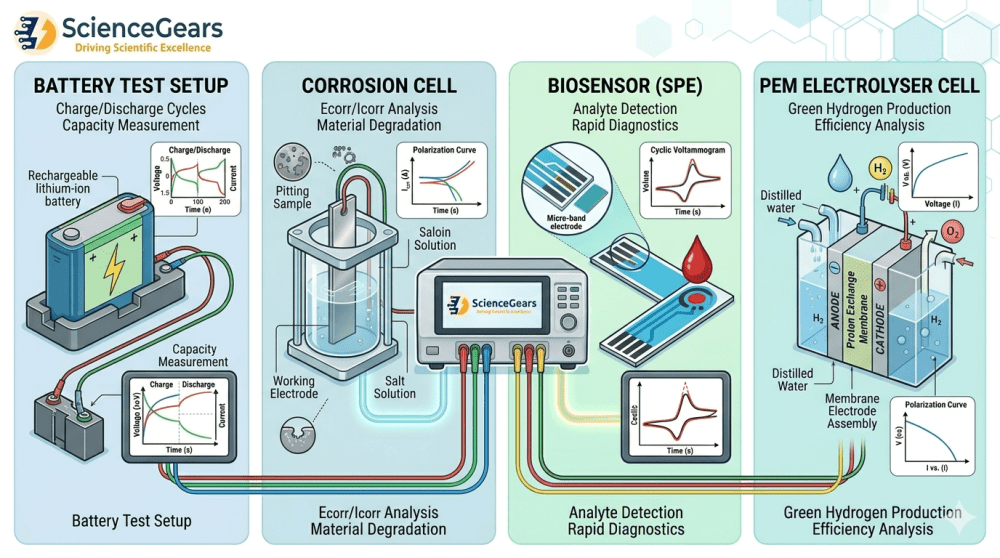
From battery research and corrosion science to biosensors, environmental monitoring, pharmaceutical analysis, and green hydrogen, potentiostat electrochemistry supports a wide range of modern research across Australia and New Zealand — all covered in depth in our potentiostat applications complete guide.
If you are new to setting up electrochemical experiments, our potentiostat setup guide covering the 3-electrode cell configuration is the practical starting point before working through sector-specific applications.
2 What Does a Potentiostat Do? The Core Answer
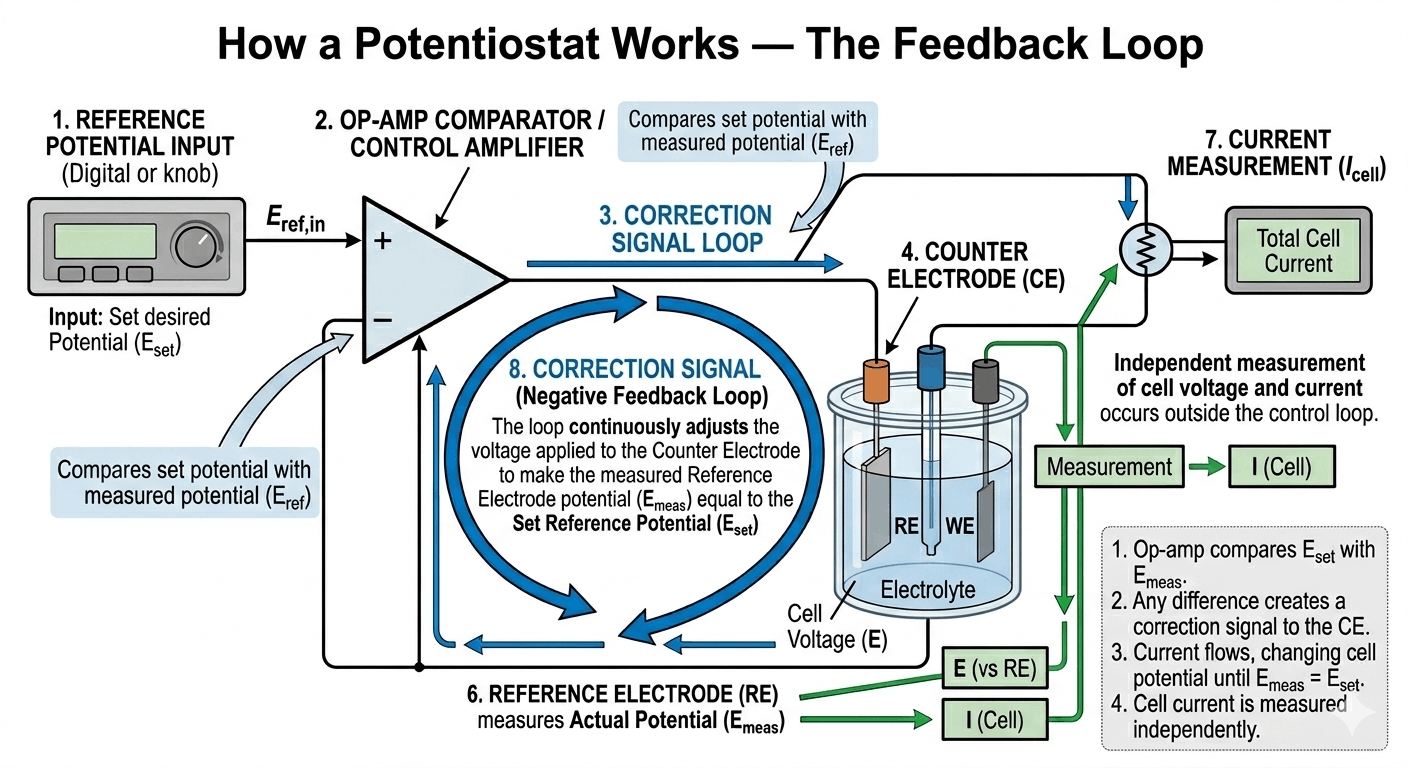
What does a potentiostat do? At its most fundamental level, a potentiostat controls the electrical potential (voltage) applied to an electrochemical working electrode, holding it at a user-defined value relative to a reference electrode, while simultaneously measuring the electrical current that flows as a result of electrochemical reactions at that surface.
The scientific depth lies in what you can learn from controlling that potential and measuring that current with precision:
- Apply a fixed potential and measure current over time → chronoamperometry, quantifying how fast a reaction proceeds at a defined driving force
- Sweep the potential linearly → cyclic voltammetry (CV), mapping accessible redox processes within the selected potential window
- Step the potential in small increments → differential pulse voltammetry (DPV) or square wave voltammetry (SWV), enabling high-sensitivity detection of electroactive analytes
- Apply a sinusoidal perturbation across frequencies → Electrochemical Impedance Spectroscopy (EIS), resolving resistive, capacitive, and diffusive impedance components
- Apply constant current and measure potential → galvanostatic mode: chronopotentiometry or GITT, estimating apparent diffusion behaviour in battery materials under suitable experimental models
People Also Ask: What Does a Potentiostat Do in Simple Terms?
A potentiostat controls the voltage applied to an electrode surface and measures the electrical current that flows as a result. By precisely controlling this voltage, researchers can drive specific chemical reactions at the electrode and measure how fast and how extensively those reactions occur — enabling study of battery materials, molecule detection, corrosion evaluation, electrocatalyst characterisation, and biosensor development, all from the same instrument platform.
3 Potentiostat Meaning: Why the Name Matters
The name tells you exactly what the instrument does. Potentia is Latin for power or potential; statos is Greek for standing still. Held constant. The potentiostat is, literally, that which keeps the potential still — and that simple constraint is what makes precise electrochemical measurement possible.
Here is the problem it solves. In any electrochemical system, current flow inevitably disturbs the potential of the electrodes — a phenomenon called polarisation. Left uncorrected, this disturbance corrupts the measurement. The potentiostat actively controls this effect by maintaining the working-electrode potential as close as possible to the programmed value. A feedback-control circuit monitors the potential between the working and reference electrodes and adjusts the counter-electrode current to minimise deviations from the set potential, with response time depending on the instrument design, cell configuration, and experimental conditions. The result is a stable, reproducible electrochemical environment that the researcher controls completely.
People Also Ask: What Is Potentiostat? Meaning and How Does It Work?
A potentiostat holds the working-electrode potential at a defined value relative to a reference electrode using closed-loop feedback control. This helps reactions occur under defined and reproducible conditions — the foundation of quantitative electrochemical measurement.
4 Potentiostat Applications Across AU/NZ Research Sectors
1. Energy Storage: Battery and Supercapacitor Research
Australia and New Zealand have active battery research communities across universities, government laboratories, and applied research organisations. Research groups at UNSW, Monash University, the University of Queensland, the University of Wollongong, and CSIRO are advancing lithium-ion, sodium-ion, lithium-sulfur, solid-state, and vanadium redox flow battery technologies with potentiostat electrochemistry serving as one of the key diagnostic toolsets.
- Cyclic voltammetry to fingerprint redox chemistry of new electrode materials
- GITT and PITT to estimate solid-state ion diffusion behaviour — the complete workflow is covered in our guide on connecting a potentiostat to a battery: GITT, PITT and cell testing protocols
- EIS to resolve internal resistance, SEI layer growth, charge-transfer kinetics, and diffusion limitations
- Galvanostatic cycling to evaluate capacity retention and coulombic efficiency during long-term ageing
ScienceGears supplies the full battery characterisation ecosystem — single-channel and multichannel potentiostat/galvanostat systems, NEWARE battery cyclers including the EIS Battery Cycler Series, battery test cells, battery environmental test chambers, and battery materials from cathode powders to electrolyte salts to separators and conductive carbons.
2. Green Hydrogen: Electrolyser and Fuel Cell Research
Australia’s hydrogen strategy and research investment have increased demand for reliable electrochemical testing in green hydrogen research. Potentiostat electrochemistry supports many parts of this development pathway:
- Linear sweep voltammetry at the rotating disc electrode evaluates OER and HER catalyst behaviour using small quantities of catalyst material
- Potentiostatic conditioning protocols can be used to condition freshly assembled PEM MEAs — the complete protocol is in our guide on potentiostat for green hydrogen: PEM electrolysis conditioning and testing protocols
- EIS at defined DC bias can help separate ohmic, charge-transfer, and mass-transport contributions; electrode-specific interpretation depends on the cell design and measurement configuration
- Accelerated stress tests are designed to speed up comparative degradation screening under controlled laboratory conditions
ScienceGears’ Energy Test Station portfolio covering PEMWE, AEMWE, AlkalineWE, PEAL, SOEC, and PEMFC configurations provides the complete test environment for green hydrogen research.
3. Corrosion Science and Infrastructure Protection
Corrosion is widely recognised as a major cost to the Australian economy, making corrosion science one of the most consequential applied electrochemistry fields in the country. The potentiostat’s role is irreplaceable:
- Tafel polarisation analysis estimates corrosion potential and corrosion current density, which can then be converted into corrosion rate, typically reported in units such as mm/year under appropriate assumptions
- Linear Polarisation Resistance (LPR) provides rapid, non-destructive corrosion rate measurement without removing the sample from service
- Potentiodynamic scanning reveals passivation behaviour and identifies breakdown potential
- EIS probes the protective properties of coatings and inhibitor films as a function of immersion time
ScienceGears provides corrosion test electrochemical cells, including Luggin capillary configurations for accurate reference-electrode positioning, suitable for experiments designed around ASTM G5 and ASTM G61 methods when configured appropriately alongside compatible potentiostat systems.

4. Environmental Monitoring and Water Quality
Water quality and environmental monitoring often require sensitive measurements that can be performed outside a central laboratory. Portable potentiostat-based methods can support on-site trace analysis when paired with suitable electrodes, validated methods, and appropriate sample handling.
- Anodic stripping voltammetry (ASV) can detect metals such as lead, cadmium, arsenic, mercury, and copper at μg/L concentrations, using an electrochemical deposition step and suitable working-electrode materials such as bismuth film or modified carbon-based electrodes
- Differential pulse voltammetry (DPV) resolves co-occurring contaminants at overlapping potentials, critical for complex water matrices such as mine drainage or agricultural run-off
- Portable, battery-powered potentiostats enable real-time on-site measurement in remote catchments across Australia — no laboratory return required
- 3D porous graphene sensing strip electrodes and thick film screen-printed electrodes provide single-use, polishing-free platforms for consistent field measurements
ScienceGears supplies lightweight Bluetooth-enabled portable potentiostats alongside the full sensing electrode range — graphene strip, screen-printed, and bismuth-film formats — configured for water quality monitoring in Australian field conditions.
5. Pharmaceutical Analysis and Drug Development
Pharmaceutical electrochemistry is a valuable analytical approach for studying electroactive drug molecules, impurities, and redox-active intermediates. AU/NZ pharmaceutical R&D teams use potentiostat electrochemistry across the full drug development lifecycle:
- Redox characterisation of active pharmaceutical ingredients (APIs) using cyclic voltammetry and DPV to map oxidation and reduction pathways before formulation
- Electrochemical oxidation can help generate or screen possible oxidative metabolites relevant to in vivo metabolic pathways, complementing enzyme-based or chromatographic studies
- Drug stability and impurity profiling via square wave voltammetry (SWV) and DPV — useful for electroactive compounds, with detection performance depending on the molecule, matrix, electrode, and validated method
- In situ Raman and UV-Vis spectroelectrochemistry can couple optical and electrochemical data simultaneously when used with compatible cells and optical configurations, supporting the study of charge-transfer intermediates and transient species
ScienceGears supplies thin-film microfabricated electrodes, thick-film screen-printed electrodes, spectroelectrochemistry cells, and in-situ operando electrochemical cells for the full pharmaceutical analysis workflow. The complete technique guide is available in our dedicated potentiostat for biosensors and the electrochemical sensing lab guide.
People Also Ask: Can a Potentiostat Be Used in Pharmaceutical Research?
Yes. Potentiostats are used extensively for characterising redox chemistry of drug molecules, simulating metabolic oxidation pathways, monitoring drug stability under oxidative conditions, and detecting electroactive impurities in active pharmaceutical ingredients. Differential pulse voltammetry and square wave voltammetry can provide sensitive detection for many electroactive compounds, but performance should be validated against the target analyte, sample matrix, electrode material, and reference analytical method.

5 Choosing the Right Potentiostat for Your Application in AU/NZ
One of the most common and costly mistakes in laboratory procurement is specifying a potentiostat based on price category alone, rather than matching the instrument’s specifications to the actual demands of the planned experiments. For a detailed purchasing framework, see our complete guide to buying a potentiostat in Australia. Here is the framework the ScienceGears team uses:
| Research Sector | Key Techniques | Critical Specifications | ScienceGears Guide |
|---|---|---|---|
| Battery & supercapacitor | CV, GITT, PITT, EIS, galvanostatic cycling | Potential range suitable for the target cell voltage; μA-level current resolution where required; EIS capability depending on model; current booster option for higher-current studies | Battery testing guide |
| Green hydrogen | LSV, EIS, potentiostatic conditioning, accelerated stress tests | ≥5 V compliance; high current; EIS to sub-mHz; RDE/RRDE control | PEM electrolysis guide |
| Corrosion science | Tafel, LPR, potentiodynamic, EIS | Typically ±3 V or wider potential range; nA–μA current measurement depending on application; EIS capability depending on model; ASTM G5/G61-compatible corrosion cell configuration | Contact ScienceGears to configure compliant corrosion test cell setup |
| Environmental monitoring | ASV, DPV, SWV | Low-current measurement capability; suitable pulse-voltammetry performance; portable format preferred for field use | Portable potentiostat + graphene sensing strip electrode range |
| Pharmaceutical/biosensing | DPV, SWV, CV, spectroelectrochemistry | Low-current measurement capability; suitable DPV/SWV performance; bipotentiostat option where dual-electrode sensing is required | Biosensors & sensing guide |
People Also Ask: What Potentiostat Do I Need for Corrosion Testing in Australia?
For corrosion experiments designed around ASTM G5 and ASTM G61 methods, researchers commonly look for a suitable potential range, low-current measurement capability for passive-film studies, EIS capability appropriate to the expected time constants, and a dedicated corrosion test cell with accurate reference-electrode positioning, such as a Luggin capillary configuration. ScienceGears supplies both the potentiostat systems and the corrosion test cell range, and can advise on the full configuration for your specific material and environment.
6 The ScienceGears Approach: One Conversation, The Right Instrument
A potentiostat recommendation that ignores the research question it needs to answer is just a product sale. ScienceGears starts from the science: the electrode material, electrolyte, technique, current range, EIS frequency requirements, cell format, and throughput requirement, then builds the instrument recommendation outward from there.
Dr Siva Arumugam’s work across spectroelectrochemistry, SERS, biosensors, and nanomaterials, together with Dr Kalai Govindasamy’s expertise in Raman spectroscopy and electroanalytical chemistry, allows ScienceGears to engage with the technical details of research applications beyond generic product selection.
This practical research background informs ScienceGears’ instrument recommendations, protocol guidance, training, and application-note development.
- Application-matched potentiostat consultation — browse the full potentiostats and galvanostats range
- Sector-specific accessory packages — electrodes, cells, and ancillary equipment for your application
- Technical resources — application notes and guides at sciencegears.com.au/application-notes
- Publications — peer-reviewed research at sciencegears.com.au/publications
- On-site and remote training — hands-on instrument setup and technique training across Australia and New Zealand
7 Summary
What does a potentiostat do? It does something different in every laboratory it sits in but the same thing in all of them: it keeps the potential still, and measures what flows.
- Battery research: Studies ion diffusion behaviour via GITT, PITT, CV, and EIS — with the full workflow explained in our GITT and battery testing guide.
- Corrosion science: Quantifies coating breakdown and passivation behaviour using a corrosion test cell with Tafel, LPR, potentiodynamic scanning, and EIS.
- Pharmaceutical chemistry: Maps drug oxidative metabolism via thin-film microfabricated electrodes and spectroelectrochemistry.
- Environmental monitoring: Supports field-based trace-metal analysis using portable potentiostats and suitable sensing electrodes.
- Biosensor development: Converts molecular recognition events at modified electrodes into measurable signals — explored in full in our potentiostat for biosensors guide.
Explore ScienceGears’ full potentiostat and electrochemical instrument portfolio at sciencegears.com.au/electrochemistry, or contact the team to discuss your research application.
Ready to Match a Potentiostat to Your AU/NZ Research Application?
ScienceGears stocks potentiostat/galvanostat systems, bipotentiostats, portable potentiostats, and a complete accessories range — with full Australian warranty and PhD-level technical support across battery, hydrogen, corrosion, environmental, and pharmaceutical applications.
Related Articles in This Series
- ← Potentiostat Applications in Modern Electrochemical Research: A Complete Guide
- → Connecting a Potentiostat to a Battery: GITT, PITT and Cell Testing Protocols
- → Potentiostat for Green Hydrogen: PEM Electrolysis Conditioning and Testing Protocols
- → Potentiostat Setup: 3-Electrode Cell, Electrode Connections and Experiment Preparation
- → Potentiostat for Biosensors and Electrochemical Sensing: A Lab Guide