

Introduction
The distinction between in-situ and operando electrochemical characterisation represents one of the most critical methodological choices in modern materials science and battery research. Whilst the terms are often used interchangeably in scientific literature, they describe fundamentally different approaches to studying electrochemical systems. Understanding this distinction is essential for researchers, laboratory scientists, and students around the world who are developing advanced batteries, electrocatalysts, and energy storage materials.
In-situ characterisation involves measuring samples in their native working environment—typically with an electrolyte present and under controlled potential conditions. Operando characterisation, by contrast, goes further: it monitors structural or electronic properties of materials during their active operation whilst simultaneously measuring functional properties such as electrochemical current and potential. This simultaneous dual measurement is the defining feature that separates operando from in-situ methodologies.
This distinction has profound implications for research outcomes. Operando studies capture transient intermediates and non-equilibrium phases that would relax or decompose during sample preparation in ex-situ techniques. For researchers investigating CO₂ reduction, hydrogen evolution reactions (HER), oxygen evolution reactions (OER), and battery cycling mechanisms, operando approaches provide unprecedented mechanistic insight.
Section 1: Fundamental Principles and Terminology
1.1 Defining In-Situ Characterisation
In-situ characterisation refers to measurements performed on materials placed in their natural working environment, specifically immersed in electrolyte at a controlled electrochemical potential or current. The key requirement is that the measurement occurs under conditions that represent or closely approximate realistic operation, rather than at ambient pressure and room temperature.
Core characteristics of in-situ studies:
- Samples remain in electrolyte throughout measurement
- Electrochemical potential is controlled via potentiostat or galvanostat
- Spectroscopic or structural data is acquired in real time
- Cell design is optimised for compatibility with analytical instruments
In-situ approaches have become foundational in studying structure-activity relationships in catalysis and battery materials. Techniques such as in-situ X-ray absorption spectroscopy (XAS), in-situ Raman spectroscopy, and in-situ X-ray diffraction (XRD) all fall into this category.
1.2 Defining Operando Characterisation
Operando characterisation represents an evolution of in-situ methodology. It integrates spectroscopic or structural measurements (as in in-situ studies) with simultaneous monitoring of the functional property of the system—typically electrochemical current, potential, or gas evolution. The critical distinction is that operando experiments correlate structural/chemical changes directly with electrochemical performance during active operation.
Defining features of operando studies:
- Simultaneous electrochemical and spectroscopic measurement
- Real-time correlation of structure with electrochemical function
- Captures non-equilibrium transient species and intermediates
- Direct linkage between catalyst/electrode structure and activity
The term "operando" derives from Latin, reflecting the concept of measuring "whilst operating." A researcher performing operando XAS on a CO₂ reduction catalyst would simultaneously record X-ray absorption spectra and electrochemical current, allowing direct comparison of catalyst oxidation state with faradaic efficiency or selectivity to specific products.
.png)
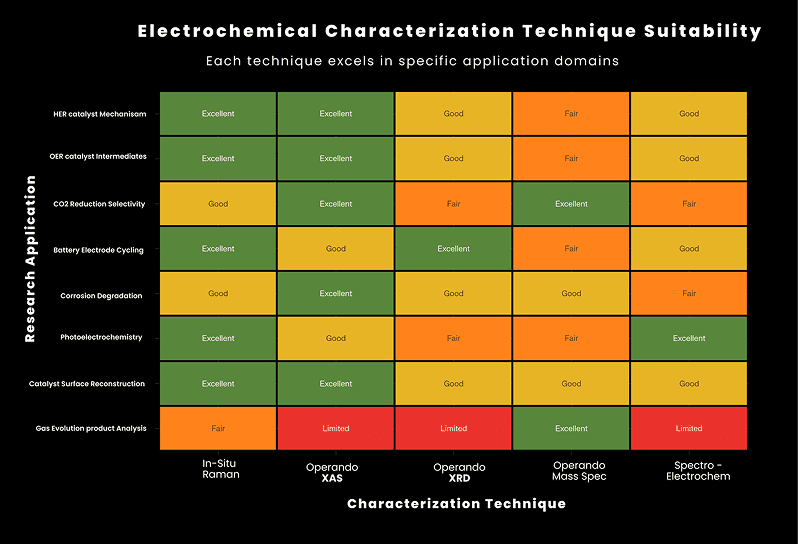
1.3 Key Advantages Over Ex-Situ Characterisation
Both in-situ and operando methods fundamentally differ from traditional ex-situ characterisation (post-mortem analysis after stopping the reaction). The advantages are substantial:
Elimination of artefactual decomposition: Ex-situ samples risk decomposition, surface oxidation, or structural relaxation during disassembly and air exposure. In-situ/operando measurements avoid this entirely.
Direct mechanistic insight: Rather than inferring reaction mechanisms from post-reaction products, operando methods reveal intermediate species, active site transformations, and transient structural states that would be inaccessible ex-situ.
No multiple-sample requirement: Operando studies track a single sample through its entire operation, whereas ex-situ approaches require multiple identical samples harvested at different reaction stages.
Real-time kinetic information: Time-resolved operando data reveals reaction kinetics, catalyst activation/deactivation, and degradation mechanisms with unprecedented temporal resolution.
Section 2: Spectroscopic Techniques and Analytical Methods
2.1 Operando Raman Spectroelectrochemistry
Raman spectroscopy is one of the most widely adopted techniques for operando electrochemical studies. Raman spectra report vibrational fingerprints of molecular species, surface-bound intermediates, and electrode materials, allowing real-time observation of chemical transformations during electrochemical reactions.
Researchers selecting suitable Raman instrumentation for operando electrochemical studies can also refer to our guide on choosing a micro Raman spectrometer For continuous electrolyte and reaction-species monitoring in flowing electrochemical systems, online Raman analysers for liquids can further enhance operando workflows
Operando Raman advantages:
- Direct identification of surface-adsorbed reaction intermediates
- High temporal resolution (seconds to sub-second timescales)
- Excellent spatial resolution (~1 μm with confocal microscopy)
- Compatible with aqueous and non-aqueous electrolytes
- Non-destructive and reversible
Key applications:
- Tracking CO₂ reduction intermediates (CO ads, COOH, formate species)
- Monitoring hydrogen and oxygen evolution reaction pathways
- Studying electrode surface reconstruction under operating conditions
- Real-time observation of graphite exfoliation or lithium plating in battery materials
ScienceGears offers a comprehensive In-Situ Raman Spectroelectrochemical Cell (REC) series (Models REC-01 through REC-09) engineered for seamless integration with upright or inverted Raman microscopes. These cells feature optical-grade quartz windows with minimal Raman background, three-electrode configurations for independent potential control, and modular designs enabling rapid electrode replacement.
2.2 Operando X-Ray Absorption Spectroscopy (XAS)
X-ray Absorption Spectroscopy—encompassing X-ray Absorption Near Edge Structure (XANES) and Extended X-ray Absorption Fine Structure (EXAFS)—provides element-specific information on local electronic structure and coordination geometry. XANES reveals oxidation state and electronic configuration, whilst EXAFS determines bond distances, coordination numbers, and atomic-scale disorder.
Operando XAS strengths:
- Element-selective probing in multi-component catalysts
- Direct oxidation state tracking during reaction
- Identification of active sites through coordination environment analysis
- Bulk sensitivity suitable for real catalysts (not just model systems)
- High time resolution at synchrotron beamlines
Implementation challenges:
- Requires synchrotron radiation (laboratory XAS systems have limited capabilities)
- Cell design must minimise X-ray absorption by electrolyte and cell materials
- Specialised cell geometries needed for fluorescence or transmission modes
ScienceGears manufactures In-Situ XAS Reaction Cells in three configurations:
- XAFC-1 (Single-Cell): Compact PEEK reactor with Kapton® windows for efficient X-ray transmission
- XAFC-2 (H-Cell, Dual-Compartment): Separated anode/cathode chambers with ion-exchange membrane, ideal for studying half-reactions in water splitting or CO₂ reduction
- XAFC-3 (Gas-Phase): Specialised for operando XAS under flowing reactive gases
Each design incorporates gas inlet/outlet ports and temperature control options, making them compatible with both laboratory and synchrotron XAS beamlines around the world.
2.3 Operando X-Ray Diffraction (XRD)
Operando XRD measures changes in crystal structure, lattice parameters, and phase composition during electrochemical cycling. This technique is particularly valuable for battery research, where lithium intercalation causes lattice expansion/contraction and phase transitions.
Operando XRD capabilities:
- Direct observation of structural changes during charge/discharge
- Quantitative phase analysis via Rietveld refinement
- Detection of metastable phases inaccessible ex-situ
- Mapping of lattice strain and stress under cycling
- High-throughput screening of multiple samples simultaneously
Applications in battery research:
- Tracking lithium-ion insertion/extraction kinetics in cathode materials
- Monitoring solid electrolyte interphase (SEI) formation on anodes
- Studying phase stability and structural degradation mechanisms
- Validating new electrode formulations (LFP, NCA, NMC, silicon-based, solid-state)
ScienceGears provides In-Situ Battery XRD Test Cells optimised for three widely-used laboratory diffractometers:
- For Japan Rigaku XRD mini: Compact design fitting Rigaku's sample stage geometry
- For Bruker D2: Bragg-Brentano geometry with beryllium or Kapton windows
- For Japan Rigaku XRD full: High-resolution variant supporting synchrotron upgrades
Each cell features stainless steel construction (chemically resistant to lithium battery electrolytes), PTFE sealing, and accommodates electrode sizes up to φ16 mm with stack thicknesses of ~5–6 mm.
2.4 Operando Mass Spectrometry (DEMS and MIMS)
Differential Electrochemical Mass Spectrometry (DEMS) and Membrane-Inlet Mass Spectrometry (MIMS) directly detect volatile products and gaseous intermediates generated during electrochemical reactions. This is invaluable for quantifying faradaic efficiency, tracking reaction selectivity, and identifying transient species in CO₂ reduction, oxygen evolution, and battery gas evolution studies.
Key advantages:
- Real-time product quantification (ppm to ppb sensitivity)
- Identification of previously undetected intermediates
- Correlation of gas evolution rates with electrochemical activity
- Feasibility of studying entire reaction networks simultaneously
Typical applications:
- CO₂ reduction: Direct measurement of CO, CH₄, H₂, and formate yields
- Oxygen evolution: Bubble nucleation dynamics and oxygen efficiency
- Hydrogen evolution: H₂ purity and competing side reactions
- Battery research: Electrolyte decomposition gas analysis during cycling
- Fuel oxidation: Selectivity mapping in alcohol oxidation reactions
ScienceGears' In-Situ Mass Spectrometry Flow Electrochemical Cell features:
- Three-electrode configuration with PTFE/PEEK construction
- Micro-channel flow architecture (1–10 mL volume, customisable)
- Direct outlet or capillary coupling to mass spectrometer inlet
- Temperature and pressure control options up to 80 °C
- Compatible with both DEMS and MIMS protocols
For complementary operando gas-phase analysis and continuous monitoring of gaseous reaction products, researchers can also utilise the Online FT-IR Analyzer,
2.5 Spectroelectrochemistry: Coupling UV-Vis and Raman
The Spectroelectrochemical Cell integrates optical transparency with electrochemical control, enabling simultaneous UV–Vis–NIR spectroscopy and three-electrode electrochemistry. This approach is particularly powerful for tracking electronic transitions and charge-transfer processes in real time.
Technical specifications:
- Optical-grade quartz cuvette construction
- Transmission window from 200–2500 nm (UV–Vis–NIR range)
- Compatible with transparent electrodes (ITO, FTO, gold mesh, carbon films)
- Supports both Raman and UV-Vis measurement simultaneously
- Gas-tight PTFE lid for aqueous, non-aqueous, and inert-gas environments
Research applications:
- Electrocatalyst characterisation via bandgap and charge-transfer analysis
- Electrochromic material studies (colour-switching polymers, dynamic windows)
- Real-time observation of redox-active species in solution and on electrodes
- Photoelectrochemical systems under controlled illumination and potential
Section 3: Complete ScienceGears Product Portfolio
ScienceGears offers a curated range of in-situ and operando cells engineered for Australian and New Zealand research institutions. Below is a comprehensive overview of all available models:
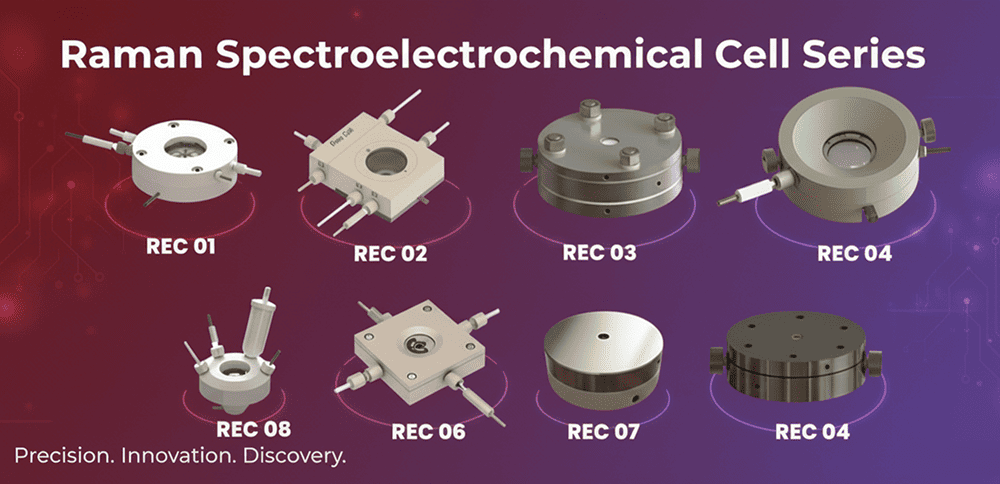
3.1 Raman Spectroelectrochemical Cell Series (REC-01 to REC-09)
| Model | Body Material | Electrode Config | Application Focus | Window Type |
|---|---|---|---|---|
| REC-01 | PTFE | 2/3 electrode | Entry-level general studies | Quartz sheet |
| REC-02 | PEEK | 2/3 electrode | Plate electrodes (ITO/FTO) | Quartz sheet |
| REC-03 | PTFE | 2/3 electrode | Adjustable optical path | Quartz sheet |
| REC-04 | PEEK | 2/3 electrode | Flow H-cell with gas distribution | Sapphire |
| REC-05 | PEEK + Titanium | 2/3 electrode | High-throughput screening | Quartz |
| REC-06 | Stainless steel 316 + PEEK | 2 electrode | Battery cells (no ventilation) | Sapphire |
| REC-07 | Stainless steel 316 | 3 electrode | Battery cycling with electrolyte flow | Quartz |
| REC-08 | Stainless steel 316 | 2 electrode | Ventilated gas circulation studies | Quartz |
| REC-09 | Stainless steel 316 | 2 electrode | Ventilated with cathode protection | Quartz |
Selection guidance:
- For general research: REC-01, REC-02, REC-03
- For battery applications: REC-06, REC-07, REC-08, REC-09
- For gas-phase or photoelectrochemical work: REC-04, REC-05
3.2 X-Ray Absorption Spectroscopy (XAS) Cell Series
In-Situ XAS Single-Cell (XAFC-1): Compact PEEK reactor (~40–50 mL) with Kapton® window for synchrotron beamlines. Supports 2- and 3-electrode configurations. Ideal for catalyst oxidation-state tracking and local coordination analysis.
In-Situ XAS H-Cell (XAFC-2): Dual-compartment design with an ion-exchange membrane separating anode and cathode chambers. Essential for electrochemical water splitting (HER/OER), CO₂ reduction half-reaction studies, and battery half-cell cycling research.
Gas-Phase XAS Cell (XAFC-3): Specialised for gas-phase catalysis operando studies. Features precise gas inlet/outlet control, humidity regulation, and temperature capability. Ideal for studying electrocatalysts under realistic operating conditions.
3.3 Battery XRD Test Cells
Three models engineered for specific laboratory diffractometer geometries:
- Rigaku XRD mini: Compact footprint, φ16 mm electrode accommodation
- Bruker D2: Bragg-Brentano geometry, optimised for laboratory sources
- Rigaku XRD full: High-resolution capable, synchrotron-compatible design
All feature Kapton or beryllium X-ray windows, stainless steel/PEEK construction, and integrated potentiostat feedthroughs.
3.4 Spectroelectrochemical Cell (Optical Cuvette Type)
Quartz cuvette design for UV–Vis–NIR and Raman simultaneous measurement. Supports transparent electrodes and three-electrode configurations. Ideal for studying electronic transitions, charge-transfer complexes, and electrochromic materials.
3.5 In-Situ Mass Spectrometry Flow Electrochemical Cell
Three-electrode flow cell (~1–10 mL channel volume) with PTFE/PEEK construction. Direct coupling to mass spectrometer inlet or membrane-interface module. Temperature control up to 80 °C with optional pressure regulation.
Section 4: Practical Comparison—When to Use In-Situ vs Operando
4.1 Choosing In-Situ Characterisation
In-situ characterisation is appropriate when your research goals require:
Structural or compositional analysis under electrochemical control: Studying how electrode material structure changes as a function of potential, independent of current or reaction rate. Example: monitoring lithium-ion insertion into a cathode material at different potentials without requiring simultaneous measurement of current.
Cost and resource optimisation: In-situ measurements typically require less beamtime at synchrotrons and lower instrument investment than operando systems. Single-channel Raman cells are significantly cheaper than operando multimodal setups.
Model system or fundamental studies: When developing new cell designs, reference electrodes, or electrode materials, in-situ characterisation provides clear, controlled measurements of structural properties without complications of simultaneous functional measurement.
High time-resolution spectroscopy: Some spectroscopic techniques (particularly Raman) can achieve very rapid acquisition rates (~millisecond timescales). In-situ measurements at fixed potential maximise signal quality without the complexity of simultaneous electrochemical control.
4.2 Choosing Operando Characterisation
Operando characterisation delivers greater insight when:
Investigating reaction mechanisms under true operating conditions: Operando approaches reveal the identity of active sites, reaction intermediates, and pathway selectivity by directly correlating catalyst structure with activity. Essential for understanding electrocatalysis and reaction selectivity.
Studying fast or transient phenomena: Non-equilibrium intermediates (e.g., COOH, CO ads, H ads, Li0 metal) appear and disappear on millisecond to second timescales. Operando methods capture these transients; ex-situ approaches cannot.
Battery cycling and degradation: Monitoring cathode/anode structure during charge/discharge reveals phase transitions, structural strain, and degradation mechanisms that occur dynamically. Operando XRD or Raman directly tracks these changes during realistic cycling protocols.
Catalyst deactivation and reconstruction: Many electrocatalysts undergo surface oxidation, leaching, or reconstruction under operating conditions. Operando techniques reveal these processes as they occur and correlate structural changes directly with activity loss or recovery.
Validating theoretical predictions: Density functional theory (DFT) and microkinetic models make predictions about intermediate coverage, active site geometry, and reaction pathways. Operando measurements test these predictions directly.
Section 5: Experimental Design Considerations
5.1 Cell Design Principles
Both in-situ and operando cells must satisfy competing requirements:
Electrochemical performance: Three-electrode configuration with working, reference, and counter electrodes; minimised iR drop; stable, reproducible potentials across repeated measurements.
Spectroscopic optimisation: Optical windows must be optically transparent (Raman, UV-Vis) or X-ray transparent (XAS, XRD); minimal background interference; optimal optical path lengths (typically 0.3–6 mm for Raman).
Chemical compatibility: Materials must withstand aggressive aqueous and organic electrolytes, elevated potentials (oxidising), and reduced potentials (reducing conditions). PTFE, PEEK, stainless steel, and quartz are the standard materials.
Thermal stability: Many studies require controlled temperature (0–80 °C or higher). Cell materials must maintain sealing integrity and electrochemical performance across this range.
5.2 Reference Electrode Design
Reference electrodes are critical for accurate potential control. ScienceGears cells support:
Ag/AgCl (aqueous systems): Standard reference electrode for neutral, acidic, and weakly basic conditions. Requires liquid junction (Luggin capillary) to prevent Cl⁻ leakage into sample.
Ag/Ag⁺ (non-aqueous systems): For organic electrolytes and ionic liquids. Reference potential is defined relative to Ag⁺/Ag couple in the specific solvent.
Custom reference electrodes: Reversible hydrogen electrode (RHE), saturated calomel electrode (SCE), or pseudo-reference electrodes can be accommodated in custom designs.
5.3 Working Electrode Selection
Working electrodes must match the research application:
Glassy carbon: Inert, stable across wide potential windows, minimal background. Standard for HER, OER, CO₂RR studies. Available as discs (φ3–16 mm) or custom shapes.
Transparent electrodes (ITO, FTO): For spectroelectrochemical studies requiring optical transmission. Lower conductivity than metals but essential for UV-Vis and Raman through electrodes.
Metal electrodes (Au, Pt, Cu, Ni): For catalyst studies or when material-specific reactivity is desired. Susceptibility to oxidation or corrosion must be considered.
Gas diffusion electrodes (GDE): Porous electrodes for high-current applications (fuel cells, electrolysers). ScienceGears offers REC-04 and REC-05 designs compatible with GDE configurations.
5.4 Electrolyte and Gas Management
Bubble-free operation: Gas bubbles (e.g., O₂ or H₂ from OER/HER) disrupt X-ray transmission, Raman optical paths, and electrode-electrolyte contact. ScienceGears cells incorporate gas outlet ports or circulation loops to maintain bubble-free conditions.
Electrolyte window thickness: In XAS and XRD, X-rays traverse the electrolyte. Thick electrolyte layers cause absorption and signal loss. Adjustable electrodes or threaded cell designs allow optimisation of electrolyte window thickness (typically 0.3–3 mm).
Organic vs aqueous electrolytes: Cell materials must be compatible. PTFE tolerates most solvents; PEEK is less permeable to some organics. Confirmation is required for novel electrolytes.
Section 6: Applications and Case Studies
6.1 Electrocatalysis: CO₂ Reduction to Chemicals
Research goal: Develop catalysts for selective CO₂ reduction to formate or ethylene, improving faradaic efficiency above 50%.
Operando approach:
- Use In-Situ Mass Spectrometry Flow Cell to quantify CO, CH₄, H₂, and formate yields in real time
- Couple with operando XAS to track copper oxidation state (Cu⁰, Cu⁺, Cu²⁺) during reduction
- Correlate gas product distribution with copper speciation to identify active sites
Expected insights:
- Identification of Cu⁺ as the active oxidation state for formate selectivity
- Detection of transient Cu⁻ hydride (CuH) intermediate in the hydrogen evolution pathway
- Determination of catalyst oxidation/reduction potentials for activity/selectivity mapping
Key ScienceGears products: XAFC-1 (single-cell XAS), In-Situ Mass Spectrometry Flow Cell
6.2 Battery Research: Lithium-Ion Cathode Cycling
Research goal: Understand lattice parameter changes and phase transitions in NMC or LFP cathode materials during charge/discharge.
Operando approach:
- Operando XRD during potentiostatic charge and constant-current discharge
- Simultaneous measurement of electrochemical current and diffraction patterns
- Rietveld refinement to track lattice a, b, c parameters and Li occupancy
Expected insights:
- Biphasic vs single-phase insertion pathways
- Structural strain and defect formation during cycling
- Identification of metastable phases inaccessible ex-situ
- Correlation of phase transitions with voltage hysteresis or capacity fade
Key ScienceGears products: In-Situ Battery XRD Test Cell (Bruker D2 or Rigaku compatible)
6.3 Operando Raman Spectroelectrochemistry: Hydrogen Evolution Catalysts
Research goal: Elucidate HER mechanisms on molybdenum disulfide (MoS₂) catalysts.
Operando Raman approach:
- In-Situ Raman Spectroelectrochemical Cell REC-07 with MoS₂ electrode
- Sequential Raman spectra during linear sweep voltammetry (LSV) from 0 to −0.5 V vs RHE
- Real-time tracking of Mo-H and S-H vibrations; observation of hydrogen adsorbate dynamics
Expected insights:
- Direct identification of S sites as catalytic centres (S-H stretch at ~2150 cm⁻¹)
- Confirmation of proposed HER mechanism: H⁺ → H ads (Volmer) → H₂ (Tafel/Heyrovsky)
- Detection of Mo-H contributions indicating minor molybdenum site participation
- Time-resolved kinetics of hydrogen adsorbate formation/removal
Key ScienceGears products: In-Situ Raman Spectroelectrochemical Cell (REC-07)
Labs that prefer a fully integrated approach — combining potentiostat, Raman microscope, and cell into one validated platform — can also consider the Spectroelectrochemistry Raman system as an alternative to assembling components individually.
Section 7: Frequently Asked Questions (FAQs)
Q1: What is the primary difference between in-situ and operando electrochemical characterisation?
In-situ characterisation measures samples in their working environment (electrolyte, controlled potential) but does not require simultaneous functional measurement. Operando characterisation integrates spectroscopic measurement with real-time monitoring of electrochemical properties (current, potential, gas evolution), directly correlating structure with function.
Q2: Which technique is superior—in-situ or operando?
Neither is universally "superior"; they address different research questions. Operando studies reveal mechanistic pathways and active site transformations during operation; in-situ measurements are ideal for fundamental structural studies, model systems, and cost-conscious research. The choice depends on your specific research objectives.
Q3: Can I perform operando experiments on a standard potentiostat?
Yes. Standard potentiostats (Zahner, CorrTest, Squidstat, Gamry, Metrohm Autolab) measure electrochemical current and potential continuously. Coupling them with ScienceGears operando cells and spectrometers enables simultaneous measurement and direct correlation of structure with electrochemical performance.
Section 8: Conclusion and Recommendations
In-situ and operando electrochemical characterisation have transformed our understanding of catalysts, battery materials, and reaction mechanisms. The distinction between these approaches is not merely semantic it reflects fundamentally different experimental philosophies and research capabilities.
For fundamental studies of material structure and composition, in-situ characterisation is efficient and cost-effective. For mechanistic investigation requiring correlation of active site structure with catalytic performance, operando methods are essential.
ScienceGears' comprehensive portfolio of electrochemical cells—from compact Raman REC series to synchrotron-grade XAS ( In-Situ X-ray Absorption Spectroscopy (XAS) Reaction Cell — Single-Cell ) and advanced mass spectrometry flow cells—enables researchers around the world to implement either methodology. Whether you are investigating hydrogen evolution catalysts, lithium-ion battery degradation, or CO₂ electroreduction selectivity, the right cell design accelerates discovery and deepens mechanistic understanding.
As electrochemical research moves towards sustainability in fuel cells, electrolysers, and batteries, operando characterisation will become more important. It will help guide catalyst and material design. Investment in these techniques today positions research groups to lead tomorrow's breakthroughs in clean energy, environmental remediation, and advanced materials synthesis.
Navigating these complex techniques requires deep expertise. Dr Arumugam and the ScienceGears team offer more than products. They provide expert advice to university research groups and industry R&D teams. With over 20 years of global experience in electrochemistry, nanomaterials, and spectroscopy, Dr Arumugam supports researchers. He helps them design strong experiments, choose the right tools, and interpret complex data. His guidance supports advanced research in energy storage, corrosion, chemical sensing, and pharmaceutical analysis, ensuring your lab achieves meaningful and publishable results.
For expert support in selecting the optimal cell configuration for your research, contact the ScienceGears technical team today. Detailed specifications and application notes are available for all products.
Related products
- Raman Spectroelectrochemical Cells (REC Series) — 9 models for various electrochemical applications
REC-01 | REC-02 | REC-03 | REC-04 | REC-05 | REC-06 | REC-07 | REC-08 | REC-09 - Spectroelectrochemical Cells (Optical Cuvette Type) — 1 product for absorption/emission studies Spectroelectrochemical Cell
- X-Ray Absorption Spectroscopy (XAS) Cells — 3 models for synchrotron research
In-Situ X-ray Absorption Spectroscopy (XAS) Reaction Cell — Single-Cell | In-Situ XAS H-Cell — Dual-Compartment with Membrane | Gas-Phase In-Situ XAS Reaction Cell - In-Situ Battery XRD Test Cells — 3 models optimised for different XRD platforms
Gas-Phase In-Situ XAS Reaction Cell | In-Situ Battery XRD Test Cell (for Bruker D2) | In-Situ Battery XRD Test Cell (for Japan Rigaku XRD full) - In-Situ Mass Spectrometry Flow Electrochemical Cell — 1 advanced flow cell
In-Situ Mass Spectrometry Flow Electrochemical Cell