

Abstract
Abstract: High-rate CO₂ electrolysis in membrane electrode assembly (MEA) reactors is limited by precipitation of sparingly soluble (bi)carbonate salts, which clog gas diffusion electrodes and flow channels. Salt formation occurs when alkaline catholyte or hydroxide generated at the cathode reacts with CO₂, producing carbonate species that crystallise as water evaporates. This whitepaper reviews the mechanisms of salt precipitation and presents practical mitigation strategies demonstrated in recent research and ScienceGears MEA electrolyser hardware. Hydrophobic coatings (e.g. ultra-thin Parylene‑C) applied to cathode flow channels cause water droplets to bead up and be removed before drying, delaying salt crystallisation. Periodic in situ flushing via a dedicated DI-water port can dissolve and wash out salts without disassembly. Optimised flow-field designs—especially serpentine channels with high pressure drop maintain gas access despite salt or water blockages, while parallel designs are more prone to flooding. Finally, humidifying the CO₂ feed (particularly with acid vapours) and heating gas lines improves membrane hydration and re-dissolves bicarbonate salts, extending continuous operation from ~80 hours to thousands of hours. By integrating these approaches (coatings, flush ports, flow-field selection, and humidity/temperature control), CO₂RR MEA electrolysers can achieve dramatically longer stable runtimes. ScienceGears’ modular test cells enable researchers to implement and combine these strategies for enhanced performance and durability.
Introduction
Salt Precipitation in CO₂ Electrolysis: A significant challenge in scaling up CO₂RR (CO₂ reduction reaction) MEA electrolysers is the formation of carbonate salts that clog electrodes and flow channels. At high current densities, hydroxide ions produced at the cathode react with CO₂ to form carbonate (CO₃²⁻) and bicarbonate (HCO₃⁻). These anions combine with cations (e.g. K⁺ from electrolytes) to precipitate sparingly soluble salts like KHCO₃ and K₂CO₃ [1]. The salts crystallise within the catalyst layer, GDL, and gas channels, impeding CO₂ transport and causing flooding, which rapidly diminishes performance [1]. Understanding the conditions that lead to salt precipitation and implementing methods to remove or prevent these deposits are essential for reliable long-term CO₂ electrolysis.
Mechanism of Salt Formation: Operando optical studies have revealed that salt crystals usually originate from drying droplets of electrolyte that migrate into the gas channels [2]. As liquid droplets evaporate on the channel walls, the dissolved carbonate and cation concentration rise until nucleation occurs. Salts tend to appear first near the gas inlet where the CO₂ feed is driest. In other words, inadequate humidity or water management at the cathode leads to droplet evaporation and salt deposition. Keeping the cathode environment sufficiently wet (or chemically acidic) can maintain carbonates in solution. Additionally, ensuring that any droplets are quickly removed (before they dry) can delay salt precipitation. Both surface hydrophobicity and humidity control are therefore key factors governing salt formation [2].
Hydrophobic Coatings to Repel Droplets
One effective strategy to mitigate salt is making the cathode flow channels more hydrophobic so that electrolyte droplets do not linger and evaporate. A recent Nature Energy briefing highlighted that applying a hydrophobic coating on the gas channel walls significantly delayed salt precipitation by causing droplets to bead up and be swept away [2].
Parylene‑C Coating: A practical implementation is coating the cathode flow-field with Parylene‑C, a chemically inert, hydrophobic polymer. Parylene‑C can be deposited as an ultra-thin (~1–5 µm) conformal film over complex channel geometries without blocking gas flow [1]. This coating dramatically increases the water contact angle of the channel surface (e.g. from ~90° to >120°), so that electrolyte forms beads instead of wetting the surface. The droplets are then easily carried out by the gas stream rather than spreading and drying into salt crystals [1]. In a zero-gap CO₂ electrolyser, a Parylene‑C coated cathode flow plate maintained stable operation for >500 hours at 200 mA cm⁻², compared to ~100 hours for an uncoated plate [2]. The hydrophobic coating prevented salt accumulation that would typically occur after ~2–3 days. Besides delaying salt formation, Parylene‑C adds a protective insulating layer, shielding metal flow plates from corrosive electrolytes.
Figure 1 – Parylene‑C Coated Channels:
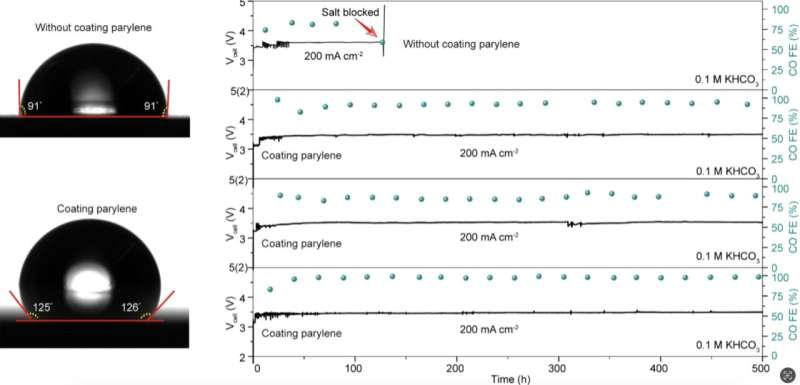
Contact angle images of a water droplet on cathode flow-field surfaces (cross-sectional view). Top: Uncoated stainless steel channel (contact angle ~91°, droplet spreads). Bottom: Parylene‑C coated channel (contact angle ~125°, droplet beads up). A higher contact angle indicates a more hydrophobic surface that repels water. The Parylene‑C coating causes droplets to roll off before they can dry, thereby preventing salt crystal deposition on the channel walls.
By keeping the cathode free of stagnant electrolyte, a hydrophobic coating significantly slows the rate of salt precipitation. However, over-extended operation may still result in some salt accumulation (e.g., in cooler areas or corners of the cell). Therefore, hydrophobic channels are best used in combination with periodic flushing to remove any salts that do form actively.
In‑Situ Flushing of Salts with DI Water
Physically washing out salt deposits is a straightforward remedial approach. Traditionally, if performance dropped due to salt, researchers would pause the experiment and flush the cell with water offline. This is labour-intensive and interrupts experiments. Instead, designing the electrolyser with an in‑situ flush port enables on-demand cleaning without disassembly. Two approaches have been reported:
- Periodic batch flush:every specific interval (e.g. every hour), halt CO₂ flow and inject a bolus of deionised water into the cathode chamber to dissolve salts, then drain.
- Continuous co-injection:trickle a small flow of DI water into the cathode gas stream during operation to dissolve salts as they form.
Studies have shown these methods can effectively clear salts. For example, flushing a zero-gap CO₂ electrolyser with ~50 mL of water hourly dissolved accumulated K₂CO₃ and restored full current density [1]. In another case, continuously feeding 0.2 mL min⁻¹ of water vapour prevented any visible salt over a run, whereas 0.1 mL min⁻¹ led to failure within 50 minutes [1]. (indicating a minimum water flux needed to balance salt production).
Flush Port Design: Implementing a flush system can be done by a 3-way valve or a dedicated nozzle:
- Inline 3-way valve:Placed upstream, it switches the cathode feed from CO₂ to water periodically. This approach requires temporarily stopping CO₂ but does not need additional ports on the cell.
- Angled injection port:A small nozzle is integrated into the flow plate, aimed at the channel near the inlet. A syringe or pump injects a water pulse through this nozzle while CO₂ flow is momentarily stopped. This targeted spray can dislodge salt crystals right where they tend to form (near the dry inlet region).
After flushing, CO₂ flow resumes, carrying the dissolved salt solution out of the cell. The channels must be hydrophobic (as above) so that the injected water does not simply sit and evaporate – instead, it should drain out, taking salts with it. In practice, only a few seconds of water flow may be needed to clear the deposits, minimising downtime.
Figure 2 – DI Water Flush Port: 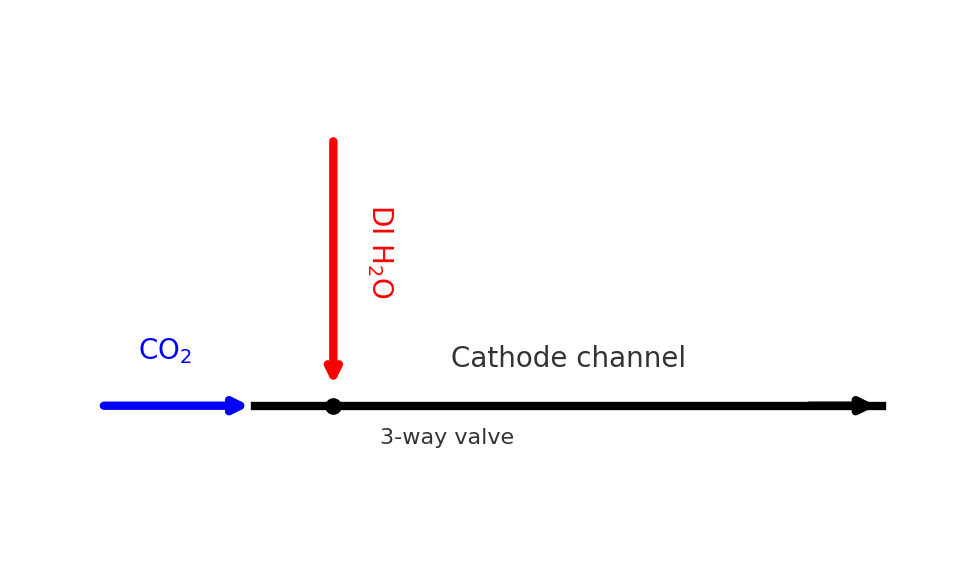
Simplified schematic of an in-situ flushing setup. A 3-way valve alternately feeds either CO₂ gas (blue arrow) or DI water (red arrow) into the cathode flow channel. In regular operation, the valve is set to CO₂. When salt cleaning is needed, the valve switches to inject a pulse of water through a dedicated port (black circle) into the channel. The water dissolves salt crystals and flushes them out; then the valve switches back to resume CO₂ feed. Such flush cycles (e.g. a few seconds each) can be scheduled periodically without fully disassembling the cell.
ScienceGears Flush Port: The ScienceGears Interchangeable‑Channel MEA Cell is available with an optional cathode flush port. In this design, a 1 mm diameter hole is drilled at a 45° angle into the first few millimetres of the cathode flow channel. An external fitting connects this port to a DI water reservoir via a valve. Users can thus periodically inject water into the live cell to dissolve salts. The interchangeable plate format allows testing the effect of the flush port by swapping between ported and non-ported plates.
Flow-Field Optimisation to Tolerate Salts
Not all flow-field patterns are equally susceptible to salt-induced blockage. Serpentine flow fields (long single-path channels) have been found to better sustain performance under salt precipitation conditions than parallel multi-path designs [1]. The reason is that a serpentine channel imposes a higher gas pressure drop, which forces CO₂ into blocked or flooded regions by backpressure. If one segment of a serpentine path becomes partially obstructed by salt, the pressure buildup helps drive gas through/around the obstruction, continuing to feed downstream catalyst areas [1]. In contrast, a parallel design offers many low-resistance paths – if one path clogs, the gas bypasses it and that region goes dead (no reactant flow).
Similarly, interdigitated flow fields (dead-ended channels) actively push gas through the GDL into the electrode, which can improve salt tolerance compared to open flow fields [1]. However, interdigitated channels still provide multiple paths (each inlet channel pairs with a neighbouring outlet channel), so a blockage can still isolate part of the electrode unless convective forces clear it.
Experiments by Subramanian et al. [1]. showed that a serpentine flow field delivered a CO partial current of 205 mA cm⁻² for over 30 minutes. In contrast, a parallel field in the same cell failed much sooner due to flooding and salt accumulation. They measured the pressure drop of each design: the serpentine plate’s pressure drop was 9× higher than the parallel plate’s, and ~1.8× higher than an interdigitated plate’s [plate’s [1]. The serpentine also had the most uniform CO₂ distribution across the catalyst, and exhibited the lowest residual capacitance (indicative of minimal flooding) after operation [1].
Figure 3 – Flow Field Patterns:
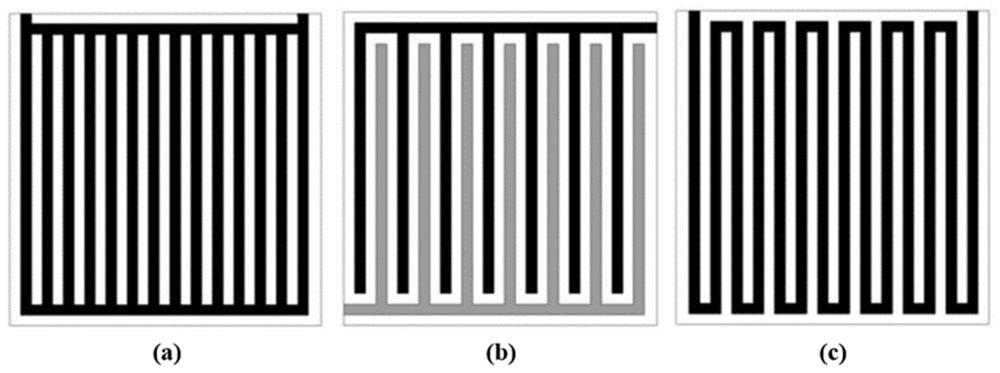
(a) Parallel channels: multiple straight channels from inlet to outlet (black = ribs, white = channels). Low pressure drop, but a salt blockage in one channel (e.g. middle) can starve that region while others still flow. (b) Interdigitated: alternating inlet and outlet channels (black = closed ends). Gas (grey arrows) must cross through the GDL between channels, flushing out water/salt. Better than parallel, but blockages can reroute flow locally. (c) Serpentine: one continuous channel winds through the area. Highest pressure drop – gas is forced through obstructions. Promotes uniform flow and resists flooding. Serpentine generally outperforms in maintaining performance under salt-precipitating conditions [1].
Modular Dual-Plate Testing: Because each flow pattern has advantages, researchers often compare them. The ScienceGears Interchangeable-Channel cell is designed for this purpose. One can quickly swap a serpentine plate for an interdigitated plate (or others like parallel, mixed, etc.) in the same cell housing. This A/B testing capability allows evaluation of salt mitigation strategies under identical conditions. For instance, one could run a long-duration CO₂ electrolysis with a serpentine field and observe minimal salt effects, then repeat with a parallel field to quantify performance drop due to salt. Such tests help in selecting the optimal flow field or combining features (some advanced designs use hybrid patterns to balance pressure and distribution).
Humidification and Feed Gas Conditioning
Another vital lever in controlling salt precipitation is the humidity and composition of the CO₂ feed gas. Salt formation is exacerbated when the cathode side dries out, so maintaining a humid environment can keep bicarbonate salts dissolved. Endrődi et al. (2021) showed that humidifying the CO₂ feed and heating it to 85 °C enabled stable CO₂ electrolysis for at least 8 hours with significantly reduced salt precipitation [3]. The added water vapour maintained membrane hydration (reducing OH⁻ production from the anolyte) and increased the solubility of any carbonate accumulating at the cathode [3]. Conversely, if the CO₂ inlet is completely dry, it can dehydrate the cathode and promote rapid salt crystallisation right at the inlet.
However, too much humidity can cause flooding or encourage competing hydrogen evolution (by providing excess water at the catalyst). So an optimal balance must be found – enough moisture to dissolve salts, but not so much as to drown the GDL. Controlling the dew point of the CO₂ and using heated gas lines is recommended to fine-tune this balance and prevent condensation in the gas channels.
Acid Humidification: A breakthrough reported in 2025 by Hao et al. is to humidify CO₂ with a dilute acid instead of pure water. By bubbling CO₂ through an acidic solution (e.g. <0.1 M), the vapour carries volatile acid (HCl, HNO3, HCOOH, etc.) into the cathode. This acid reacts with K₂CO₃/KHCO₃ salt as it forms, converting it to soluble KHCO₃ or KCl that can remain in solution. Essentially, the acid prevents solid carbonate from precipitating. Using acidified humidification, a CO₂ electrolyser was run for >2000 hours in the lab (and even 4500 h in a scaled 100 cm² cell) with no salt clogging. In contrast, a water-humidified control failed after ~80 h. Importantly, the acid vapour did not appear to harm the catalysts or membrane, and did not compromise CO selectivity. This simple chemistry solution – adding a “dash of acid” – could be a game-changer for long-term CO₂RR operation.
Figure 4 – Humidifier Setup:
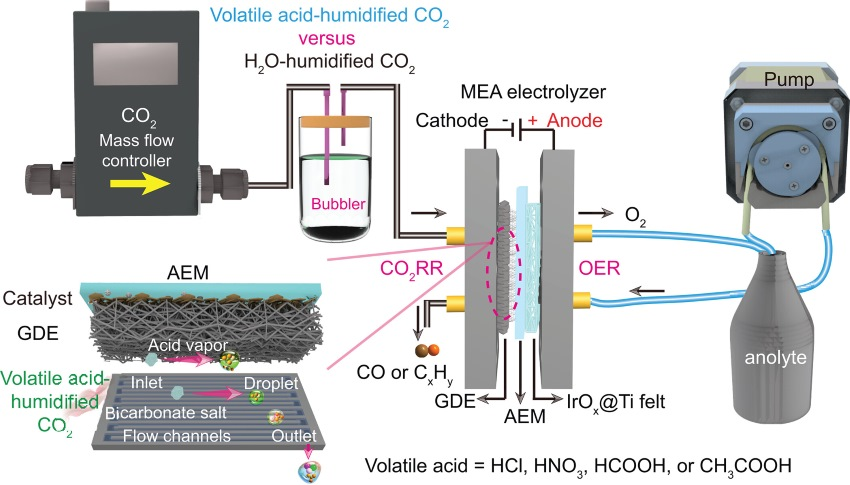
Schematic of a CO₂ gas humidification system for MEA electrolysers. The dry CO₂ from a cylinder is passed through a bubbling flask (humidifier) containing either deionised water or a dilute acid (e.g. HCOOH, HCl). The outgoing gas is saturated with H₂O or acid vapour. Heated tubing (pink) carries the humidified CO₂ to the cell, maintaining the gas above its dew point to avoid condensation. In the cell, the humid CO₂ prevents the cathode from drying out. Acid humidification further dissolves salts by converting K₂CO₃ to soluble KHCO₃/KCl, drastically extending run times (by >50× in tests).
Integration in Practice: ScienceGears MEA cells include built-in ports and adapters for gas humidification. For instance, the MEA Test Cell has optional fittings to connect an external humidifier bottle to the gas inlet. Gas line heaters or heating tapes can be wrapped around the tubing and cell inlet to keep the temperature controlled (avoiding cold spots where moisture could condense and drop out). By adjusting the humidifier temperature or bypass (many commercial humidifiers allow setting the dew point), researchers can experiment with different humidity levels to find the threshold that stops salt precipitation without causing flooding. In addition, our Visual MEA Cell with transparent windows is ideal for observing condensation or salt formation as humidity is varied.
Putting It All Together
Combating salt precipitation in CO₂ reduction MEA electrolysers requires a multi-faceted approach. No single fix is sufficient; instead, a combination of preventative and active measures yields the best results:
- Prevent salt formation:Use hydrophobic coatings and humidified (or acidified) CO₂ feeds to minimise initial salt precipitation. These steps address the root causes (drying and crystallisation).
- Tolerate some salt safely:Employ high-pressure-drop flow fields (serpentine) so that if salt does form, the system continues to operate without immediate failure. This extends the effective operating window.
- Remove salt periodically:Include flush ports or water-injection schemes to actively dissolve and wash out salts during operation, before they accumulate to a detrimental extent.
Using these strategies, researchers have demonstrated order-of-magnitude improvements in operating lifespan – from tens of hours to hundreds or thousands of hours [1]. The mitigation methods are practical to implement in new or existing cells. For example, a metal flow plate can be Parylene-coated by specialty coating services; humidifiers are standard lab equipment; and even a simple manual water flush can be rigged onto many cells.
ScienceGears Solution: ScienceGears has incorporated these advances into its product line of MEA electrolyser hardware. Our cells are designed for flexibility, allowing users to swap components and test different configurations with ease:
- Hydrophobic Parylene-C coatingsare available on flow plates to replicate the benefits observed in literature.
- Flush portscan be included or omitted on request, enabling in situ cleaning trials.
- Multiple flow-field plates(serpentine, interdigitated, etc.) are provided for comparative experiments.
- Humidifier integrationand heating options are supported, with guidance on how to connect and control them.
By providing a modular platform, ScienceGears aims to accelerate CO₂RR research and help labs find the optimal combination of strategies for their specific catalysts and conditions. The ultimate goal is to achieve stable, continuous CO₂ conversion processes that can run for weeks or more without interruption – a key step toward commercial viability in carbon utilisation.
Acknowledgment: The author thanks the ScienceGears engineering team and our academic collaborators for their contributions to developing the mitigation techniques described. ScienceGears is committed to supporting the CO₂ electrolysis community with advanced MEA test hardware and open knowledge exchange.
References
- Subramanian, S.; Yang, K.; Li, M.; Sassenburg, M.; Abdinejad, M.; Irtem, E.; Middelkoop, J.; Burdyny, T. “Geometric Catalyst Utilization in Zero‑Gap CO₂ Electrolyzers.” ACS Energy Letters8, 222–229 (2023). DOI: 10.1021/acsenergylett.2c02194
- Hao, S. et al.“Managing bicarbonate salt formation in CO₂ reduction electrolysers for stable operation.” Nature Energy 10, 164–165 (2025). DOI: 10.1038/s41560-025-01707-x
- Sassenburg, M.; Kelly, M.; Subramanian, S.; Smith, W. A.; Burdyny, T. “Zero‑Gap Electrochemical CO₂ Reduction Cells: Challenges and Operational Strategies for Prevention of Salt Precipitation.” ACS Energy Letters8, 321–331 (2023). DOI: 10.1021/acsenergylett.2c01885
- Perfetto, I. “Simple chemistry overcomes obstacle to CO₂ utilisation at scale.” Cosmos Magazine(June 23, 2025). Available: Cosmos, https://cosmosmagazine.com/news/carbon-dioxide-utilisation-reduction/
- ScienceGears Pty Ltd. “MEA Test Cells for PEM & AEM.” ScienceGears Product Page, Brisbane, 2025. Available: https://www.sciencegears.com.au/membrane-electrode-assembly-mea-test-cells(accessed Aug. 2025)