
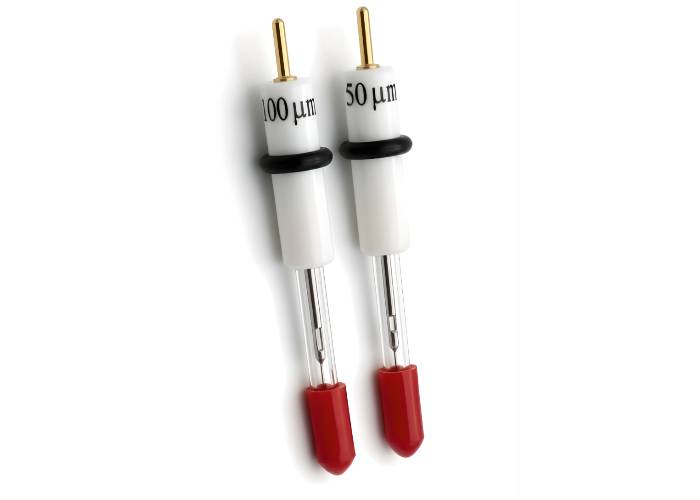
Nickel Microelectrode – 50 µm or 100 µm
Nickel Microelectrode – 50 µm or 100 µm
Nickel Microelectrode
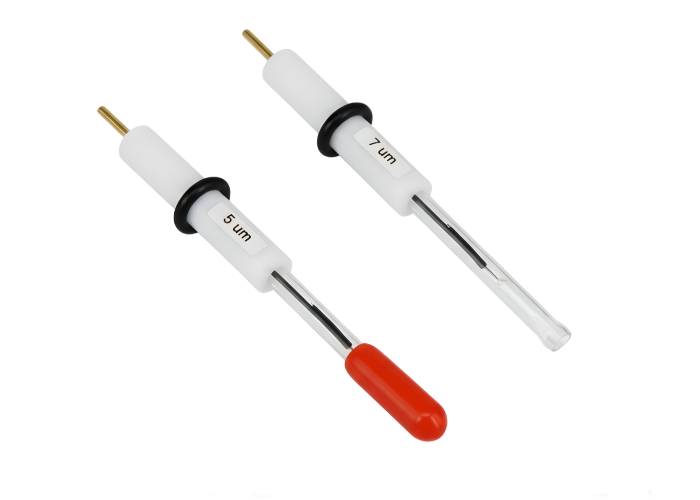
A nickel microelectrode (often referred to as an ultramicroelectrode, UME) is a high-purity nickel wire sealed into an insulating body (commonly glass), with the tip polished to a mirror-finish microdisk. The micron-scale diameter dramatically reduces capacitive charging and iR drop, enabling stable electrochemistry in low-conductivity media and fast kinetic studies with improved signal-to-noise at very low currents.
Working Principle
When paired with a potentiostat, the nickel microdisk establishes a well-defined diffusion field. At sufficiently small diameters, mass transport becomes dominated by radial diffusion, producing steady-state or near steady-state currents in quiescent solutions—ideal for mechanistic electrochemistry, surface film studies, and localised corrosion behaviour.
Key Features & Typical Specifications
- Available diameters: 50 µm and 100 µm nickel microdisk
- Construction: nickel wire sealed in a rigid insulating shank (typically glass)
- Finish: precision-polished tip for reproducible geometric area and clean surfaces
- Electrical connection: robust pin/contact for low-noise measurements
- Best practice: compatible with standard microelectrode polishing and cleaning workflows
Compatibility
- Works with most potentiostats/galvanostats (including low-current measurement ranges).
- Compatible with standard electrochemical cells, microcells, and many corrosion or alkaline test setups.
- Suitable for integration with complementary platforms such as EIS modules, temperature-controlled cells, and spectroelectrochemistry (application-dependent).
Typical Applications
- Nickel oxide/hydroxide formation and redox cycling (alkaline media)
- Localised corrosion and passivation studies
- Electrocatalysis screening (e.g., OER-related nickel surfaces)
- Kinetic studies where low currents and minimal ohmic error are essential
Why Source via ScienceGears
ScienceGears supports researchers across Australia and New Zealand with electrochemical instrumentation selection, method guidance, and seamless pairing of microelectrodes with potentiostats, electrochemical cells, and in-situ spectroscopy workflows.
Resources & Downloads
Everything you need to get started
Electrochemical Impedance Spectroscopy (EIS): Core Concepts for Confident Understanding
Squidstat - Admiral
Customer Reviews
Related Product
Explore our precision instruments designed for electrochemical research and energy applications
Still Wondering About Something?
Explore our FAQ for fast, clear answers to the most common questions—available 24/7.