
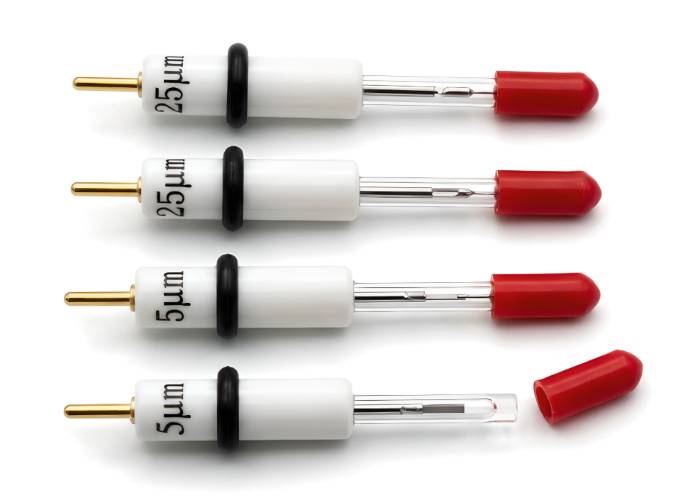
Platinum Microelectrode (10 µm, 25 µm, 50 µm, 100 µm or 200 µm)
Platinum Microelectrode (10 µm, 25 µm, 50 µm, 100 µm or 200 µm)
Platinum ultramicroelectrodes for low-current electrochemistry
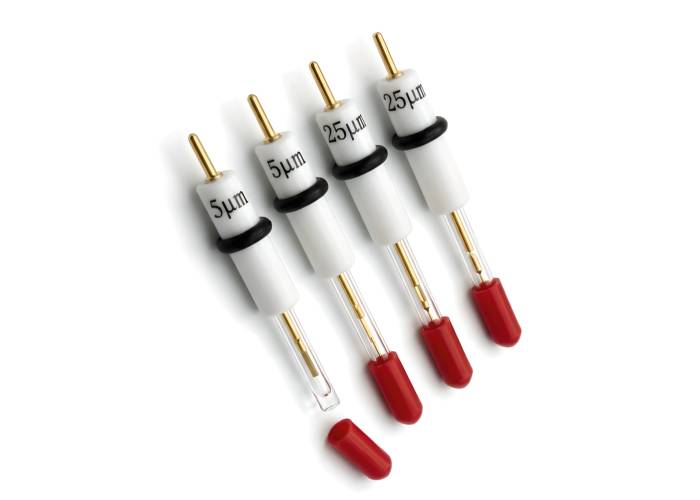
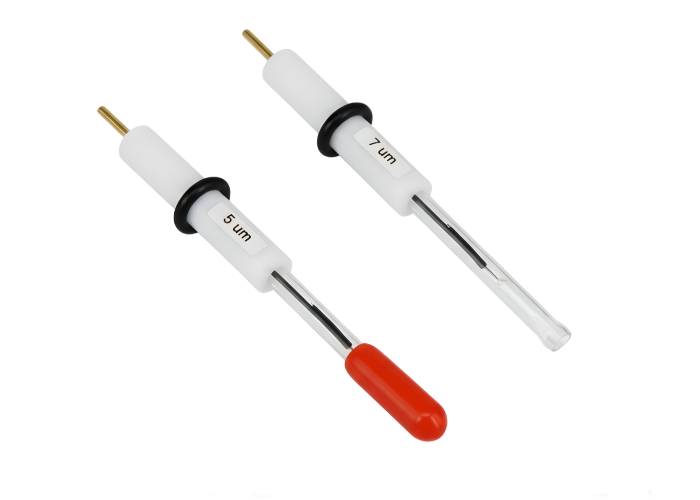
A platinum microelectrode (also called an ultramicroelectrode, UME) is a polished platinum disk sealed into an insulating body (commonly glass or glass/fluoropolymer). By reducing the electrode diameter to the micron scale, mass transport becomes predominantly radial/hemispherical diffusion, which helps establish stable, steady-state currents and enables measurements in challenging media where conventional macroelectrodes suffer from large iR drop and capacitive artefacts.
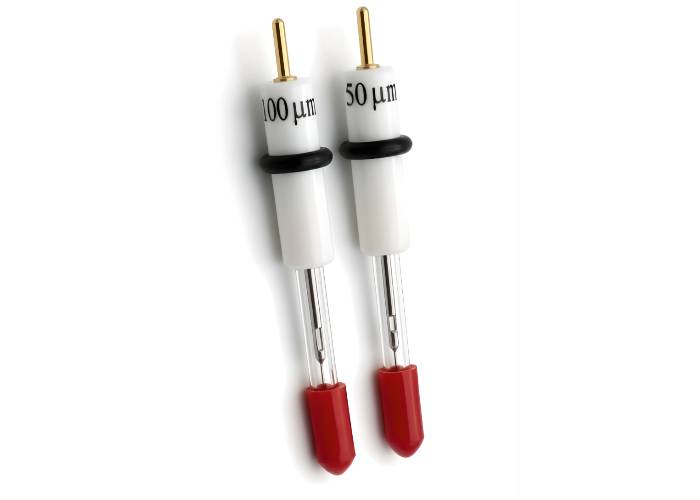
Available microelectrode sizes (platinum disk diameter)
Select a diameter to match your current range, noise floor, and diffusion regime:
- 10 µm – ultra-low currents, fastest steady-state behaviour, ideal for microvolumes and high-resistance media
- 25 µm – versatile UME for kinetics and steady-state voltammetry with improved robustness vs 10 µm
- 50 µm – higher limiting current, easier handling; ideal for routine method development
- 100 µm – stronger signal while retaining many microelectrode advantages
- 200 µm – highest current option in this range; useful when signal-to-noise is the priority
Key features and typical construction
- Platinum disk working surface with mirror-finish polishability (refreshable with routine polishing)
- Insulated shank suited to standard electrochemical cells; many research designs use an approximately 4 mm OD body and reliable low-noise electrical contact
- Supports quiescent-solution experiments and fast transient techniques due to reduced double-layer charging
Compatibility and typical applications
Compatible with most potentiostats and standard 2- or 3-electrode cell configurations (with an appropriate reference and counter electrode). Common uses include:
- Steady-state and fast-scan voltammetry of redox mediators and catalysts
- Kinetic studies in dilute electrolyte, non-aqueous systems, and high-impedance environments
- Low-concentration analytes and microvolume electrochemistry
- Screening electrocatalysts where stable diffusion control is required
Researchers choose ScienceGears for practical diameter selection support and integration guidance with complementary potentiostats, Faraday cages, and electrochemical cells.
Customer Reviews
Related Product
Explore our precision instruments designed for electrochemical research and energy applications
Still Wondering About Something?
Explore our FAQ for fast, clear answers to the most common questions—available 24/7.