
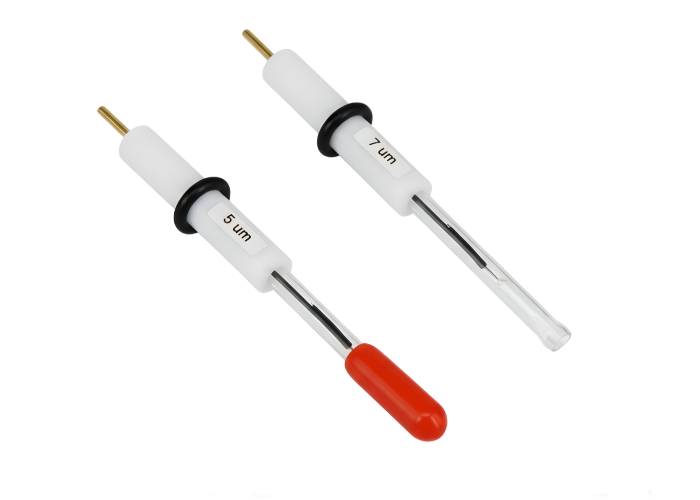
Carbon Fibre Microelectrode – 5 µm or 7 µm
Carbon Fibre Microelectrode – 5 µm or 7 µm
A carbon fibre microelectrode is an ultramicro working electrode built from a single carbon fibre (5 µm or 7 µm diameter) sealed into an insulating body, with only a microscopic disc (or short protruding tip) exposed to solution. The small active area dramatically reduces capacitive charging and iR drop, enabling stable measurements at very low currents and improved performance in high-resistance or poorly supported electrolytes.
How it works (principle)
The carbon surface supports fast electron-transfer reactions for many redox-active species. At micro-scale dimensions, radial diffusion dominates, often producing steady-state (sigmoidal) voltammograms and rapid response times. This makes carbon fibre microelectrodes ideal for trace detection, fast transients, and measurements in tiny volumes.
Key features and specifications
- Sensor material: high-purity carbon fibre (5 µm or 7 µm)
- Geometry: micro-disc / ultramicro working electrode
- Insulation: glass or chemically resistant polymer body for low leakage currents
- Low-noise operation: suited to picoamp–nanoamp regimes (instrument dependent)
- Renewable surface: can be refreshed by electrochemical activation or gentle polishing (method dependent)
Sizes of microelectrodes available
- 5 µm carbon fibre microelectrode
- 7 µm carbon fibre microelectrode
Compatibility
Compatible with most potentiostats/galvanostats that offer sensitive low-current ranges and stable cabling/shielding. Pair with a suitable reference electrode and counter electrode, and consider a Faraday cage for best signal-to-noise. Works well with microelectrode-capable electrochemical cells and optional spectroscopy add-ons where optical access is required.
Typical applications
- Fast-scan cyclic voltammetry (FSCV) and amperometry for neurotransmitters and oxidisable biomolecules
- Electrochemical biosensor development (enzyme/film-modified carbon surfaces)
- Micro-volume or high-resistance electrolytes (low supporting salt)
- Localised electrochemistry and method development (CV, DPV, SWV)
Why ScienceGears: local AU/NZ technical support and seamless integration with potentiostats, electrochemical cells, Faraday cages, and related electroanalysis accessories for a complete research workflow.
Customer Reviews
Related Product
Explore our precision instruments designed for electrochemical research and energy applications
Still Wondering About Something?
Explore our FAQ for fast, clear answers to the most common questions—available 24/7.