
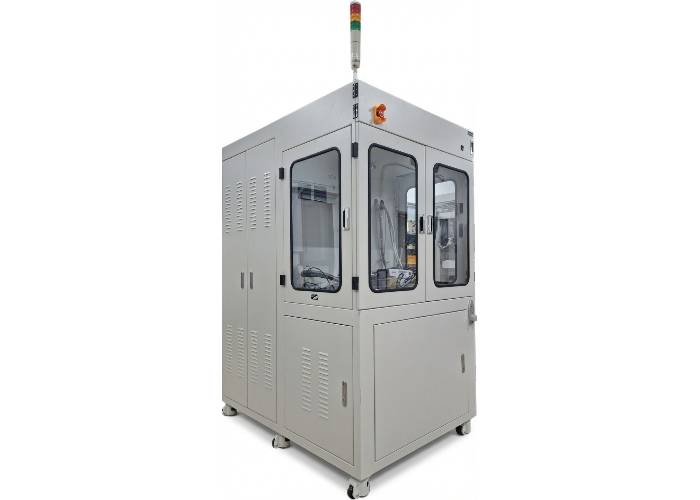
Alkaline Water Electrolyser Stack Test Station (5–10 kW) (SE5K-AL, SE10K-AL)
Alkaline Water Electrolyser Stack Test Station (5–10 kW)
Working principle
The SE5K-AL / SE10K-AL Stack Test Station is designed to operate and characterise alkaline water electrolyser stacks under controlled, repeatable conditions. It combines a DC power supply (constant current or constant voltage) with integrated electrolyte handling, gas conditioning, and automated data acquisition (DAQ) to quantify performance, stability, and gas quality during hydrogen production.
Key system functions
- Electrolyte supply & circulation: Pumped circulation with flow metering, filtering, and gas/liquid separation to stabilise operation when using KOH electrolyte (or specified water feed).
- Temperature management: Liquid temperature control and monitoring (typically RT to ~95 °C), with cooling support where required.
- Gas measurement & conditioning: Mass flow measurement for H₂/O₂, plus gas cooling and condensate trapping and optional drying / dewpoint monitoring.
- Pressure control & safety: Automated back-pressure control (typically 10 bar; 30 bar optional) with safety logic, alarms, and shutdown pathways.
- Gas purity monitoring: Optional concentration detection for H₂-in-O₂ and O₂-in-H₂ to support safe, research-grade operation.
Specifications (5–10 kW class)
- Models: SE5K-AL (5 kW), SE10K-AL (10 kW)
- Station size: 1100 (W) × 1800 (D) × 2000 (H) mm
- Indicative flow capacity: up to ~25–50 slpm H₂ (model-dependent) with matched O₂ flow measurement
- Diagnostics option: AC impedance / HFR capability (frequency range typically 10 mHz to 10 kHz) for stack health and resistance tracking
Typical applications
- Alkaline stack performance mapping (polarisation curves, efficiency trends)
- Durability and load-cycling studies, start/stop protocols, and fault-condition testing
- Balance-of-plant optimisation: electrolyte flow, temperature, pressure, and gas handling impacts
- Materials and component evaluation (electrodes, separators/diaphragms, catalysts)
Why ScienceGears
ScienceGears supports Australian and New Zealand labs with local technical guidance and integration know-how—linking stack testing to upstream screening tools (e.g., potentiostats with EIS for electrode development) and complementary platforms such as spectroscopy and in-situ cells for mechanistic studies.
Customer Reviews
Related Product
Explore our precision instruments designed for electrochemical research and energy applications


Still Wondering About Something?
Explore our FAQ for fast, clear answers to the most common questions—available 24/7.