

Stack Test Station (30–50 kW) – Alkaline Water Electrolyser (SE30K-AL / SE50K-AL)
Stack Test Station (30–50 kW) – Alkaline Water Electrolyser
Overview
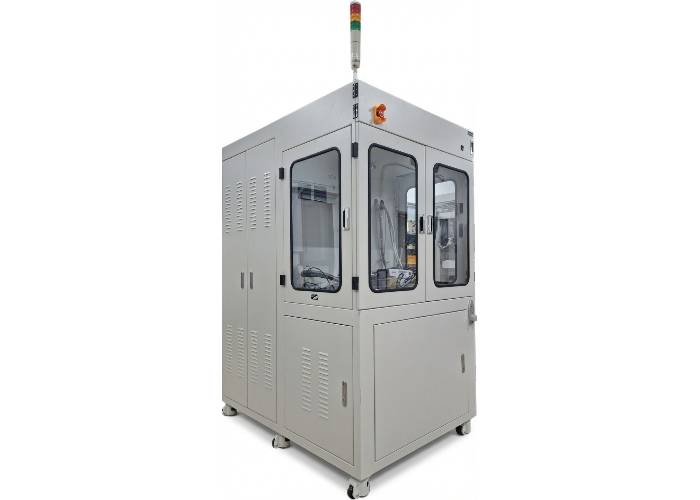
The SE30K-AL / SE50K-AL Stack Test Station is a high-power, instrumented platform designed to operate and characterise alkaline water electrolyser (AWE) stacks under controlled, repeatable conditions. It combines DC power delivery with balance-of-plant functions—KOH electrolyte circulation, gas handling, pressure/temperature control, and safety interlocks—to generate credible performance and durability data for hydrogen research and pilot-scale validation.
Principle of operation
In alkaline electrolysis, electrical energy drives water splitting in an aqueous alkaline electrolyte (commonly ~30 wt% KOH). The test station stabilises operating conditions around the stack—electrolyte flow, temperature, purge routines, and product-gas management—so researchers can quantify polarisation behaviour, efficiency, degradation rates, and gas crossover without building a bespoke rig.
Key specifications and features
- Power range: up to 50 kW (stack operation and dynamic load protocols)
- Cabinet footprint: 1400 (W) × 2200 (D) × 2000 (H) mm
- Gas flow measurement (typical ranges):
- SE30K-AL: up to ~150 slpm H₂ and ~75 slpm O₂
- SE50K-AL: up to ~250 slpm H₂ and ~125 slpm O₂ - Mass-flow control/measurement: turndown up to 100:1 with automated control logic
- Electrolyte loop: RT to ~95 °C temperature control, level monitoring/alarms, liquid–gas separation, and controlled circulation
- Gas conditioning: cooling/trap for condensate management, dryer/dew-point monitoring options
- Safety: auto N₂ purge, gas detection (H₂), alarm signalling and automated shutdown pathways
- Diagnostics: stack/channel voltage monitoring (selected channels); optional AC-impedance/HFR (10 mHz–10 kHz) for advanced characterisation
- Pressure control: automated back-pressure control (high-pressure options available)
Compatibility and typical applications
Suitable for AWE stacks used in catalyst screening scale-up, materials validation, long-duration durability studies, start/stop cycling, and pilot test protocols. The control/DAQ architecture supports integration with complementary tools (e.g., potentiostats for half-cell catalyst work, gas analysis, or broader hydrogen test station workflows).
Why ScienceGears
ScienceGears supplies these systems with local support across Australia & New Zealand, including selection guidance, installation/commissioning coordination, and integration with related electrochemistry and energy testing instrumentation.
Customer Reviews
Related Product
Explore our precision instruments designed for electrochemical research and energy applications




Still Wondering About Something?
Explore our FAQ for fast, clear answers to the most common questions—available 24/7.