
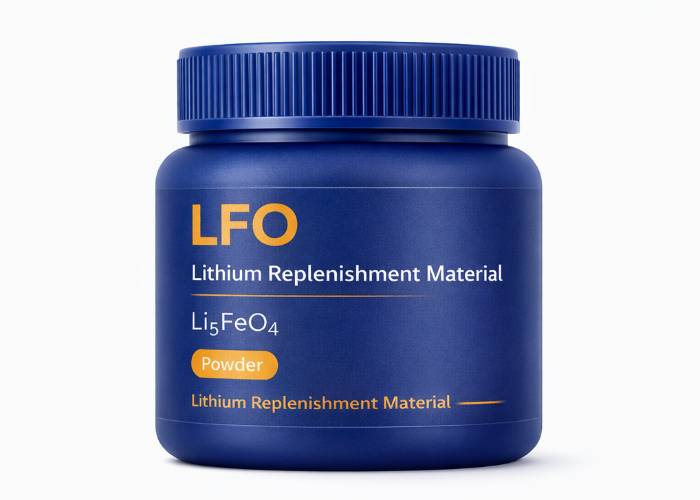
LFO, LFC Lithium Replenishment Material
LFO Lithium Replenishment Material (Li₅FeO₄) Powder
Overview
LFO (also referred to as LFC in some catalogues) is a lithium-rich iron oxide (Li₅FeO₄) used as a sacrificial lithium replenishment additive for LFP-based lithium-ion batteries. It is typically blended in small fractions with LFP cathode powder to compensate for irreversible lithium loss during first-cycle formation (mainly SEI growth on the anode), improving lithium inventory and practical energy density.
Working Mechanism (Formation-Time Lithium Release)
During the first charge, Li₅FeO₄ undergoes stepwise delithiation that releases lithium ions into the electrolyte within the LFP-compatible voltage window:
- First charging platform (≈3.5–4.0 V): Li₅FeO₄ → Li₃FeO₄ + 2Li⁺ + 2e⁻
- Second charging platform (≥4.0 V): Li₃FeO₄ → LiFeO₂ + 2Li⁺ + 2e⁻ (with potential oxygen evolution depending on conditions)
This behaviour is largely irreversible by design, so the additive primarily acts during formation rather than contributing to reversible cycling capacity.
Key Features
- Designed for LFP cathode systems (also used in selected ternary blends)
- High lithium-release capability (high theoretical charge capacity)
- Helps improve: initial coulombic efficiency (ICE), formation yield, and capacity retention in lithium-limited full cells
Compatibility & Typical Use Cases
- LFP cells paired with graphite or Si–C anodes (where first-cycle lithium loss is higher)
- High-loading electrodes and lithium-lean designs where lithium inventory is critical
- R&D optimisation of formation protocols (cut-off voltage, dwell steps, gas management)
Why Source via ScienceGears
ScienceGears supports Australian and New Zealand battery researchers with local supply and practical guidance on integration with battery fabrication workflows, including related categories such as battery cyclers, coin/pouch cell tooling, and electrochemical test equipment for formation and performance validation.
Customer Reviews
Related Product
Explore our precision instruments designed for electrochemical research and energy applications






Still Wondering About Something?
Explore our FAQ for fast, clear answers to the most common questions—available 24/7.