
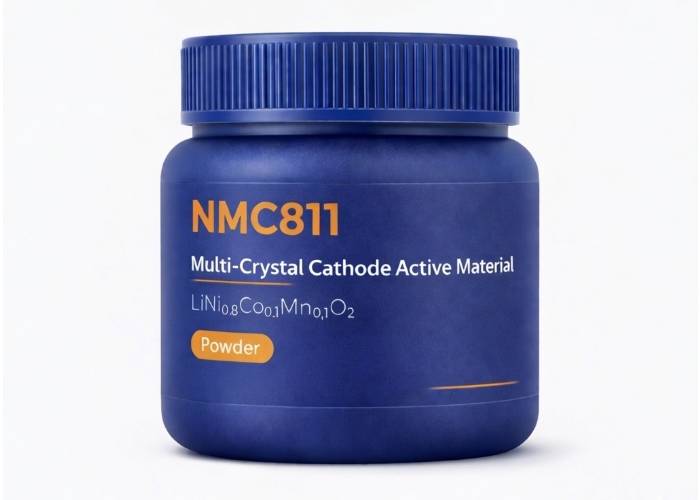
NMC811 Multi-Crystal Cathode Active Material
NMC811 Multi-Crystal Cathode Active Material (LiNi₀.₈Co₀.₁Mn₀.₁O₂) Powder
Overview
NMC811 Multi-Crystal Cathode Active Material (LiNi₀.₈Co₀.₁Mn₀.₁O₂) Powder is a nickel-rich layered oxide designed for high-energy lithium-ion battery research and electrode engineering. Its working mechanism is based on reversible Li⁺ intercalation/deintercalation within a layered crystal framework during charge/discharge, delivering high specific capacity when formulated into composite cathodes with suitable binders, conductive additives, and electrolytes.
What “Multi-Crystal” means (and why it matters)
This grade uses a multi-crystal (polycrystalline) morphology, where each secondary particle consists of many fused/sintered primary crystallites. Compared with single-crystal NMC, multi-crystal materials are commonly chosen to evaluate:
- Electrode packing density and calendaring response (how well the cathode compacts)
- Mechanical integrity of the cathode layer during cycling
- Microstructural changes such as particle-level cracking and pore evolution, which can influence impedance growth and ageing behaviour
Key features and typical specifications
- Particle size distribution: D10 5.0 ± 1.0 µm; D50 10.0 ± 2.0 µm; D90 20.0 ± 4.0 µm; Dmax ≤ 40 µm
- Moisture: ≤ 600 ppm
- Density targets: Tap density ≥ 2.1 g/cm³; Compacted density ≥ 3.2 g/cm³
- Specific surface area: 0.6 ± 0.3 m²/g
- Residuals/impurities control: pH ≤ 11.80; OH⁻ ≤ 0.40 wt%; CO₃²⁻ ≤ 0.30 wt%; Fe + Cr ≤ 100 ppb
- Electrochemical targets: Capacity ≥ 205 mAh/g; Efficiency ≥ 88%
Compatibility and applications
Suitable for slurry casting and coating on aluminium current collectors, and compatible with coin, pouch, and cylindrical lab-cell builds. Typical applications include:
- Cathode formulation optimisation and calendaring studies
- Cycling/ageing benchmarking and EIS diagnostics (with potentiostats)
- Electrolyte/additive screening and process-development workflows (with battery cyclers)
Why ScienceGears
ScienceGears supports ANZ researchers by helping integrate NMC811 cathode materials into complete battery testing workflows—from cell hardware and cyclers to potentiostats for mechanistic electrochemistry and impedance analysis.
Customer Reviews
Related Product
Explore our precision instruments designed for electrochemical research and energy applications









Still Wondering About Something?
Explore our FAQ for fast, clear answers to the most common questions—available 24/7.