
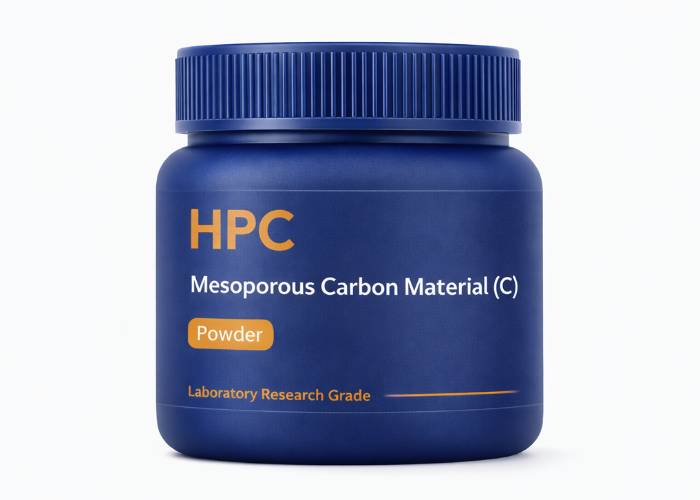
HPC Mesoporous Carbon Material (C) Powder
HPC Mesoporous Carbon Material (C) Powder
Overview
HPC Mesoporous Carbon Material is a porous carbon powder engineered as a high-performance conductive host for advanced battery electrodes. Its open porous structure features a large pore diameter (~130–150 nm) with thin pore walls (~15 nm), supporting efficient electrolyte access and rapid mass transport. The carbon framework is partially graphitised yet structurally disordered, balancing electrical conductivity with abundant defect sites for electrochemical functionality. Surface-level carbon, oxygen, and nitrogen are distributed uniformly, which can improve wettability and interfacial compatibility in electrode formulations.
Working principle in battery electrodes
In sulfur-based cathodes (e.g., lithium–sulfur systems), mesoporous carbon acts as a conductive scaffold that:
- physically accommodates active material within pores,
- promotes electron percolation through a conductive network, and
- helps stabilise interfacial reactions by improving electrolyte contact and ion transport pathways.
Key material attributes
- Pore architecture: ~130–150 nm pore diameter with ~15 nm wall thickness
- Carbon structure: partially graphitised, disordered carbon (conductive + defect-rich)
- Surface chemistry: uniform C/O/N distribution to support wetting and dispersion
- Form factor: fine powder suitable for slurry casting and composite fabrication
Compatibility and typical use
HPC mesoporous carbon is commonly incorporated into:
- sulfur–carbon composites (melt infusion or solution impregnation approaches)
- cathode slurries with standard binders (e.g., PVDF, water-based binders where applicable)
- research-scale coin cells, pouch cells, and lab test cells
Why source via ScienceGears (Australia & NZ)
ScienceGears supports researchers with practical selection guidance and end-to-end workflow alignment—linking electrode materials to battery cyclers, potentiostats/EIS, and compatible electrochemical cells for reproducible battery testing and electrochemical characterisation.
Customer Reviews
Related Product
Explore our precision instruments designed for electrochemical research and energy applications






Still Wondering About Something?
Explore our FAQ for fast, clear answers to the most common questions—available 24/7.