
The rotating ring-disk electrode (RRDE) is one of the most powerful tools in electrochemistry for understanding reaction mechanisms and catalyst performance. At the heart of RRDE measurements lies a critical parameter that determines data quality and interpretability: collection efficiency. This metric tells researchers what fraction of material generated at the disk electrode is actually detected at the ring electrode. Mastering RRDE collection efficiency calculation and measurement is essential for anyone conducting advanced electrochemical research, particularly in fuel cell development, battery technology, and electrocatalysis.
In this comprehensive guide, you'll learn how to calculate theoretical collection efficiency, measure it empirically, interpret your results accurately, and apply these insights across diverse electrochemistry applications. Whether you're optimizing oxygen reduction reaction (ORR) catalysts or investigating hydrogen evolution reactions (HER), understanding collection efficiency is the foundation of reproducible, meaningful RRDE data.
What Is RRDE Collection Efficiency?
Collection efficiency is the fraction of electrochemically generated species at the disk electrode that successfully reaches and reacts at the ring electrode. Expressed as a decimal or percentage (typically 0–1 or 0–100%), collection efficiency is defined by the ratio of ring current to disk current under specific conditions.
In simpler terms: if a molecule is oxidized or reduced at the disk, collection efficiency tells you the probability it will arrive at the ring electrode intact for detection. A collection efficiency of 0.25 means 25% of generated species reach the ring, while 75% are lost to competing chemical reactions or diffusion away from the electrode assembly.
Why RRDE Collection Efficiency Matters
Understanding and accurately determining collection efficiency unlocks several critical research advantages. This parameter directly influences how reliably you can interpret RRDE experiments and extract meaningful kinetic data.
Accurate reaction mechanism studies: When you know your collection efficiency, you can confidently determine whether reactions proceed via single-electron or multi-electron pathways. For oxygen reduction, RRDE allows researchers to distinguish between the desirable four-electron pathway and the less-efficient two-electron pathway that produces hydrogen peroxide as an intermediate.
Reliable faradaic efficiency measurement: Faradaic efficiency quantifies what percentage of electrons transferred that contribute to your desired product versus side reactions. Collection efficiency directly influences this calculation; without accurate efficiency values, FE calculations become unreliable and can vary dramatically with rotation rate.
Kinetic and electrocatalyst characterization: RRDE enables assessment of both kinetic parameters and reaction mechanisms for catalysts, which is invaluable for fuel cell and battery research. Collection efficiency is the bridge between raw current measurements and meaningful kinetic information.
Intermediate detection: RRDE excels at detecting short-lived intermediates in homogeneous solutions. Collection efficiency determines how sensitively you can detect these fleeting species before they decompose via competing chemical pathways.
Generator-collector experiments: By comparing empirical collection efficiency to apparent collection efficiency, researchers can quantify the decay rate of reaction intermediates—a powerful approach impossible with simpler electrochemical techniques.
How RRDE Collection Efficiency Works
Understanding the Electrode Geometry
The RRDE consists of two concentric electrodes: a central disk (typically glassy carbon) surrounded by a ring electrode (often platinum) with a non-conductive barrier separating them. The spacing between these electrodes is precisely controlled, usually around 375 μm. This geometry is critical because collection efficiency depends on the relative dimensions of the disk and ring for geometrically similar RRDE designs, rather than their absolute size.
The Role of Rotation and Laminar Flow
When the RRDE rotates, it creates laminar fluid flow patterns. Solution flows radially outward across the disk surface, then reverses and flows back inward across the ring electrode. Species electrogenerated at the disk travel through this controlled flow field to reach the ring. The rotation speed influences how quickly intermediates transit from disk to ring, which directly affects how much time unstable species have to decompose via competing reactions.
At faster rotation rates, the transit time decreases, allowing more intermediates to reach the ring intact. This is why rotation rate significantly influences apparent collection efficiency for unstable intermediates—though theoretical collection efficiency should remain constant regardless of speed.
Theoretical Versus Empirical Collection Efficiency
Theoretical collection efficiency is calculated from RRDE geometry (disk diameter, ring inner diameter, ring outer diameter) using mathematical equations. For a standard configuration with a 5 mm glassy carbon disk and platinum ring separated by 375 μm, theoretical efficiency is approximately 24.9%.
Empirical (or measured) collection efficiency is determined experimentally using a well-behaved, reversible redox system. The most common choice is the ferrocyanide redox couple: Fe(CN)64− ↔ Fe(CN)63+ + e⁻. Under limiting current conditions at high rotation rates, the measured ratio of ring anodic current to disk cathodic current gives you the empirical collection efficiency.
The empirical value is preferred in practice because it accounts for real-world variations in electrode machining, polishing effects, and temperature changes that can alter actual dimensions from nominal specifications.
Key Components of RRDE Collection Efficiency Measurement
Step 1: Prepare and Calibrate Your Electrodes
Begin with thorough electrode preparation. For glassy carbon disk electrodes, polish sequentially with 5 μm, 0.3 μm, and 0.05 μm alumina suspensions on microcloth, rinsing thoroughly between steps. For platinum ring electrodes, follow similar gentle polishing protocols. Poor electrode surface preparation introduces irreproducible roughness that affects current measurement and degrades collection efficiency determination.
Use a three-electrode system with stable reference electrode (typically reversible hydrogen electrode in acidic conditions) and platinum wire counter electrode. Before measurements, condition the working electrode at potentials where hydrogen or oxygen evolution occurs to ensure a consistent surface state.
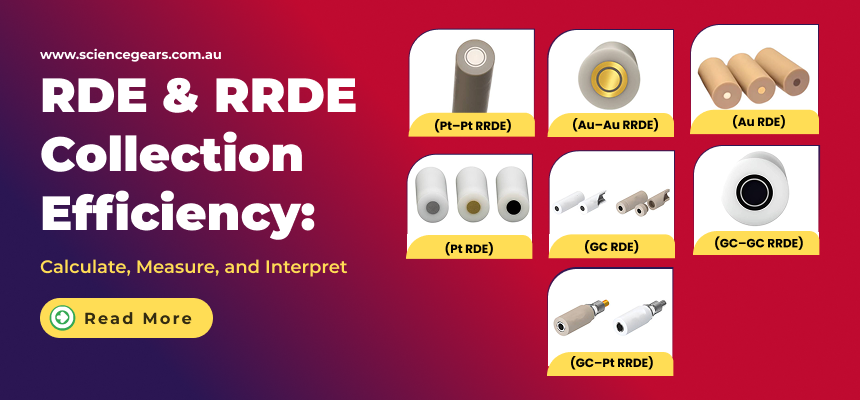
Electrode Selection for Your Research: ScienceGears offers precision-engineered RDE and RRDE electrodes in multiple material configurations. The Glassy Carbon Rotating Disk Electrode (GC RDE) provides an inert, smooth surface ideal for initial kinetic studies and baseline mechanistic investigations. For advanced catalyst characterization, the GC Disk, Pt Ring RRDE Electrode combines the chemical inertness of glassy carbon with platinum's superior intermediate detection capability, making it a widely adopted configuration for ORR and HER research. Each ScienceGears electrode is fabricated to tight mechanical tolerances for precise concentric alignment and reproducible collection efficiency determination.
Step 2: Prepare the Calibration Solution
Dissolve ferrocyanide ([Fe(CN)6]4−) and ferricyanide ([Fe(CN)6]3−) in your supporting electrolyte. A typical concentration is 10 mM for each species in 1 M KCl or a similar electrolyte. This redox couple is ideal because it exhibits rapid electron transfer kinetics, reversible behavior, and transport-limited currents across a wide potential window.
Ensure the solution is free of dissolved oxygen by degassing with nitrogen or argon if conducting more demanding studies, though oxygen-saturated solutions work acceptably for ferrocyanide calibration.
Step 3: Record Voltammograms at Multiple Rotation Rates
Using a potentiostat configured in bipotentiostat mode (controlling both disk and ring independently), sweep the disk potential linearly through the voltammetric window where you observe both oxidation and reduction of ferrocyanide. Hold the ring at a constant potential corresponding to the reverse reaction (oxidize if disk reduces ferrocyanide, or vice versa).
If you are still evaluating instruments or planning a new RRDE setup, it is crucial to match your RRDE requirements with the right control electronics. For a detailed breakdown of channels, current ranges, and RRDE-specific features, see How to Choose a Bipotentiostat: A Comprehensive Guide to Electrochemistry Research.
Perform measurements at several rotation rates spanning your typical experimental range—commonly 400 to 2000 rpm. Ensure the system reaches steady state at each rotation rate before recording data; allow 2–3 minutes for current stabilization.
Step 4: Identify Limiting Currents and Calculate Empirical Efficiency
In the voltammogram, identify regions where current plateaus, indicating mass-transport limitation. These limiting currents—one for the disk reduction, one for ring oxidation—are independent of applied potential but proportional to rotation rate.
Empirical collection efficiency is calculated as: N = –Iring / Idisk, where Iring is anodic (positive) limiting current and Idisk is cathodic (negative) limiting current.
Because both limiting currents scale with rotation rate to the same power (ω0.5), the ratio remains constant—empirical collection efficiency should be independent of rotation speed. If you observe significant variation with rotation rate, investigate electrode surface conditions or experimental parameters.
Step 5: Validate Consistency Across Multiple Runs
Repeat the collection efficiency measurement after several days, following electrode cleaning and repolishing protocols. Empirically determined collection efficiency should remain consistent when measured with the same electrode geometry. Once established, treat this value as a fixed property of that specific RRDE for all subsequent experiments.
Best Practices and Tips for RRDE Collection Efficiency
Employ high rotation rates for intermediate studies: When investigating reaction intermediates that decay via competing chemical pathways, use rotation rates exceeding 1000 rpm when possible. Higher speeds minimize transit time, allowing unstable species to reach the ring before decomposition, bringing apparent efficiency closer to empirical efficiency.
Always measure empirical efficiency, don't assume theoretical values: While theoretical collection efficiency calculations are straightforward, real RRDE electrodes deviate from nominal dimensions due to machining tolerances and polishing effects. Empirical measurement is the only reliable approach for your specific electrode.
Use charge-based faradaic efficiency calculations for robustness: Rather than calculating FE from instantaneous current values at specific potentials, integrate ring and disk currents over a complete voltammetric cycle to obtain charge values. This charge-based approach is remarkably stable across varying rotation rates and scan rates, minimizing artifacts from transient time delays.
Maintain rigorous electrode cleaning protocols: Contamination or oxidized surface layers dramatically reduce signal quality and reproducibility. For routine use, polish with 0.05 μm alumina followed by ultrasonic rinsing. For degraded performance, implement periodic cleaning with sequential 0.3 and 0.05 μm steps. For severely contaminated surfaces, use aggressive five-micron polishing followed by periodic and routine steps.
Pair your electrodes with appropriate electrode materials for your research goals: The material composition of your RRDE directly impacts collection efficiency and catalytic response. The Platinum Rotating Disk Electrode (Pt RDE) is exceptional for hydrogen and oxygen evolution studies, delivering superior catalytic activity and reproducible surface characteristics. For more complex mechanistic studies involving multiple electrode types, consider the Platinum–Platinum Rotating Ring-Disk Electrode (Pt–Pt RRDE), which delivers a typical empirical collection efficiency of approximately 37% (depending on electrode geometry and surface condition), with excellent durability across acidic, alkaline, and neutral electrolytes. Alternatively, the Glassy Carbon–Glassy Carbon Rotating Ring-Disk Electrode (GC–GC RRDE) offers a symmetric, non-catalytic configuration (~37% collection efficiency) ideal for baseline mechanistic studies and reference experiments.
Control environmental conditions: Stable temperature (±1°C), proper solution degassing (if required), and electromagnetic shielding of your measurement cell all enhance reproducibility. Temperature fluctuations alter solution viscosity and diffusion coefficients, shifting limiting currents and distorting efficiency calculations.
Account for reference electrode stability: Drift in reference electrode potential introduces systematic errors into potential-dependent measurements. For long experiments, verify reference electrode stability periodically. Store Ag/AgCl electrodes in 3 M KCl; allow adequate equilibration time before measurements.
Select appropriate scan rates and potential windows: For collection efficiency calibration, use moderate scan rates (10 mV/s typical) that allow full establishment of limiting currents without excessive background charging current. Narrow potential windows (just sufficient to encompass the limiting current plateau) reduce experimental noise.
Common Mistakes to Avoid in RRDE Collection Efficiency Determination
Confusing theoretical and empirical collection efficiency: Researchers sometimes apply theoretical efficiency values calculated from nominal dimensions without experimental validation. This introduces systematic errors because actual electrode dimensions often differ from specifications, particularly after polishing or thermal cycling.
Ignoring rotation rate dependence of apparent efficiency: For unstable intermediates, apparent collection efficiency decreases at lower rotation rates as more intermediate decomposes before reaching the ring. Failing to recognize this effect leads to misinterpretation of reaction mechanisms and incorrectly calculated electron transfer numbers.
Using inconsistent or unstable ring potential: The ring electrode potential must be set precisely to detect your target species under mass-transport-limited (diffusion-controlled) kinetics. If ring potential drifts or is set too far from the diffusion limit, your measured ring current becomes kinetically limited rather than diffusion-limited, invalidating collection efficiency assumptions.
Inadequate electrode surface preparation: Rough, oxidized, or contaminated electrode surfaces introduce irreproducible currents and shift measured collection efficiency values. Many researchers underestimate the importance of proper polishing; spending 10–15 minutes on thorough electrode conditioning pays dividends in data quality.
Not verifying empirical efficiency consistency over time: After determining collection efficiency, some researchers assume this value remains valid indefinitely. In reality, electrode surface changes, temperature cycling, and solution contamination can alter effective geometry. Periodic re-verification (monthly or after significant experiments) confirms your efficiency values remain valid.
Misapplying collection efficiency from one electrode to another: Different RRDE electrodes—even from the same manufacturer—exhibit different collection efficiencies due to manufacturing tolerances. Never assume your calibrated efficiency applies to a different electrode. Always re-measure when switching electrode units.
Neglecting transient time effects in fast scan experiments: At very high scan rates (>50 mV/s) combined with low rotation rates (<500 rpm), transient time delay becomes significant. Ring current response lags disk current generation, and direct current-ratio FE calculations become unreliable. Charge integration methods are more robust in these conditions.
FAQs About RRDE Collection Efficiency
What is a typical collection efficiency value for standard RRDEs?
Most commercially available RRDEs exhibit theoretical collection efficiencies between 20% and 45%, depending on electrode geometry. A glassy carbon disk with platinum ring separated by 375 μm yields approximately 24.9% theoretical efficiency. For platinum-based systems like the Pt–Pt RRDE from ScienceGears, typical empirical collection efficiency is around 37%, making such electrodes popular for intermediate quantification studies. Empirically measured values typically fall within the expected range, though variations occur based on machining tolerances and surface conditions.
How do I know if my measured collection efficiency is correct?
Empirically measured collection efficiency should be independent of rotation rate when using the ferrocyanide redox couple at limiting current conditions. If your measured value changes substantially (>5%) across rotation speeds from 400 to 2000 rpm, suspect electrode surface problems, solution contamination, or improper potential selection. Additionally, compare your measured value to theoretical predictions for your electrode geometry; large discrepancies warrant investigation.
Can collection efficiency change during an experiment?
Yes, collection efficiency can shift if electrode surfaces become contaminated or oxidized during measurements, particularly in aggressive electrochemical environments (high potentials, caustic solutions). This is rare but possible. If you conduct lengthy experiments, re-measure collection efficiency beforehand and afterward to confirm stability. Store RRDE electrodes under inert conditions and handle carefully to prevent surface degradation.
Why does collection efficiency matter more for some reactions than others?
For reactions generating stable, non-reactive intermediates (e.g., simple electron transfer with no subsequent chemistry), collection efficiency is less critical because apparent efficiency equals empirical efficiency across rotation rates. However, for reactions producing unstable intermediates (ORR producing H₂O₂, CO₂ reduction producing various products), collection efficiency is vital because apparent efficiency varies dramatically with rotation rate and kinetics.
Should I use theoretical or empirical collection efficiency in my calculations?
Always use empirically measured collection efficiency for any quantitative analysis. Theoretical values provide useful reference points but do not account for real-world variations in machining, polishing, or temperature effects. Empirical measurement requires only 20–30 minutes and provides far superior accuracy.
How does the bipotentiostat configuration affect collection efficiency measurement?
The bipotentiostat (dual potentiostat) controls disk and ring electrodes independently, enabling precise potential selection for each electrode. This is essential for collection efficiency calibration because you must set ring potential precisely at the diffusion limit for your detection reaction. Single channel potentiostats cannot independently control disk and ring potentials and are therefore not suitable for quantitative RRDE collection efficiency measurements. For a structured checklist on comparing different bipotentiostats for RRDE and general electrochemistry, refer to How to Choose a Bipotentiostat: A Comprehensive Guide to Electrochemistry Research.
Can I use different redox systems besides ferrocyanide for collection efficiency calibration?
Yes, any rapidly reversible redox couple that exhibits transport-limited kinetics across your potential window works. However, ferrocyanide is the gold standard because of its well-documented kinetics, stability, and availability. Other systems (Fe²⁺/Fe³⁺, hydroquinone/quinone) are occasionally used but offer no advantages for calibration purposes.
What happens if my ring electrode is dirty or damaged?
Contamination or physical damage to the ring electrode severely distorts current response and makes collection efficiency determination unreliable. Ring electrode damage typically manifests as anomalously low (or inconsistent) measured collection efficiency despite healthy disk performance. Professionally resurface damaged ring electrodes or replace the electrode assembly.
RRDE Collection Efficiency Applications Across Electrochemistry Research
The power of RRDE collection efficiency extends across numerous electrochemical research domains, each leveraging this parameter for unique mechanistic or performance insights.
Oxygen Reduction Reaction (ORR) studies represent the most widespread RRDE application. Fuel cell and metal-air battery development depends on understanding whether ORR catalysts promote the efficient four-electron pathway (O₂ + 4e⁻ + 4H⁺ → 2H₂O) or the undesirable two-electron pathway producing hydrogen peroxide. By holding the ring at a potential that oxidizes H₂O₂, researchers directly measure hydrogen peroxide production, quantify Faradaic efficiency, and screen thousands of catalyst formulations. For a detailed explanation, see our guide on RRDE Applications in Fuel Cells: Measuring ORR Selectivity and Peroxide Yield.
Hydrogen Evolution Reaction (HER) kinetics benefit from RRDE analysis, particularly when investigating hydrogen peroxide formation at competing sites or in systems where intermediate hydrogen atoms interact with catalyst surfaces. RRDE enables real-time quantification of side reactions and selectivity toward desirable pathways.
Carbon Dioxide Reduction (CO₂RR) research uses RRDE to distinguish between reduction products—carbon monoxide, formic acid, alcohols, or hydrocarbons each form via different electron transfer pathways. Collection efficiency enables researchers to quantify product selectivity and optimize catalyst design for specific target products.
Heterogeneous catalysis mechanism studies employ RRDE to probe intermediate decomposition kinetics on catalyst surfaces. By measuring apparent collection efficiency at varying rotation rates and comparing to empirical efficiency, researchers deduce intermediate lifetime and reaction rate constants—information inaccessible through simpler electrochemical methods.
Hydrogen oxidation and fuel cell anode reactions can be systematically characterized using RRDE, yielding detailed kinetic parameters and reaction order information that guides catalyst development for next-generation fuel cells.
Homogeneous electrocatalytic studies of compounds catalyzing oxygen reduction benefit from RRDE's ability to detect H₂O₂ production and distinguish competing reaction pathways. This approach is increasingly common in molecular catalyst research, where traditional electrochemical methods don't apply. For specialized applications involving sulfur, halide, and oxygen-based reactions, the Gold–Gold Rotating Ring-Disk Electrode (Au–Au RRDE) from ScienceGears offers excellent conductivity, corrosion resistance, and catalytic selectivity (~37% collection efficiency) ideal for CO₂ reduction, thiol oxidation, and advanced mechanistic studies.
Redox flow battery development leverages RRDE to measure faradaic efficiency and selectivity of battery reactions, particularly oxygen evolution reaction (OER) and hydrogen evolution reaction (HER) at negative electrodes—critical factors determining battery cycle life and round-trip efficiency.
The ScienceGears Multi-Function RRDE System exemplifies modern instrumentation supporting these diverse applications. This 4-in-1 platform combines precise rotating disk and ring-disk electrode capabilities with integrated spin coating functionality, enabling researchers to fabricate, modify, and electrochemically characterize catalytic materials in a single integrated workflow.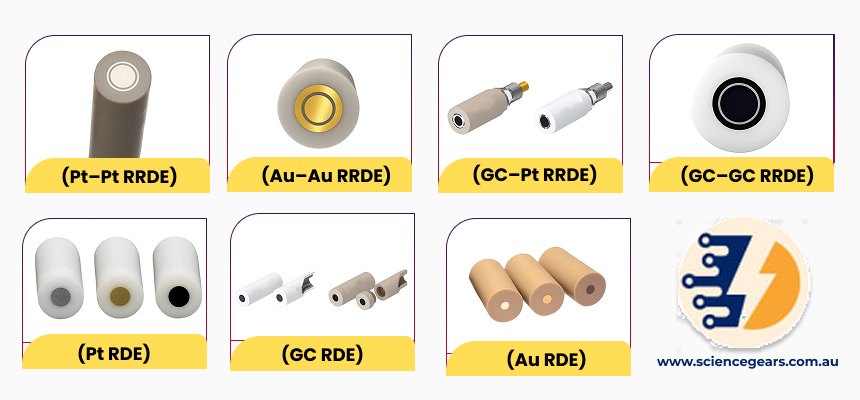
Conclusion
RRDE collection efficiency is far more than an abstract electrochemistry parameter—it is the fundamental bridge connecting raw electrode currents to meaningful chemical insights. By mastering collection efficiency calculation, measurement, and interpretation, researchers unlock the full potential of RRDE for catalyst development, reaction mechanism elucidation, and selectivity optimization across fuel cells, batteries, electrosynthesis, and beyond.
The key takeaways are straightforward: always empirically measure collection efficiency rather than relying on theoretical predictions; maintain rigorous electrode preparation and environmental controls; use charge-based Faradaic efficiency calculations for improved robustness across varying experimental conditions; and understand how rotation rate and intermediate stability interact to influence apparent versus empirical efficiency.
Whether you're optimizing oxygen reduction catalysts for fuel cells, developing hydrogen evolution reaction electrocatalysts for water splitting, or designing selective carbon dioxide reduction systems, investing time in proper RRDE collection efficiency determination will substantially improve your experimental reproducibility, data interpretation, and ultimately, your research outcomes. Start today by measuring empirical collection efficiency on your RRDE system, and build a foundation of quantitative confidence for all your subsequent electrochemistry investigations.
Explore ScienceGears' complete range of RDE and RRDE electrodes to find the perfect material configuration for your specific research needs.