

SE100K-PEAL Stack Test Station (100 kW) for PEM & Alkaline/AEM Water Electrolysers
SE100K-PEAL Stack Test Station (100 kW) for PEM & Alkaline/AEM Water Electrolysers
High-power stack validation for next-generation electrolysers
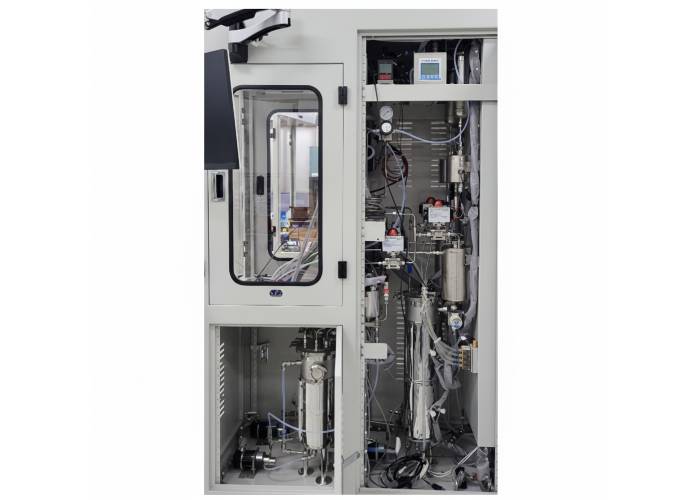
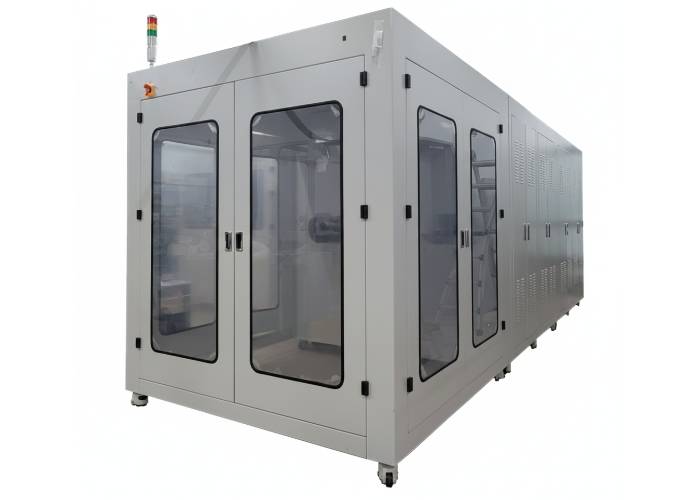
The SE100K-PEAL is a high-power water electrolyser stack test station designed to characterise and validate PEM stacks as well as alkaline or AEM systems in a controlled, instrumented environment. At its core, the station combines a precision power platform with closed-loop fluid and gas management so researchers can quantify performance, stability, and safety under realistic operating conditions.
Principle of operation
The station delivers controlled electrical drive to the stack while maintaining stable temperature, pressure, and reactant delivery. Integrated sensing continuously tracks operating variables (electrical, thermal, flow, and gas-side parameters), enabling repeatable polarisation mapping, load cycling, and long-duration durability studies.
Key features and specifications
- Maximum test power: up to 100 kW (stack-level testing)
- System footprint: 1500 (W) × 3000 (D) × 2200 (H) mm
- Automated N₂ purge sequencing and operational interlocks for safe start/stop behaviour
- Back-pressure control with stable regulation (high-pressure capability available as an option)
- Configurable gas cooling/condensate trapping and drying/filtration to protect sensors and improve data integrity
- Electrolyte/water circulation modules with temperature conditioning and level monitoring to support both DI-water (PEM) and alkaline/AEM liquid management
- Optional high-frequency resistance / impedance-style diagnostics and multi-channel voltage monitoring for stack health insight
Compatibility and typical applications
- R&D and scale-up testing for PEM, alkaline, and AEM electrolyser stacks
- Polarisation curves, efficiency and energy-balance studies, dynamic load profiles, and start–stop validation
- Materials and component development (membranes, catalysts, porous transport layers, separators) under realistic stack conditions
Why source through ScienceGears
ScienceGears supports researchers in Australia and New Zealand with local guidance on configuration, installation planning, and application fit, and can align the test station with related instrumentation workflows such as potentiostats (electrode/material screening), spectroscopy and in-situ cells (mechanistic studies), and broader energy test station infrastructure.
Customer Reviews
Related Product
Explore our precision instruments designed for electrochemical research and energy applications


Still Wondering About Something?
Explore our FAQ for fast, clear answers to the most common questions—available 24/7.