
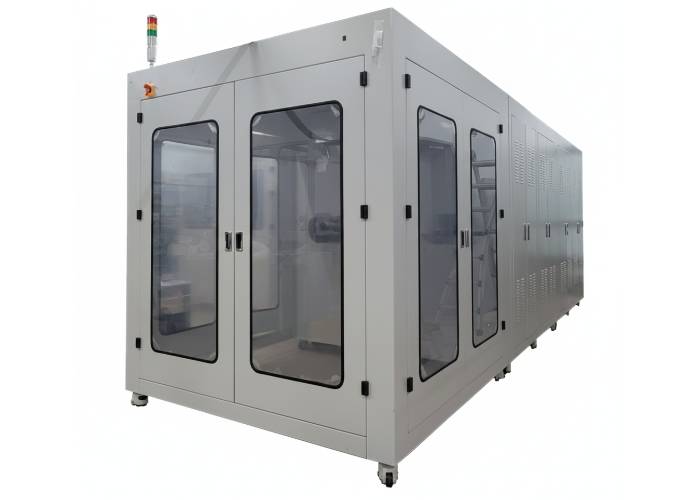
SE200K-PEAL Stack Test Station (200 kW) for PEM & Alkaline (or AEM) Water Electrolysis
SE200K-PEAL Stack Test Station (200 kW)
Overview and working principle
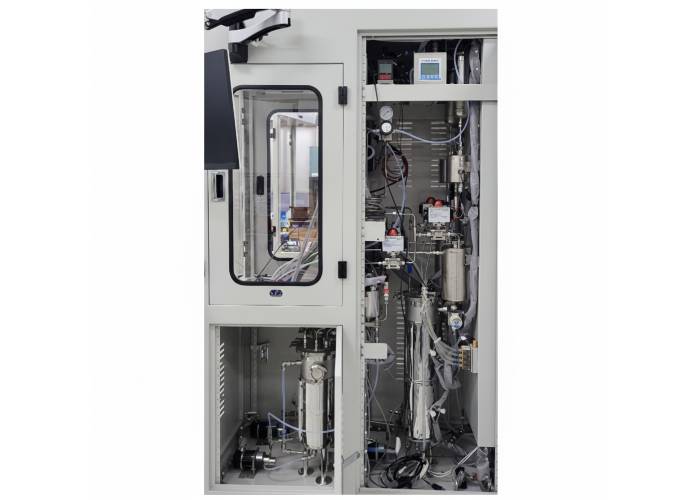
The SE200K-PEAL Stack Test Station (200 kW) is a high-power, integrated platform for controlled testing of water electrolyser stacks across PEM and alkaline (or AEM) architectures. It combines a programmable DC power delivery system with a managed balance-of-plant (BoP)—including liquid circulation, gas–liquid separation, gas flow measurement, safety interlocks, and data logging—so researchers can quantify performance, efficiency and durability under repeatable conditions.
In operation, the station drives the stack at defined current/voltage profiles while regulating process conditions (flow, temperature and pressure). Product gases are conditioned and monitored, supporting safe, traceable testing at elevated power levels.
Key specifications and configuration highlights
- Test range: up to 200 kW
- System dimensions: 1800 (W) × 4000 (D) × 2200 (H) mm
- Gas flow measurement (typical capacity): H₂ up to 1000 slpm, O₂ up to 500 slpm
- Mass flow performance: turndown up to 100:1
- Automated N₂ purge: anode and cathode purge via MFC control
- Back-pressure control: up to 10 bar (optional 30 bar)
- Cell voltage monitoring: nominated channels, ±5 V/channel
- Optional diagnostics: AC-impedance / HFR (10 mHz to 10 kHz), including multi-channel HFR options
Fluid-path compatibility
- PEM mode (anode): DI-water loop with temperature control (RT to ~95 °C), level/alarm logic and conductivity monitoring
- Alkaline/AEM mode (anode & cathode): electrolyte circulation with temperature control (RT to ~95 °C), level/alarm monitoring and gas–liquid separation
Typical applications
- High-power stack validation and scale-up studies (PEMWE, alkaline WE, AEMWE)
- BoP optimisation: pumps, separators, dryers/filters, pressure management and controls
- Efficiency mapping, durability protocols, start–stop cycling, and safety-limit characterisation
Why choose ScienceGears
ScienceGears supports AU & NZ teams with configuration guidance, commissioning support, and integration advice—including complementary instrumentation such as potentiostats (for electrochemical diagnostics/HFR), gas analysis, electrochemical cells, and broader energy test station workflows.
Customer Reviews
Related Product
Explore our precision instruments designed for electrochemical research and energy applications


Still Wondering About Something?
Explore our FAQ for fast, clear answers to the most common questions—available 24/7.