

Stack Test Station (5–10 kW) – PEM & Alkaline (or AEM) Water Electrolyser Test Station (SE5K-PEAL, SE10K-PEAL)
Stack Test Station (5–10 kW) – SE5K-PEAL / SE10K-PEAL
Principle of operation
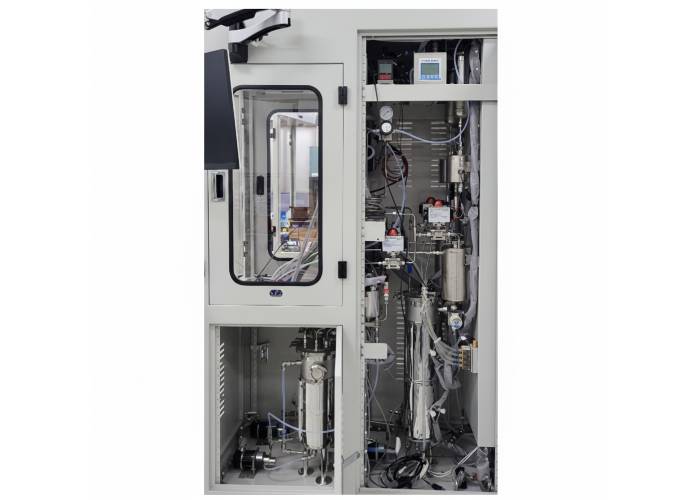
SciTech Korea’s SE5K-PEAL / SE10K-PEAL Stack Test Station is a fully integrated water electrolyser test platform for controlled characterisation of PEM and liquid-electrolyte systems (alkaline or AEM). The station delivers regulated DC power to an electrolyser stack while managing the supporting balance-of-plant functions—electrolyte/water circulation, gas handling, thermal control, pressure regulation, and safety interlocks. This enables repeatable measurement of polarisation behaviour, energy efficiency, and durability under steady-state or dynamic operating profiles up to 10 kW.
Key features and specifications (5–10 kW platform)
- Test capacity: 5 kW (SE5K-PEAL) or 10 kW (SE10K-PEAL)
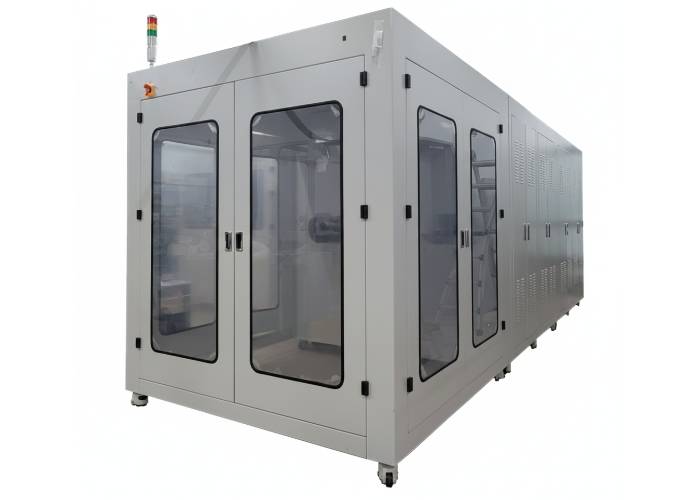
- Station dimensions: 1400(W) × 2200(D) × 2000(H) mm
- Mass flow control & purge: high-precision MFC/MFM control (turndown 100:1) with automated N₂ purge routines
- Electrolyte circulation: RT–95 °C temperature control, level monitoring/alarms, gas–liquid separation and filtration (DI-water loop for PEM; liquid loop for alkaline/AEM)
- Gas conditioning: gas cooling with condensate trap, dryer/gas filtration and optional dew-point monitoring
- Crossover monitoring: H₂-in-O₂ and O₂-in-H₂ concentration sensing to support safety logic and quality control
- Pressure management: automated back-pressure control (up to 10 bar, with higher-pressure options available by configuration)
- Electrochemical diagnostics: multi-channel cell-voltage monitoring (±5 V/channel) with optional AC impedance / HFR capability (10 mHz–10 kHz)
Compatibility and typical applications
Designed for research stacks and pilot-scale development, the station supports PEMWE, alkalineWE, and AEMWE workflows, including start/stop cycling, dynamic load testing, long-duration stability studies, and rapid screening of catalysts, membranes, and stack components.
Why choose ScienceGears
ScienceGears provides local Australia & New Zealand support for commissioning, training, and method development. We can also help integrate complementary research tools—such as potentiostats/bipotentiostats (EIS), specialised electrochemical cells, and in-situ spectroscopy platforms (e.g., Raman-enabled setups)—to deepen mechanistic understanding alongside system-level performance.
Customer Reviews
Related Product
Explore our precision instruments designed for electrochemical research and energy applications


Still Wondering About Something?
Explore our FAQ for fast, clear answers to the most common questions—available 24/7.