
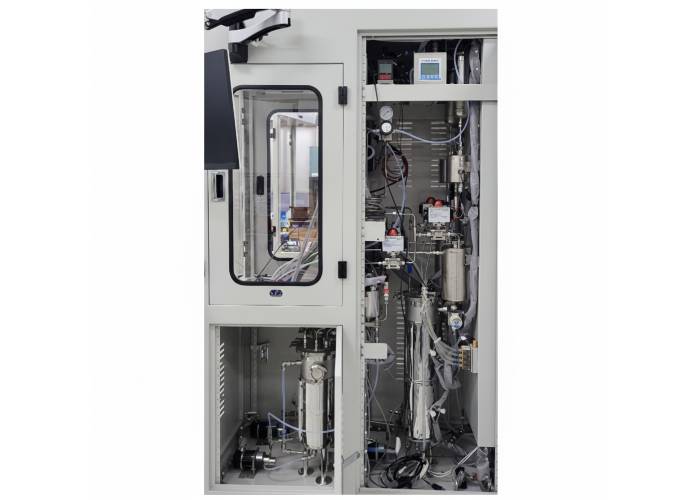
Water Electrolyser Stack Test Station (1–3 kW) – SE1K-PEAL / SE3K-PEAL
Water Electrolyser Stack Test Station (1–3 kW) – SE1K-PEAL / SE3K-PEAL
Overview and Working Principle
The SciTech Korea SE1K-PEAL / SE3K-PEAL Stack Test Station is a fully integrated water electrolysis research platform for controlled testing of PEM, alkaline or AEM electrolysers from ~1 to 3 kW. A programmable DC power supply drives the electrolyser under precisely defined current/voltage conditions, while the station manages the balance-of-plant (BoP): reactant circulation, temperature, pressure and gas handling.
Hydrogen and oxygen streams are conditioned through cooling and liquid–gas separation, enabling stable gas flow measurement, safer vent management, and optional gas quality checks for crossover diagnostics. The result is repeatable, lab-grade electrochemistry data suitable for stack development and system optimisation.
Key Features and Specifications (1–3 kW class)
- Power range: up to 3 kW (1 kW and 3 kW configurations)
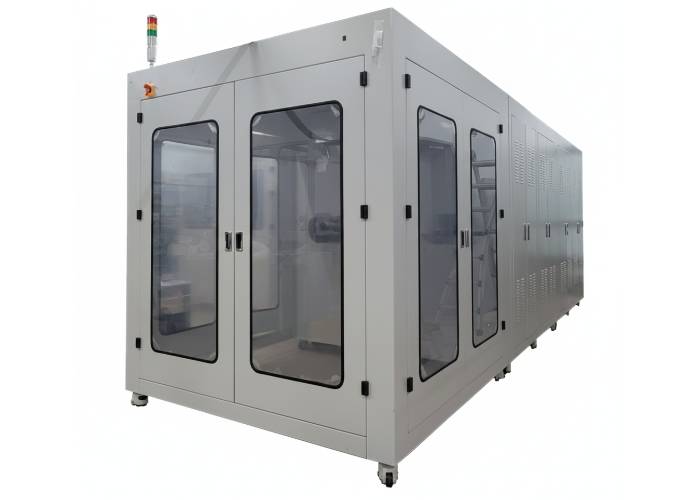
- Station size: 800 (W) × 1300 (D) × 2000 (H) mm
- Gas metrology: mass flow measurement suitable for small-stack operation (typical capability up to ~15 slpm H₂ for 3 kW class systems)
- Thermal control: liquid temperature regulation from ambient to ~95 °C, with line heating where required
- Pressure control: automated back-pressure regulation (commonly 10 bar, with higher-pressure options available)
- Gas conditioning & monitoring: drying/filtration, dew-point monitoring, and optional H₂-in-O₂ / O₂-in-H₂ concentration sensing
- Safety & automation: automated purge, alarms/interlocks, and shutdown logic for safer operation
Compatibility and Configurability
- PEM mode: DI-water feed and anode-side water management
- Alkaline / AEM mode: electrolyte circulation (e.g., KOH-based) with corrosion-resistant tanks, pumps and fittings
- Flexible configuration for single cell or small stack fixtures, external chillers, and additional analysers.
Typical Applications
- Polarisation mapping, start/stop cycling, and durability studies
- Hydrogen production efficiency and BoP optimisation
- Screening of catalysts, membranes/diaphragms and electrode architectures
Why Choose ScienceGears (Australia & New Zealand)
ScienceGears supports selection, commissioning and local technical support, and can package complementary research instruments such as potentiostats (materials screening), optional HFR/impedance modules, and relevant in-situ spectroscopy accessories where required.
Customer Reviews
Related Product
Explore our precision instruments designed for electrochemical research and energy applications


Still Wondering About Something?
Explore our FAQ for fast, clear answers to the most common questions—available 24/7.