
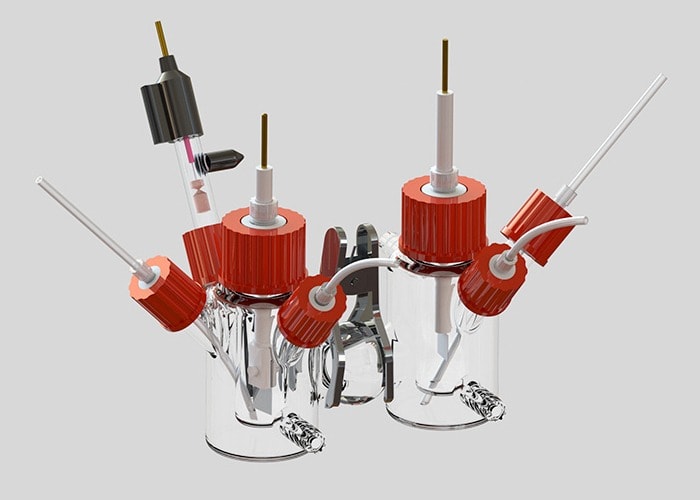


Jacketed H-Type Membrane Cell (Temperature-Controlled Dual-Compartment Electrochemical Cell)
Jacketed H-Type Membrane Cell
Overview and working principle
The Jacketed H-Type Membrane Cell is a dual-compartment electrochemical reactor designed for membrane-separated experiments where the anode and cathode chemistries must be isolated. Two borosilicate glass chambers are joined by a central membrane interface (ion-exchange membrane supplied by the user), enabling selective ionic transport while limiting product crossover and unwanted mixing.
A water-circulation jacket surrounds each compartment and connects to an external recirculating chiller/heater. This allows tight temperature regulation—critical for kinetics, gas solubility, membrane conductivity, and reproducible electrochemical data.
Key features and construction
- Borosilicate glass chambers for chemical resistance and clean electrochemistry
- Water jacket on each half-cell for stable thermal control during long experiments
- Replaceable membrane design to suit PEM/AEM/other separators (e.g., Nafion, anion-exchange membranes)
- Three-electrode compatibility (working + reference in one chamber; counter in the other) to support accurate control and low solution resistance artefacts
- Leak-resistant sealing using PTFE cap hardware and O-rings (typical) for reliable operation
- Multiple chamber volume options (commonly 20–250 mL per compartment) for low-reagent use or higher throughput
Compatibility and typical applications
Ideal for researchers running membrane-separated electrochemistry with controlled atmospheres and temperature, including:
- CO₂ reduction (CO2RR), nitrogen reduction (NRR), and selective electrosynthesis
- Water splitting and catalyst screening (anodic/cathodic isolation)
- Ion-transport and membrane screening studies
- Corrosion and inhibitor studies where cross-contamination must be avoided
- Redox mediator or crossover-sensitive systems
Why choose ScienceGears
ScienceGears supports end-to-end electrochemistry workflows in Australia and New Zealand—pair this cell with potentiostats/galvanostats, ion-exchange membranes, electrodes, and (where relevant) spectroelectrochemistry or battery cycler platforms to build a complete, research-ready setup.
For further information or to discuss your specific research requirements, please contact us.
Technical Specifications
Precision engineering for accurate measurements
| Capacity | 20ML, 30ml, 50ml, 100ml, 150ml, 200ml, 250ml |
|---|
Resources & Downloads
Everything you need to get started

Electrochemical Impedance Spectroscopy (EIS): Core Concepts for Confident Understanding
Squidstat - Admiral
Customer Reviews
Related Product
Explore our precision instruments designed for electrochemical research and energy applications
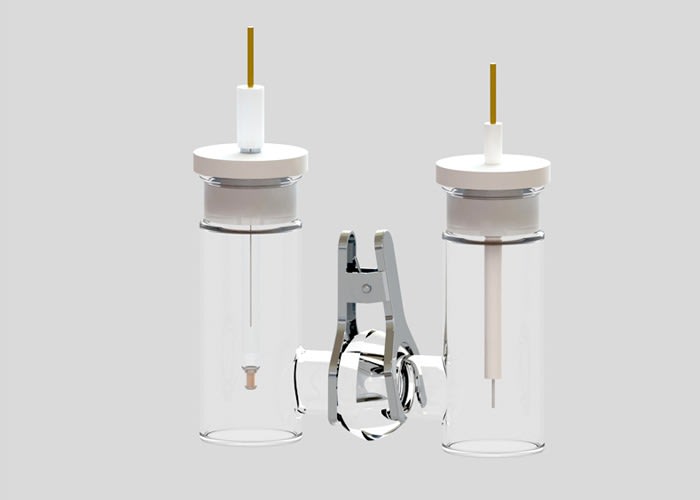
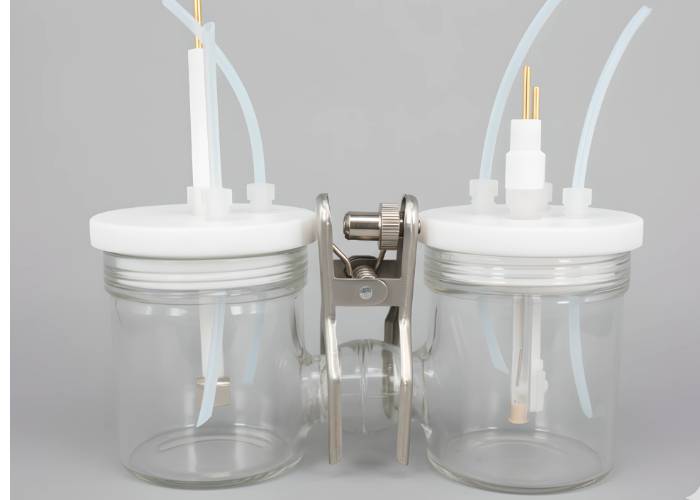
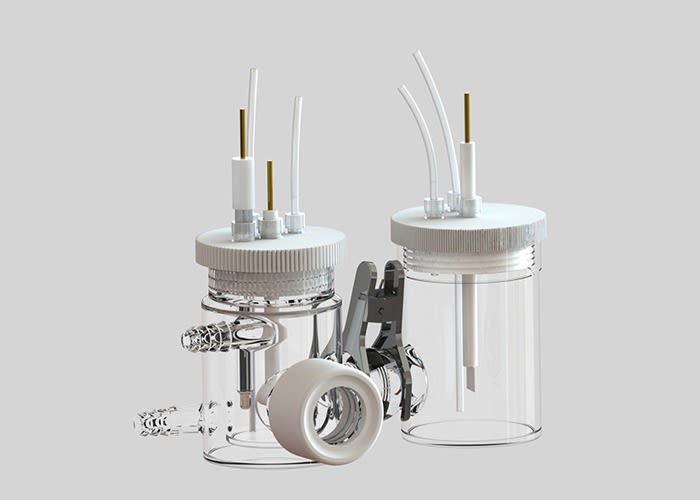
Sealed H-Cell – Gas-Tight Dual-Compartment Electrochemical Cell
- Capacity: 20ML, 30ml, 50ml, 100ml, 150ml, 200ml, 250ml

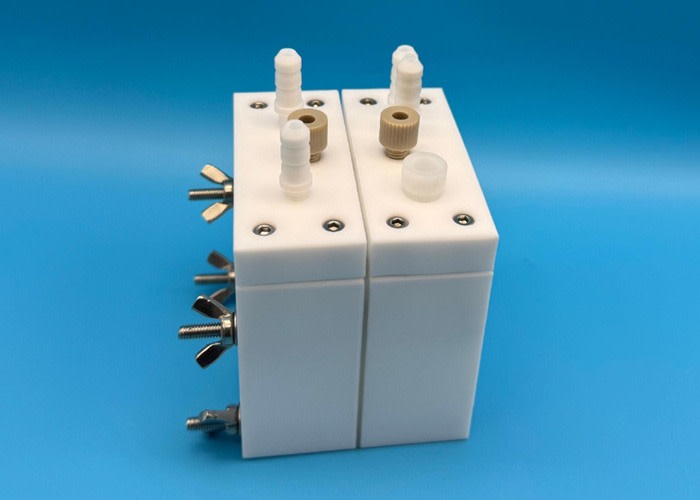
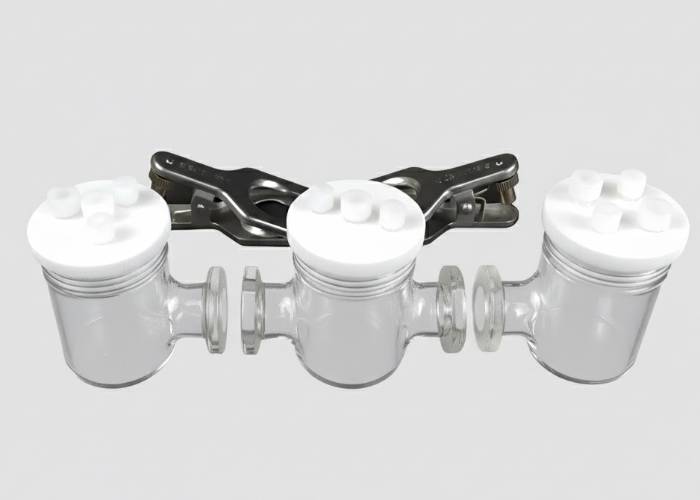
Three-Chamber H-Cell (Triple H-Cell) – Gas-Tight Electrochemical Cell
- Capacity: 20ML, 30ml, 50ml, 100ml, 150ml, 200ml, 250ml

Still Wondering About Something?
Explore our FAQ for fast, clear answers to the most common questions—available 24/7.