
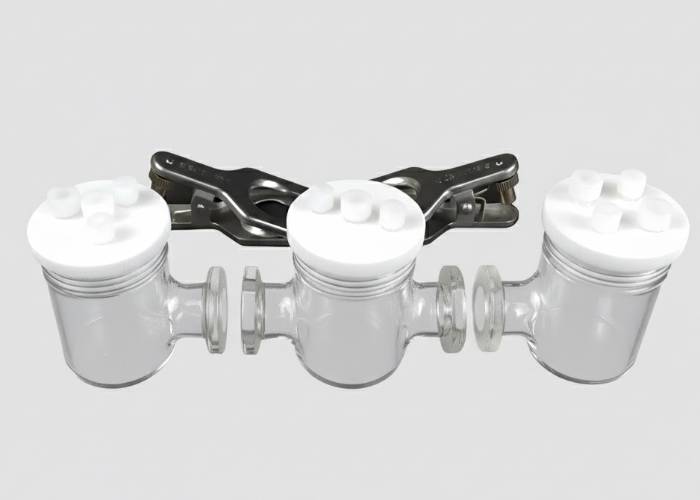
Three-Chamber H-Cell (Triple H-Cell) – Gas-Tight Electrochemical Cell
Three-Chamber H-Cell (Triple H-Cell) – Gas-Tight Electrochemical Cell
Three-compartment control for cleaner electrochemistry
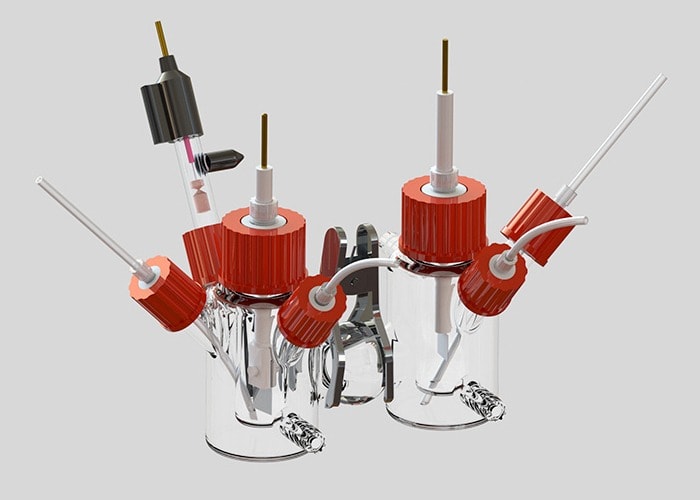
A Three-Chamber H-Cell (Triple H-Cell) is designed for experiments where anode, cathode, and an intermediate/conditioning chamber must be physically separated while still allowing selective ionic transport. The compartments are assembled in a modular H-cell format and can be configured with ion-exchange membranes (e.g., cation/anion-exchange films) between chambers to minimise cross-over, prevent product re-oxidation/reduction, and stabilise sensitive reference conditions.
How it works
In operation, the working and counter reactions occur in separate chambers, while the third chamber can act as a buffer zone (e.g., for ion exchange, mediator chemistry, or staged separation). Membrane interfaces support controlled ion migration while restricting bulk mixing, enabling higher-fidelity electrolysis and mechanistic studies.
Key features and materials
- Borosilicate glass chambers for chemical resistance and solvent compatibility
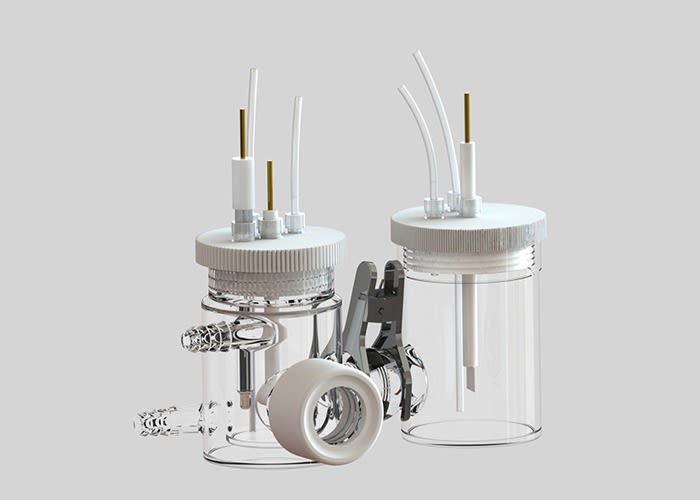
- PTFE lids + O-ring sealing for gas-tight, leak-resistant assembly
- Multiple electrode and gas ports for three-electrode measurements and purging under inert atmosphere
- Scalable volumes (commonly in the tens to hundreds of mL per chamber) for screening through preparative studies
- Configurable for Nafion/Fumasep and related separators, plus custom porting on request
Compatibility and typical set-ups
Compatible with standard three-electrode configurations (Ag/AgCl or Hg/HgO reference; Pt/graphite counter; custom working electrodes) and routine connection to potentiostats/galvanostats for CV, CA/CP, and bulk electrolysis.
Typical applications
- Electrodialysis and ion-exchange research
- Electro-organic synthesis with reduced cross-contamination
- CO₂ reduction or selective catalysis requiring separated anodic/cathodic products
- Membrane screening and transport studies (crossover, permselectivity)
Why choose ScienceGears
ScienceGears supports AU & NZ researchers with practical guidance on membrane selection, electrode integration, and compatible instrumentation (potentiostats, electrodes, and related electrochemical cells), plus fast quoting and configuration support for your exact workflow.
For detailed specifications or custom configurations, please contact us.
Technical Specifications
Precision engineering for accurate measurements
| Capacity | 20ML, 30ml, 50ml, 100ml, 150ml, 200ml, 250ml |
|---|
Resources & Downloads
Everything you need to get started
Electrochemical Impedance Spectroscopy (EIS): Core Concepts for Confident Understanding
Squidstat - Admiral
Customer Reviews
Related Product
Explore our precision instruments designed for electrochemical research and energy applications
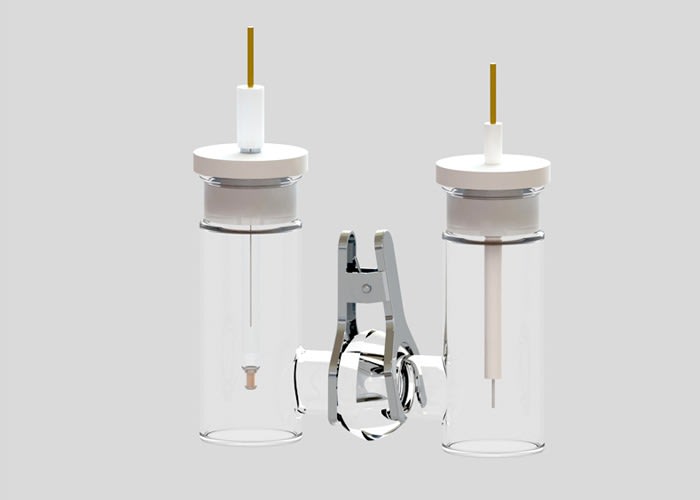
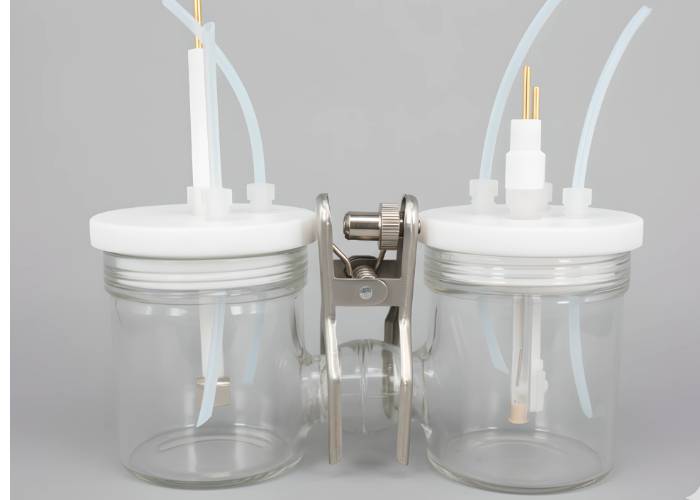
Sealed H-Cell – Gas-Tight Dual-Compartment Electrochemical Cell
- Capacity: 20ML, 30ml, 50ml, 100ml, 150ml, 200ml, 250ml
Jacketed H-Type Membrane Cell (Temperature-Controlled Dual-Compartment Electrochemical Cell)
- Capacity: 20ML, 30ml, 50ml, 100ml, 150ml, 200ml, 250ml


Still Wondering About Something?
Explore our FAQ for fast, clear answers to the most common questions—available 24/7.