
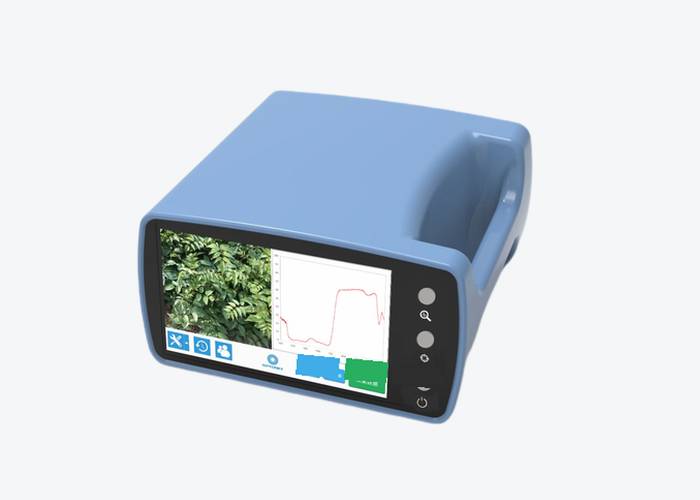
ATP9100 Series Handheld Field Spectroradiometers
Integrated handheld VNIR-to-SWIR systems with touchscreen control, targeting and configurable spectral range
Description
The ATP9100 Series combines integrated handheld field spectroradiometers for applications ranging from routine 300–1100 nm VNIR measurements to broadband 200–2500 nm field spectroscopy. The range includes the standard ATP9100, camera-assisted ATP9100F, higher-resolution ATP9100S configurations and broadband ATP9100W models. Researchers can therefore choose the spectral range, detector architecture and cooling configuration required while retaining a portable touchscreen-based field workflow.
Product Overview
The ATP9100 family is designed for researchers who want more field integration than a miniature connected-device spectrometer provides.
The standard ATP9100 and ATP9100F use a 2048-channel CMOS platform covering 300–1100 nm. ATP9100F adds direct visual association between the camera target region and the acquired spectrum.
The ATP9100S family extends coverage to 1700 or 2500 nm and uses cooled detector configurations with a raster-scanning approach.
The ATP9100W family provides broadband handheld configurations covering either 300–1700 nm or 300–2500 nm, with uncooled low-power and cooled SWIR detector choices.
How It Works
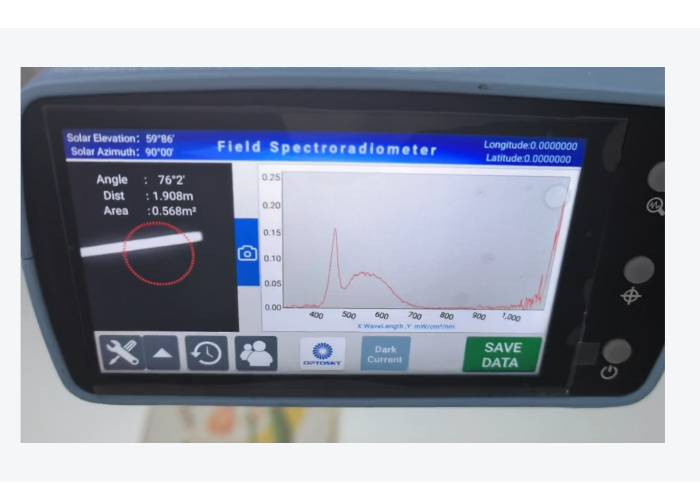
Light from the target enters the selected field-of-view optics and is resolved into a wavelength-dependent signal. The instrument's integrated screen and camera support target positioning and spectrum review in the field.
A suitable reflectance standard is used when the objective is spectral reflectance. The target and reference should be measured using consistent illumination, distance and viewing geometry.
The integrated camera does not convert the instrument into a hyperspectral imager. It helps the operator document and identify the physical target area associated with the point spectrum.
Model Comparison
| Model | Spectral range | Configuration | Best suited to |
|---|---|---|---|
| ATP9100 | 300–1100 nm | 2048-channel CMOS | General handheld VNIR work |
| ATP9100F | 300–1100 nm | CMOS + target-region display | VNIR work needing visual target confirmation |
| ATP9100S-17TC | 200–1700 nm | Cooled wideband configuration | UV–VIS–NIR/SWIR research |
| ATP9100S-25TC | 200–2500 nm | Cooled full-range configuration | UV–VIS–NIR–SWIR measurements |
| ATP9100W-17 | 300–1700 nm | 256-pixel InGaAs SWIR, low-power configuration | Extended NIR with lower power demand |
| ATP9100W-17TC | 300–1700 nm | Cooled 512-pixel InGaAs | Higher-SNR extended-NIR measurements |
| ATP9100W-25TC | 300–2500 nm | Cooled 512-pixel InGaAs | Handheld full-range VNIR–SWIR work |
Key Technical Distinctions
ATP9100/ATP9100F are specified at:
- 2048 detector channels
- ±0.5 nm wavelength accuracy
- spectral resolution below 2.7 nm at 756 nm
- 0.4 nm spectral sampling
- selectable 1°, 8°, 15° and 25° field-of-view optics
- 5-inch Android touchscreen
- 13 MP front camera
- GPS and angle sensing
- IP65 enclosure
ATP9100W configurations extend the measurement range using InGaAs SWIR detectors. ATP9100W-17 uses a 256-pixel low-power SWIR detector, while ATP9100W-17TC and ATP9100W-25TC use cooled 512-pixel InGaAs configurations.
ATP9100S provides a separate cooled wideband pathway extending down to 200 nm.
Package and Configuration
Current ATP9100/ATP9100F and ATP9100W documentation lists a standard field configuration that includes:
- charging adaptor
- nominal 95% reflectance reference panel
- 25° field-of-view lens
- cosine lens
ATP9100S documentation additionally identifies data cable and PC software within its standard attachment list.
Alternative field-of-view lenses, reflectance probes, leaf clips, illumination and other accessories may be required depending on the application. Final inclusions should be confirmed for the selected model.
Applications
- crop and canopy monitoring
- vegetation-index measurements
- forestry and ecosystem studies
- geological and mineral field investigation
- soil and road-surface assessment
- water and oceanographic research
- ground-reference measurements for satellite or airborne remote sensing
- environmental-impact studies
How to Select the Right ATP9100 Configuration
Choose ATP9100 for general 300–1100 nm handheld measurements.
Choose ATP9100F when the same spectral range is adequate but visual confirmation of the target area associated with the spectrum is useful.
Choose ATP9100W-17 when you need coverage to 1700 nm with a lower-power extended-NIR detector.
Choose ATP9100W-17TC where 1700 nm coverage is required with a cooled SWIR detector.
Choose ATP9100W-25TC when field measurements need to extend to 2500 nm.
Choose ATP9100S-17TC or ATP9100S-25TC when ultraviolet extension to 200 nm and the S-series cooled raster-scanning architecture are relevant to the method.
ATP9100-4CH is not part of this handheld family page because it is an online multi-channel monitoring system and belongs under Online Field Spectroradiometer Systems.
Why Source Through ScienceGears
ScienceGears can help identify whether the application actually needs 1100, 1700 or 2500 nm coverage, whether detector cooling is useful, and which field-of-view lens, reference standard or probe configuration is appropriate. This can prevent over-specification while ensuring that the selected system covers the spectral features required by the research.
Frequently Asked Questions
What is the difference between ATP9100 and ATP9100F?
They use the same core 300–1100 nm spectral platform. ATP9100F adds direct display of the physical target region corresponding to the recorded spectrum.
Is ATP9100S one single model?
No. The currently documented configurations are ATP9100S-17TC and ATP9100S-25TC, covering 200–1700 nm and 200–2500 nm respectively.
What is the difference between ATP9100S and ATP9100W?
Both extend beyond the standard VNIR range, but they use different detector/platform configurations. ATP9100S extends to 200 nm at the short-wavelength end and uses cooled wideband configurations, while ATP9100W starts at 300 nm and offers several InGaAs SWIR detector choices.
Do I need 2500 nm coverage?
Only when important sample features occur in the SWIR region beyond 1700 nm. Many vegetation and visible-surface studies can be completed with 1100 or 1700 nm coverage.
Is ATP9100-4CH included on this page?
No. It is an online four-channel monitoring system and should be listed under the separate Online & Multi-Channel Field Spectroradiometers subcategory.
Can the systems calculate vegetation indices?
Documented ATP9100-family software supports vegetation-index functions on applicable configurations.
Contact ScienceGears
Contact ScienceGears with your application, required wavelength region, target size, measurement distance and field conditions to compare ATP9100, ATP9100F, ATP9100S and ATP9100W configurations.
Customer Reviews
Still Wondering About Something?
Explore our FAQ for fast, clear answers to the most common questions—available 24/7.