
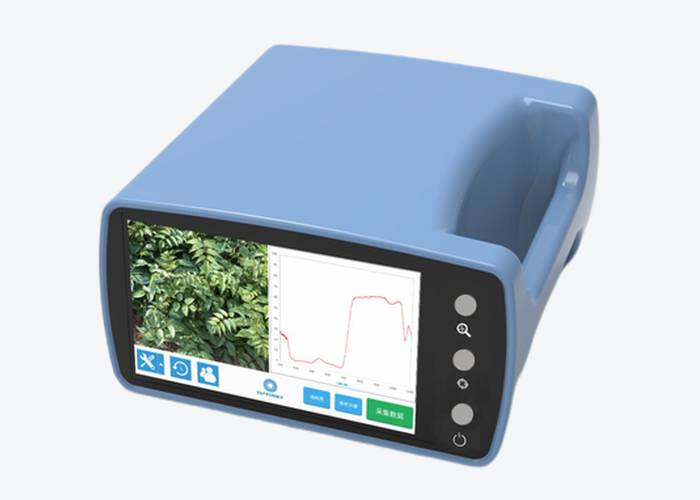

ATP9100F Handheld Field Spectroradiometer
Integrated 300–1100 nm field system with camera-guided target and spectrum display
Description
The ATP9100F is an integrated 300–1100 nm handheld field spectroradiometer for measurements where the operator needs to view both the target region and the acquired spectrum on the instrument. It combines a 2048-channel linear CMOS detector, 13 MP front camera, 5-inch Android touchscreen, GPS and angle sensing in a 1.1 kg IP65 enclosure. The F configuration displays the camera target region alongside the spectrum, helping the operator relate the recorded data to the actual measurement footprint.
Product Overview
Field measurements can be affected by incorrect target alignment, mixed surfaces, changing distance and inconsistent measurement geometry. The ATP9100F addresses part of this workflow by integrating targeting, imaging, spectral acquisition and field metadata into one portable instrument.
The 300–1100 nm range covers ultraviolet-edge, visible and near-infrared measurements used in vegetation, remote sensing, environmental studies, geological surveys and general surface-reflectance research.
How It Works
Light from the selected field target enters the fitted field-of-view lens and is dispersed onto a 2048-channel linear CMOS detector. The integrated camera displays the target area while the instrument records its spectrum.
For reflectance work, the operator normally collects a dark measurement and a suitable white-reference measurement before or between target measurements. The reference and target signals are then processed to calculate spectral reflectance. The 650 nm laser assists target positioning, while the camera and angle information help document the measurement geometry.
Depending on calibration, optics and software, the platform can also support radiometric, photometric and colorimetric workflows.
Standard Package and Options
The documented standard package comprises:
- ATP9100F main unit
- 5 V charger
- 25° field-of-view lens
- 10 × 10 cm reference standard with nominal 95% reflectance
- Cosine lens
- USB cable
- Equipment case
- User manual
- Warranty card
- Product certificate
- Factory test report
Documented optional accessories include:
- 30%, 50% and 99% reflectance standards
- 1°, 8° and 15° field-of-view lenses
- Tripod
- ATG1600 contact probe
- Leaf clip for the contact probe
- Backpack
- Optical fibre
- Halogen lamp
The final supplied package should always be confirmed in the quotation.
Key Features
- 300–1100 nm spectral range
- 2048-channel linear CMOS detector
- Wavelength accuracy of ±0.5 nm
- Spectral resolution below 2.7 nm at 756 nm
- 0.4 nm spectral sampling interval
- Camera-guided display of the target region and spectrum
- Selectable 1°, 8°, 15° and 25° field-of-view optics
- Android control through a 5-inch capacitive touchscreen
- GPS, probe-angle and environmental metadata
- Internal 5200 mAh battery with more than four hours of stated operation
- IP65 enclosure for field deployment
Technical Specifications
| Parameter | Specification |
|---|---|
| Detector | Linear-array CMOS sensor |
| Detector channels | 2048 |
| Spectral range | 300–1100 nm |
| Wavelength accuracy | ±0.5 nm |
| Spectral resolution | <2.7 nm at 756 nm |
| Spectral sampling interval | 0.4 nm |
| Signal-to-noise ratio | >800:1 in the visible region |
| Hardware spectral averaging | Up to 100,000 measurements |
| Standard field of view | 25° |
| Optional field of view | 1°, 8° and 15° |
| Targeting laser | 650 nm, 5 mW |
| Operating system | Android |
| Camera | 13 MP front camera |
| Display | 5-inch, 1280 × 720 capacitive touchscreen |
| Integration time | 1 ms to 10 s; automatic optimisation available |
| Data output | USB Type-C |
| Probe-angle range | 0°–180° |
| Location data | GPS |
| Environmental sensors | Humidity, temperature and altitude |
| Battery | Built-in 5200 mAh lithium battery |
| Stated battery operation | More than 4 hours |
| Operating temperature | −10 to 45 °C |
| Storage temperature | −20 to 65 °C |
| Working humidity | Below 90% RH |
| Enclosure rating | IP65 |
| Dimensions | 151 × 157 × 85 mm |
| Weight | 1.1 kg |
Applications
- Crop, leaf and canopy reflectance studies
- Vegetation-index and plant-condition research
- Forestry and ecosystem monitoring
- Soil, rock and mineral surface comparison
- River, coastal and oceanographic research
- Ground-reference measurements for satellite, drone and airborne remote sensing
- Environmental-impact assessment
- University teaching and field spectroscopy training
Compatibility and Selection Guidance
The standard 25° field of view is appropriate for relatively broad, uniform targets. Narrower 1°, 8° or 15° optics can help isolate smaller targets, but they require more careful alignment.
The included reflectance reference supports field reflectance workflows, while the cosine lens is intended for suitable irradiance-related measurements. The optional contact probe and leaf clip are useful where a controlled probe-to-target geometry is required. Confirm illumination, reference procedure and accessory compatibility before ordering because the correct arrangement depends on the target and intended measurement quantity.
Why Source Through ScienceGears
ScienceGears can help define the wavelength requirement, field of view, reference method, target distance, contact-probe requirements, software workflow and optional accessories. Configuration and quotation support are available for researchers, universities and technical teams across Australia and New Zealand.
Frequently Asked Questions
What is the difference between ATP9100 and ATP9100F?
Both share the same core spectral platform. The ATP9100F adds the function that displays the camera target region alongside the corresponding spectrum, making it easier to relate the measurement to the selected target footprint.
What wavelength range does it cover?
The current V6.2 datasheet specifies a range of 300–1100 nm.
How is reflectance measured?
A suitable reference standard is measured using the same illumination and geometry as the target. The software then relates the target spectrum to the reference measurement to calculate reflectance.
Which field-of-view lens is supplied?
The documented standard package includes a 25° field-of-view lens. The 1°, 8° and 15° lenses are optional.
Can the instrument store location and orientation information?
Yes. The documented system includes GPS positioning and gyroscope-based probe-angle measurement. Environmental sensors also record temperature, humidity and altitude information.
How long can it operate from its battery?
The supplied V6.2 datasheet states more than four hours under the manufacturer’s specified operating conditions. Actual operating time can vary with screen use, integration settings, environmental conditions and battery condition.
Can it be used for leaf measurements?
Yes. General non-contact leaf measurements are possible with appropriate geometry. A contact probe and corresponding leaf clip are also listed as optional accessories for more controlled measurements.
Contact ScienceGears
Contact ScienceGears with your target type, wavelength requirement, measurement distance, field-of-view preference and reference method to confirm the appropriate ATP9100F package and optional accessories.
Customer Reviews
Related Product
Explore our precision instruments designed for electrochemical research and energy applications

Still Wondering About Something?
Explore our FAQ for fast, clear answers to the most common questions—available 24/7.