
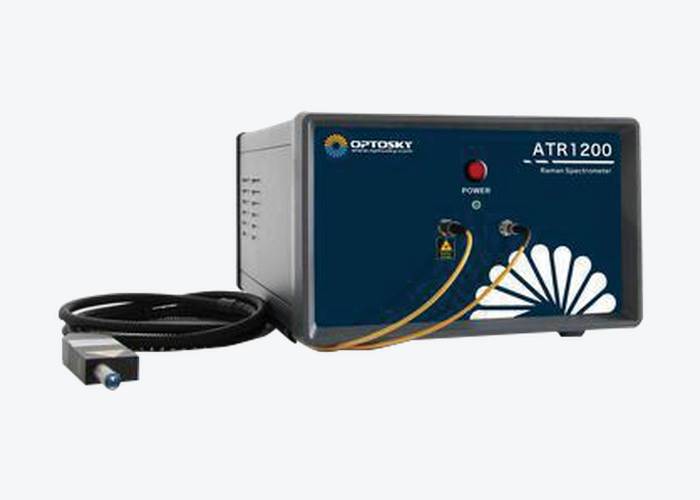
ATR1200 Teaching Raman Spectrometer
University Raman teaching system for spectroscopy principles, instrument operation and practical experiments
Description
The ATR1200 is an educational Raman system designed for university laboratories that want students to understand how Raman spectroscopy works rather than use an instrument only as a black-box analyser. The teaching package combines a narrow-linewidth Raman laser, fibre Raman probe, thermoelectrically cooled spectrometer and structured practical experiments covering optical setup, Raman acquisition, spectral interpretation, material identification and introductory quantitative analysis.
Product Overview
Raman spectroscopy is increasingly used across chemistry, materials science, pharmaceuticals, biology, geology and engineering.
For teaching, however, a fully enclosed research instrument can hide the key components from students.
ATR1200 is intended to expose the measurement workflow so students can understand:
- where the laser originates
- how the Raman probe operates
- how scattered light reaches the spectrometer
- how Raman shift is calculated
- how characteristic peaks relate to molecular structure
- how unknown samples can be compared with references
How Raman Spectroscopy Works
A monochromatic laser interacts with molecules in the sample.
Most scattered photons undergo Rayleigh scattering and leave with essentially the same energy as the incident laser.
A very small fraction exchanges energy with molecular vibrations and leaves with a slightly different energy. This Raman-shifted light contains information about molecular bonds and structure.
The Raman spectrometer separates these wavelengths and converts them into a Raman spectrum plotted against Raman shift in cm⁻¹.
Teaching System Components
The official educational documentation identifies:
- narrow-linewidth Raman laser
- Raman fibre probe
- thermoelectrically cooled spectrometer
- experimental samples and reagents
- experiment guide/course material
A PC is specifically identified as excluded from the documented teaching package, so the computer should be planned separately unless the quotation explicitly states otherwise.
Documented Teaching Experiments
The manufacturer teaching material includes exercises covering:
- Raman laser inspection
- Raman probe principle and use
- Raman system construction
- Raman measurement of CCl₄
- chemical identification using example liquids
- Raman spectra of standard plastic specimens
- unknown identification by comparison with a spectral library
- introductory quantitative analysis of an inorganic-salt solution
Actual chemical use must of course follow the university's laboratory safety and chemical-handling procedures.
Learning Outcomes
Students can use the platform to understand:
- Raman-shift units
- Stokes Raman scattering
- excitation wavelength
- laser power
- fibre-probe operation
- spectral resolution
- integration time
- spectral libraries
- qualitative identification
- basic calibration concepts
- instrument configuration
Key Features
- Purpose-built Raman teaching platform.
- Modular laser, probe and spectrometer concept.
- Cooled spectrometer.
- Fibre Raman probe.
- Structured laboratory exercises.
- Real sample spectra.
- Reference-library comparison.
- Introductory quantitative exercise.
- Suitable for instrumental-analysis and spectroscopy teaching.
- Provides a bridge between optical theory and practical Raman measurement.
Applications
- undergraduate analytical chemistry
- spectroscopy practical classes
- materials-science teaching
- physical chemistry
- instrumental analysis
- postgraduate instrument training
- Raman-method demonstrations
- laboratory skills education
Compatibility and Selection Guidance
Before purchasing a teaching system, consider the number of students and how the practical class will run.
A single system may be suitable for demonstration, while multiple stations may be preferable for hands-on classes.
Confirm:
- student group size
- available PCs
- laser-safety controls
- sample/reagent requirements
- laboratory space
- course duration
- whether the supplied experiments match the curriculum
ATR1200 should not be selected as a substitute for a high-performance research Raman microscope. Its primary purpose is education.
Why Source Through ScienceGears
ScienceGears can help universities review class size, computer requirements, experiment objectives and whether the teaching package should be complemented by a separate research Raman system.
Frequently Asked Questions
Is ATR1200 a research Raman instrument?
Its primary design purpose is teaching Raman principles and operation. Research users with demanding performance requirements should consider the ATR2xxx/3xxx or Raman microscope ranges.
Is the computer included?
The official teaching document specifically identifies the PC as excluded from the standard teaching system.
Can students measure real materials?
Yes. The teaching program includes measurement and identification of real chemical and polymer samples.
Does it teach quantitative Raman?
An introductory concentration-analysis experiment is included in the documented teaching curriculum.
Does it include a Raman laser and probe?
Yes, both are identified as core parts of the educational system.
What safety requirements apply?
The university must apply appropriate laser-safety and chemical-safety controls according to the configured laser and local procedures.
Contact ScienceGears
Contact ScienceGears with your course, class size, student level and available laboratory computers so the ATR1200 teaching configuration can be reviewed for your university program.
Customer Reviews
Related Product
Explore our precision instruments designed for electrochemical research and energy applications


Still Wondering About Something?
Explore our FAQ for fast, clear answers to the most common questions—available 24/7.