

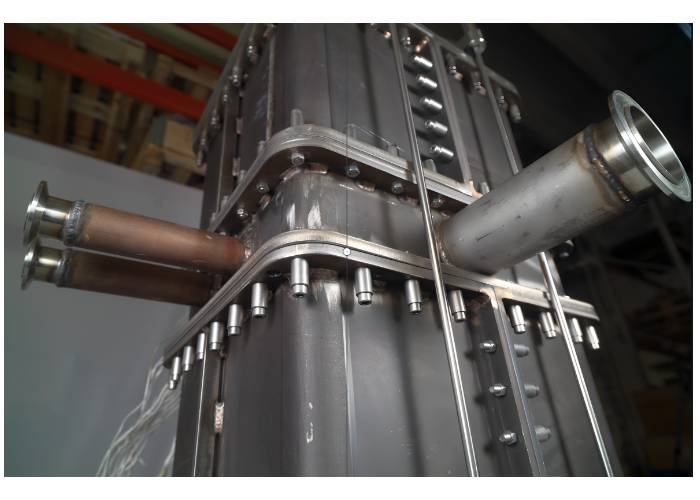
Elcogen elcoModule® Solid Oxide Modules
Integration-ready one- or four-stack modules for SOFC, SOEC and reversible systems
Elcogen elcoModule® Solid Oxide Modules
Elcogen elcoModule® solid oxide stack modules are integration-ready assemblies for original equipment manufacturers, system integrators and research testems. Available in standard one- or four-stack configurations, each module integrates elcoStack® E3000 technology with a dedicated compression system, common gas manifolds and an optimised air-distribution structure. This modular approach supports consistent stack compression, uniform flow distribution and more efficient integration into larger energy-conversion systems.
Product Overview
A solid oxide stack requires carefully controlled compression, gas distribution, temperature and electrical connections to operate reliably. The elcoModule® combines the principal mechanical and gas-distribution elements needed to integrate one or multiple E3000 stacks into a system.
Standard configurations accommodate either one stack or four stacks. Customised and larger multi-stack solutions may also be discussed for specialised applications and system-scale development.
The module can form the electrochemical core of systems operating as:
- Solid oxide fuel cells (SOFCs) for electricity and heat generation
- Solid oxide electrolysis cells (SOECs) for high-temperature hydrogen production
- Reversible solid oxide cells (rSOCs) capable of alternating between power-generation and electrolysis modes
How It Works
In fuel-cell mode, a hydrogen-containing fuel is supplied to the fuel electrode while air is supplied to the oxygen electrode. Oxygen ions pass through the solid ceramic electrolyte and react electrochemically with the fuel, generating electricity and heat without conventional combustion inside the cell.
In electrolysis mode, the process is reversed. Steam is supplied to the system and converted into hydrogen using electrical energy. Operating at elevated temperature allows part of the required energy to be supplied as heat, which can be particularly valuable when the system is integrated with suitable industrial waste-heat sources.
The elcoModule® provides the compression and distribution architecture surrounding the stacks. The complete system must also incorporate suitable gas or steam preparation, thermal management, electrical power equipment, instrumentation, controls and safety systems.
Key Features
- Standard configurations for one or four elcoStack® E3000 stacks
- Integrated compression system for controlled and consistent stack loading
- Common gas manifolds for distributing process gases between stacks
- Optimised air-distribution structure for uniform flow management
- Suitable for SOFC, SOEC and reversible solid oxide system development
- Modular architecture supporting system scaling and repeated configurations
- Compatible with fuel-cell power generation and high-temperature steam-electrolysis projects
- Custom module engineering available for specialised integration requirements
- Engineering support available for process design, balance-of-plant selection and system integration
- Suitable for integration into laboratory prototypes, pilot systems and commercial equipment platforms
Technical Specifications
Module Configuration
| Parameter | Specification |
|---|---|
| Product type | Solid oxide stack integration module |
| Compatible stack | Elcogen elcoStack® E3000 |
| Standard stack configurations | One stack or four stacks |
| Operating modes | SOFC, SOEC and reversible operation |
| Integrated mechanical function | Stack compression system |
| Integrated gas-handling functions | Common gas manifolds and optimised air distribution |
| Custom configurations | Available subject to application and engineering review |
Reference E3000 G2 Stack Data
The following values apply to each current E3000 G2 stack and should not be interpreted as final aggregate module ratings.
| Parameter | SOFC Mode | SOEC Mode |
|---|---|---|
| Electrical power | 3,000 W output | 9,000 W input |
| Hydrogen-production rate | Not applicable | 3 Nm³ h⁻¹ |
| Operating voltage | 83–112 V | 142–180 V |
| Maximum current | 30 A | 60.5 A |
| Operating temperature | 570–720 °C | 650–720 °C |
| Stack dimensions | 189.1 (W) × 229.5 (L) × 283 (H) mm | Same stack format |
| Stack mass | 33 kg | Same stack format |
Final module dimensions, mass, interfaces and aggregate capacity depend on the selected stack quantity and project configuration and should be confirmed during system design.
Applications
Elcogen elcoModule® configurations may be considered for:
- Combined heat and power systems
- Distributed and off-grid electrical generation
- High-temperature green-hydrogen production
- Power-to-X and synthetic-fuel development
- Renewable-energy storage using reversible solid oxide technology
- Industrial process integration using available high-temperature heat
- Pilot-scale fuel-cell and electrolyser platforms
- Solid oxide system validation and durability programmes
- Development of modular multi-stack energy systems
In fuel-cell applications, the installed stacks can operate with hydrogen and may support fuels such as natural gas, biogas, methanol, ammonia or other hydrocarbons when the system incorporates appropriate fuel processing and operating controls.
Compatibility and Selection Guidance
The module should be selected as part of the complete solid oxide system rather than as an isolated component. Before ordering, the following requirements should be defined:
- SOFC, SOEC or reversible operating mode
- One-stack or four-stack configuration
- Required electrical output, input power or hydrogen-production capacity
- Fuel composition or steam-feed conditions
- Target operating temperature and pressure
- Gas-flow, humidification and steam-generation requirements
- Thermal enclosure and heat-recovery arrangement
- DC power supply, electronic load, inverter or power-conversion requirements
- Cell-voltage monitoring and electrochemical diagnostic requirements
- Control architecture, gas detection, ventilation and emergency shutdown functions
For electrolysis projects, steam quality, steam utilisation, hydrogen handling and available process heat are important design considerations. Fuel-cell systems may require reforming, desulphurisation or other fuel-conditioning equipment depending on the selected fuel.
Why Source Through ScienceGears
ScienceGears supports Australian and New Zealand research groups, original equipment manufacturers and industrial development teams with configuration discussions, quotation coordination and compatibility review. Support can include matching the stack module with suitable gas handling, steam generation, electrical equipment, instrumentation and solid oxide test-system requirements.
Frequently Asked Questions
What is the difference between an elcoStack® and an elcoModule®?
The elcoStack® contains the electrochemically active solid oxide cells. The elcoModule® integrates one or more stacks with compression hardware, gas manifolds and an air-distribution structure to simplify incorporation into a larger system.
How many stacks can a standard module accommodate?
Standard elcoModule® configurations are available for either one E3000 stack or four E3000 stacks. Specialised configurations can be reviewed for larger or application-specific projects.
Can the same module be used for fuel-cell and electrolysis operation?
The underlying stack technology supports SOFC, SOEC and reversible operation. The surrounding balance of plant, electrical equipment, gas handling and controls must also be designed for the intended operating mode.
Is the elcoModule® a complete turnkey fuel-cell or electrolyser system?
No. It is an integration-ready stack module forming the electrochemical core of a system. Additional thermal management, gas or steam preparation, power electronics, instrumentation, controls and safety equipment are required.
What fuels can be used in SOFC mode?
Hydrogen can be used directly. Natural gas, biogas, methanol, ammonia and other hydrogen-containing fuels may be considered when the system includes suitable fuel processing and the operating conditions are confirmed.
What information is required for a quotation?
Provide the intended operating mode, number of stacks, required power or hydrogen output, fuel or steam conditions, operating pressure, electrical interfaces and whether the module is intended for research, pilot-scale validation or equipment integration.
Can ScienceGears assist with the surrounding test or balance-of-plant equipment?
Yes. ScienceGears can discuss compatible gas and steam handling, power supplies, electronic loads, monitoring equipment and integrated solid oxide test-system requirements for Australia and New Zealand.
Contact ScienceGears to request a quotation or discuss the appropriate elcoModule® configuration, operating mode, balance-of-plant requirements and system-integration interfaces for your application.
Customer Reviews
Related Product
Explore our precision instruments designed for electrochemical research and energy applications


Still Wondering About Something?
Explore our FAQ for fast, clear answers to the most common questions—available 24/7.