

O215 Integrated Electrochemical Raman Microscope
Integrated Raman mapping and three-electrode analysis with a German-made motorised open-loop XYZ stage
O215 Integrated Electrochemical Raman Microscope
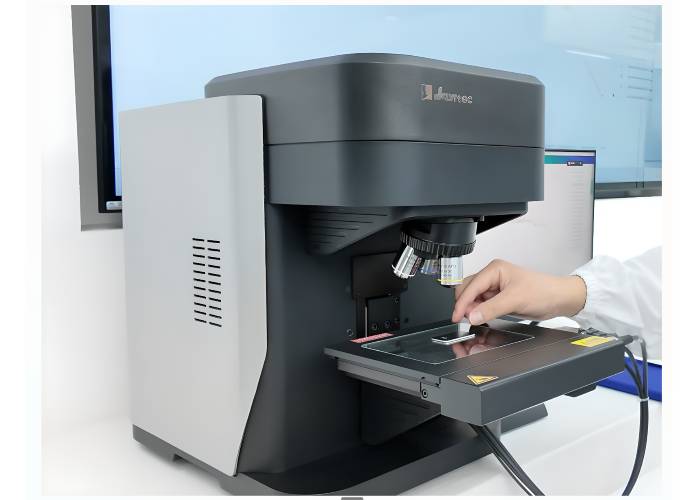
The O215 is an integrated electrochemical Raman microscope for researchers who need to correlate microscopic images, Raman spectra and electrochemical response at the same sample location. It combines reflected-light microscopy, Raman acquisition and mapping, a three-electrode electrochemical module and synchronised software in one compact platform. Its defining configuration is a German-made, high-precision motorised open-loop XYZ translation stage for accurate mapping and in-situ or operando interface studies.
Product Overview
Separate Raman microscopes, potentiostats, electrochemical cells and software platforms can make timing, cabling, positioning and data correlation difficult. The O215 integrates microscopic imaging, Raman spectroscopy, Raman mapping and electrochemical control within one system. It supports steady-state and transient electrochemical Raman experiments, with a specified electrochemical-to-Raman trigger delay of ≤100 ns.
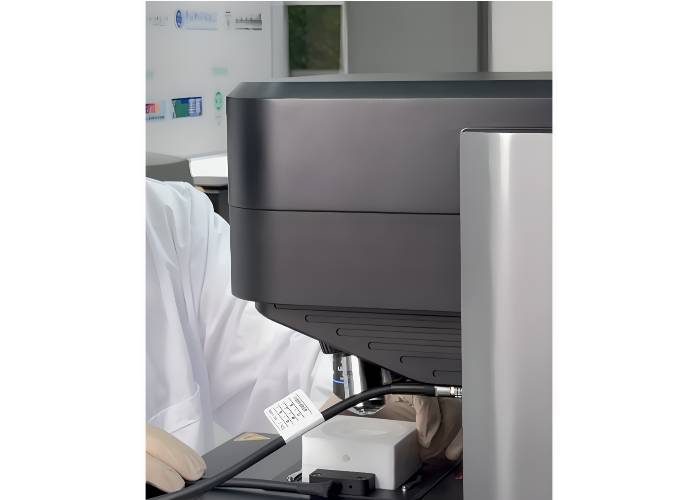
Its compact format can be considered for glovebox installation after reviewing utilities, thermal management and laser-safety controls.
How It Works
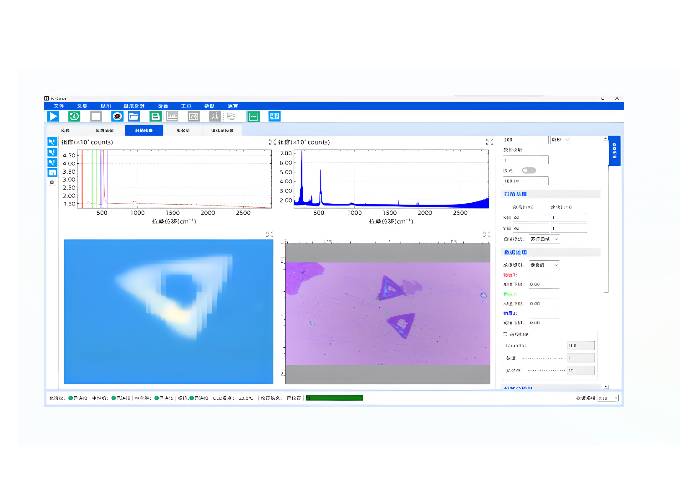
A selected laser is focused onto the sample through the microscope objective, and Raman-scattered light is collected by the spectrometer and cooled detector. The electrochemical module controls the working-electrode potential and records current in a three-electrode configuration. During Raman mapping, the motorised XYZ stage moves the sample through defined positions, allowing spectra to be converted into spatially resolved chemical images. The software displays and associates microscopic, Raman and electrochemical data.
Key Features
- Integrated microscopy, Raman spectroscopy, Raman mapping and three-electrode electrochemistry.
- Synchronised electrochemical and Raman triggering with a specified delay of ≤100 ns.
- German-made motorised open-loop XYZ stage with ≥75 × 50 × 50 mm travel, ≤0.01 µm minimum step and ±3 µm accuracy.
- Choice of 532, 633 or 785 nm excitation.
- Upright reflected-light microscope with LED illumination, bright-field optics and an 8 MP camera.
- Five-position turret with 10×, 50× and 100× objectives.
- Two-stage detector cooling below -20 °C and spectral resolution better than 4 cm⁻¹.
- Unified acquisition and analysis software with CSV and TXT export.
Technical Specifications
| Category | Specification |
|---|---|
| Model designation | O215 |
| Excitation options | 532 nm, 633 nm or 785 nm |
| Laser output | ≥100 mW at 532 nm; ≥30 mW at 633 nm; ≥100 mW at 785 nm |
| Spectral range | 170–3900 cm⁻¹ at 532 or 633 nm; 170–3400 cm⁻¹ at 785 nm |
| Grating / resolution | 1800 grooves/mm, rotatable; better than 4 cm⁻¹ |
| Detector | Two-stage cooled below -20 °C; signal-to-noise ratio 5000:1 |
| Microscope | Upright reflected-light design, LED illumination, bright-field optics and 8 MP camera |
| Confocal rejection | Slit-based; no physical confocal pinhole |
| Objectives | 10×: NA 0.3, WD 8.5 mm; 50×: NA 0.75, WD 3.0 mm; 100×: NA 0.9, WD 1.0 mm |
| Stage | German-made motorised open-loop XYZ stage; travel ≥75 × 50 × 50 mm |
| Minimum step / accuracy | ≤0.01 µm / ±3 µm |
| Raman imaging resolution | Better than 1 µm |
| Electrochemical voltage | ±10 V; applied-voltage accuracy 0.1% FS ±1 mV |
| Potential measurement deviation | 0.2% FS ±2 mV |
| Electrochemical current | ±250 mA; applied-current accuracy 0.1% FS |
| Current measurement deviation | ±0.2% FS |
| Reference input impedance | >1 × 10¹² Ω |
| Electrode configuration | Three-electrode operation |
| EIS | Not supported by the built-in electrochemical module |
| Data and integration | CSV/TXT export; basic HTTP control interface |
| Nominal dimensions | 33 × 62 × 48 cm |
Applications
- In-situ Raman studies of electrocatalytic reactions and adsorbed intermediates.
- Potential-dependent surface and interface chemistry.
- Battery electrode and electrolyte-interface research.
- Corrosion products, passive films and coating transformations.
- Transient Raman measurements during cyclic voltammetry or potential-step experiments.
- Chemical mapping of heterogeneous electrodes, particles and catalyst materials.
Compatibility and Selection Guidance
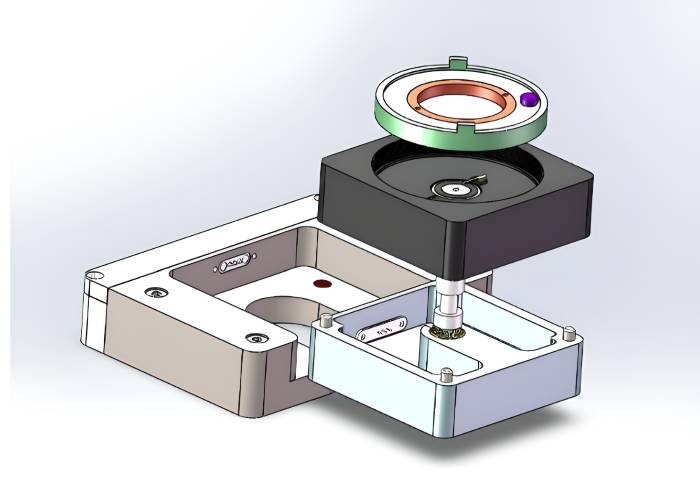
The matched electrochemical cell can accommodate standard disc electrodes, flat round or square metal plates, glassy carbon disc electrodes and carbon paper. Liquid flow-through operation is supported. Foams, gas-diffusion electrodes, membrane assemblies, powders on substrates and sealed gas-controlled experiments should be assessed before quotation because suitability depends on geometry, optical access, sealing and objective working distance.
Select the excitation wavelength according to Raman response, fluorescence, sample-heating risk and the required spectral range. Users requiring electrochemical impedance spectroscopy (EIS) should discuss a separate potentiostat and suitable synchronisation workflow.
The available laser sources are Class 3B. The selected laser, enclosure or interlock arrangement, institutional controls and applicable electrical, electromagnetic-compatibility and laser-safety documentation must be reviewed before ordering and installation in Australia or New Zealand.
Researchers comparing integrated and modular approaches may also review ScienceGears Raman spectroelectrochemistry systems and in-situ and operando electrochemical cells.
Why Source Through ScienceGears
ScienceGears can assist with wavelength selection, cell and electrode compatibility, sample-trial discussions, complementary electrochemical equipment and installation planning across Australia and New Zealand.
Frequently Asked Questions
Is the microscope confocal?
It uses slit-based confocal rejection, not a physical confocal pinhole. This distinction is important when comparing it with pinhole-confocal Raman systems.
Does the integrated electrochemical module support EIS?
No. It supports three-electrode electrochemical operation but does not currently provide electrochemical impedance spectroscopy.
What distinguishes the O215 stage?
It uses a German-made motorised open-loop XYZ stage with ≥75 × 50 × 50 mm travel, a minimum step of ≤0.01 µm and specified accuracy of ±3 µm.
Which laser wavelength should be selected?
The choice depends on Raman intensity, fluorescence, absorption, possible sample heating and the required spectral range. Sample testing is recommended when the optimum wavelength is uncertain.
Which working-electrode formats are compatible?
Verified formats include standard disc electrodes, flat round or square metal plates, glassy carbon disc electrodes and carbon paper. Other geometries should be confirmed before ordering.
Can the system be installed inside a glovebox?
Its compact integrated format is intended for constrained environments, but space, heat, cable routing, vibration, service access and Class 3B laser-safety measures must be assessed.
Can data be exported for independent analysis?
Yes. Spectra, maps, time-series information and electrochemical data can be exported in CSV or TXT formats. A basic HTTP control interface is also available.
Contact ScienceGears
Contact ScienceGears to request a quotation or discuss wavelength, cell configuration, electrode geometry, mapping, safety documentation and installation requirements.
Customer Reviews
Related Product
Explore our precision instruments designed for electrochemical research and energy applications

Still Wondering About Something?
Explore our FAQ for fast, clear answers to the most common questions—available 24/7.