
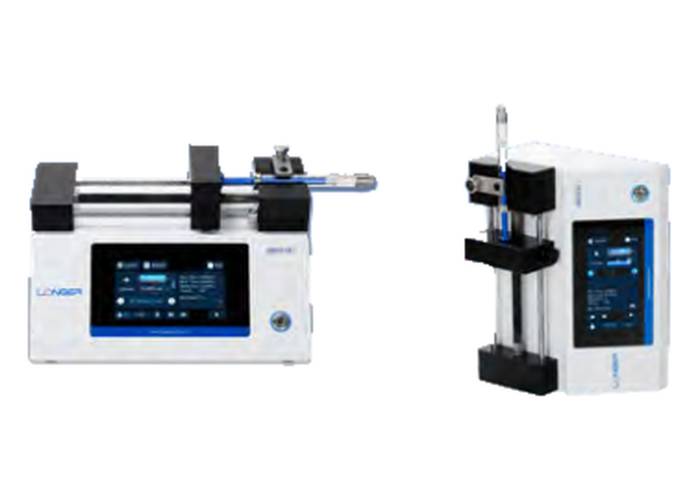
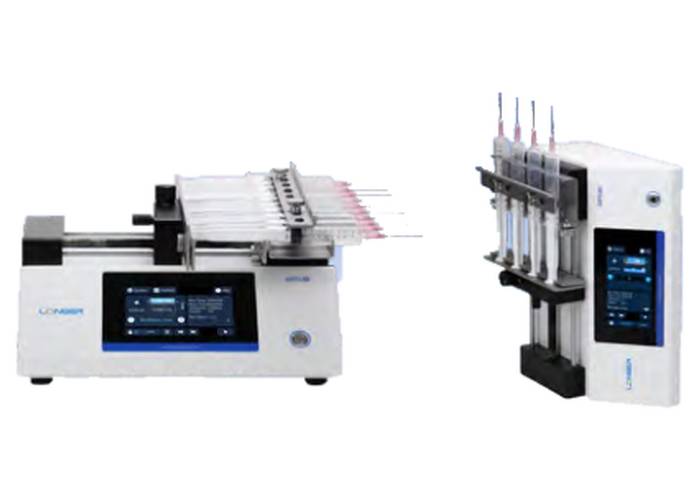
Longer ASP100 Series Digital Laboratory Syringe Pumps
Touchscreen syringe pumps for precision infusion, controlled withdrawal and multichannel laboratory fluid delivery
Overview
The Longer ASP100 Series Digital Laboratory Syringe Pumps are touchscreen-controlled pumping systems designed for precise liquid infusion, controlled withdrawal and low-volume fluid delivery in laboratory research. The range includes single-syringe, dual-syringe and multichannel configurations, accommodating different experimental volumes and flow requirements. Six models are available: ASP11-1A, ASP11-1AP, ASP11-2AP, ASP12-1B, ASP12-2B and ASP12-XB. The series combines digital operating controls, syringe calibration, external interfaces and RS485 communication for laboratory use and compatible automated research systems.
How the ASP100 Series Works
A syringe pump delivers or withdraws liquid by moving a syringe plunger at a controlled linear speed. The syringe's internal diameter and the plunger displacement determine the nominal liquid delivery rate.
Unlike peristaltic pumps, which move liquid through flexible tubing using rotating rollers, syringe pumps regulate displacement through a syringe barrel.
The ASP100 Series allows operators to select syringe parameters, configure delivery rates and adjust operating settings using a touchscreen interface.
Different ASP100 models support different operating functions:
- ASP11 Series: Single or repeated infusion operations.
- ASP12 Series: Infusion, withdrawal and supported infusion/withdrawal operating sequences.
- ASP12-XB: Multichannel configurations supporting 4, 6, 8 or 10 syringes using the selected rack.
A multichannel rack should not be assumed to provide independently adjustable flow rates for every syringe. The exact drive and channel arrangement must be confirmed.
Key Features
- Digital touchscreen operation: 4.3-inch colour LCD for configuration, operating parameters and pump status.
- Six model configurations: Single-, dual- and multichannel syringe-pump arrangements.
- Wide reference flow range: From picolitre-per-minute settings to higher-volume liquid delivery, depending on the model and syringe selected.
- Syringe compatibility: Supports manufacturer-specified syringe capacities from 0.5 µL up to 150 mL, depending on model.
- Adjustable delivery: Flow-rate settings can be modified during operation.
- Calibration functions: Supports calibration using defined syringe parameters to improve delivery performance.
- Controlled linear force: Adjustable force settings, with a manufacturer-specified maximum of 320 N.
- Stored parameter methods: Up to 20 parameter sets can be saved and recalled.
- Remote operation: External control, footswitch operation and RS485 communication using Modbus RTU or Longer OEM protocol.
- LabVIEW integration: Manufacturer-provided drivers and demonstrations support integration with compatible laboratory control systems.
- Flexible installation: Suitable models can operate in different physical orientations to reduce occupied bench space.
ASP100 Model Comparison
| Model | Number of syringes | Compatible syringe capacity | Reference flow-rate range | Main operating capability |
|---|---|---|---|---|
| ASP11-1A | 1 | 0.5 µL–60 mL | 3.3 pL/min–120 mL/min | Single/repeated infusion |
| ASP11-1AP | 1 | 0.5 µL–60 mL | 0.9 pL/min–29.5 mL/min | Fine-resolution infusion |
| ASP11-2AP | 2 | 0.5 µL–60 mL | 0.9 pL/min–29.5 mL/min | Dual-syringe infusion |
| ASP12-1B | 1 | 0.5 µL–150 mL | 3.3 pL/min–226 mL/min | Infusion and withdrawal |
| ASP12-2B | 2 | 0.5 µL–150 mL | 3.3 pL/min–226 mL/min | Dual-syringe infusion/withdrawal |
| ASP12-XB | 4, 6, 8 or 10 | 0.5 µL–10 mL | 3.3 pL/min–39 mL/min | Multichannel infusion/withdrawal |
Important: These are manufacturer reference flow-rate ranges across compatible syringe sizes. The complete range is not available with every individual syringe. Actual delivery performance depends on syringe dimensions, fluid properties, operating conditions and calibration.
Technical Specifications
| Parameter | Specification |
|---|---|
| Product family | ASP100 Series |
| Pump mechanism | Motor-driven syringe displacement |
| Display | 4.3-inch colour LCD touchscreen |
| Maximum linear force | 320 N, adjustable from 20% to 100% |
| Linear travel accuracy | ≤ ±0.35% when travel is at least 30% of stroke |
| Linear travel coefficient of variation | ≤ 0.03% when travel is at least 30% of stroke |
| Maximum stroke — ASP11 models | 110 mm |
| Maximum stroke — ASP12 models | 140 mm |
| Plunger movement per microstep — ASP11-1A | 0.0326 µm |
| Plunger movement per microstep — ASP11-1AP / ASP11-2AP | 0.0088 µm |
| Plunger movement per microstep — ASP12 models | 0.0326 µm |
| User-defined syringe configurations | Up to 20 |
| Stored parameter methods | Up to 20 |
| Local control | Touchscreen |
| External operation | Compatible control inputs and optional footswitch |
| Digital communication | RS485, Modbus RTU / Longer OEM |
| Software integration | Manufacturer LabVIEW drivers and demonstrations |
| Operating temperature | 0–40 °C |
| Power adapter input | AC 90–260 V |
The linear travel accuracy specification describes plunger movement accuracy under the manufacturer's stated test conditions. It should not be interpreted as guaranteed liquid-delivery accuracy for every syringe, fluid or experimental setup.
Choosing the Appropriate ASP100 Model
ASP11-1A — General Laboratory Infusion
The ASP11-1A provides one syringe position and supports infusion-oriented laboratory applications. It can accommodate compatible syringes from 0.5 µL to 60 mL.
It may be suitable when controlled delivery is required without withdrawal operation.
ASP11-1AP — Fine-Resolution Infusion
The ASP11-1AP offers a finer motor displacement per microstep than the ASP11-1A.
Its lower reference flow range makes it useful for applications requiring particularly small controlled flow settings, subject to syringe selection and experimental conditions.
ASP11-2AP — Dual-Syringe Infusion
The ASP11-2AP provides two syringe positions with infusion-oriented operation.
It can support compatible experiments where two syringes need to be driven using the same pump platform. Independent control of each syringe should not be assumed without verification.
ASP12-1B — Infusion and Withdrawal
The ASP12-1B supports both infusion and withdrawal functions and accommodates compatible syringes up to 150 mL.
It is suitable for applications that need liquid introduction, withdrawal or supported alternating operating sequences.
ASP12-2B — Dual-Syringe Infusion/Withdrawal
The ASP12-2B provides two syringe positions and supports infusion and withdrawal operating modes.
It can be considered for laboratory workflows requiring dual-syringe configurations or controlled liquid exchange, subject to the selected operating mode and system arrangement.
ASP12-XB — Multichannel Syringe Pump
The ASP12-XB is designed for applications requiring multiple syringe positions.
Depending on the selected rack, it can accommodate 4, 6, 8 or 10 syringes, with manufacturer-specified compatible syringe capacities of 0.5 µL–10 mL.
The ASP12-XB is particularly relevant to multichannel microfluidic experiments, parallel sample delivery and research workflows where several syringe positions are required.
Typical Laboratory Applications
The ASP100 Series can be considered for:
- Microfluidic experiments and microfluidic-chip research
- Low-volume reagent delivery and controlled liquid addition
- Analytical instrumentation and method development
- Capillary electrophoresis and compatible sample-handling workflows
- Electrospinning and coating research
- Flow-chemistry experiments and controlled synthesis
- Experimental systems requiring infusion or withdrawal
- Multichannel laboratory research and parallel fluid handling
For electrochemical experiments involving acidic, alkaline or organic electrolytes, the syringe material, seals, tubing, fittings and system pressure must be checked before use.
Syringe Selection and Integration
Selecting an ASP100 pump requires more than choosing the number of syringe positions.
Important considerations include:
- Minimum and maximum required flow rates
- Syringe volume and internal diameter
- Required dispensing or withdrawal volume
- Continuous versus intermittent operation
- Number of syringes and control requirements
- Liquid compatibility with syringe and fluid-path materials
- Expected backpressure and allowable linear force
- External-control and communication requirements
The pump should be configured with compatible syringes appropriate for the intended experiment. Syringes, tubing, fittings and optional controls must not be assumed to be included in every configuration.
Why Source Through ScienceGears?
ScienceGears assists researchers and engineers with selecting suitable syringe-pump models, syringe capacities, flow ranges and control configurations.
Our team can help assess requirements for microfluidics, analytical research and experimental fluid handling before preparing a quotation.
International enquiries are welcome, with product availability and delivery destinations confirmed according to the applicable manufacturer arrangements.
Frequently Asked Questions
What is the difference between the ASP11 and ASP12 models?
The ASP11 models primarily support infusion-oriented operation, while the ASP12 models add withdrawal and supported infusion/withdrawal sequences.
Which ASP100 model is suitable for very low flow rates?
The ASP11-1AP and ASP11-2AP provide finer plunger displacement per microstep and lower reference flow-rate settings than the ASP11-1A. Actual suitability depends on the syringe and application requirements.
Can the ASP100 Series operate multiple syringes?
Yes. Models range from one or two syringe positions to the ASP12-XB with 4, 6, 8 or 10 positions. Independent flow control for every syringe is not implied by the number of positions.
Does the ASP100 Series support remote control?
Yes. The manufacturer specifies RS485 communication, Modbus RTU or Longer OEM protocols, external operating inputs and LabVIEW integration options.
Can a syringe pump provide continuous liquid delivery?
Selected ASP12 models support continuous infusion/withdrawal operating sequences. Whether a particular setup provides uninterrupted liquid output depends on the pump configuration, syringe arrangement and fluid connections.
What is the maximum syringe capacity?
The ASP12-1B and ASP12-2B support compatible syringe capacities up to 150 mL. The ASP11 models support up to 60 mL, while ASP12-XB rack configurations support up to 10 mL per syringe position.
Can the ASP100 Series be used for electrochemical research?
It may be suitable for controlled electrolyte delivery and compatible electrochemical flow experiments. The syringe and fluid-path materials, flow range and operating pressure must be verified for the specific experiment.
Contact ScienceGears
Contact ScienceGears to discuss Longer ASP100 model selection, syringe compatibility, microfluidic applications, multichannel configurations, remote-control requirements and quotation enquiries.
Customer Reviews
Still Wondering About Something?
Explore our FAQ for fast, clear answers to the most common questions—available 24/7.