
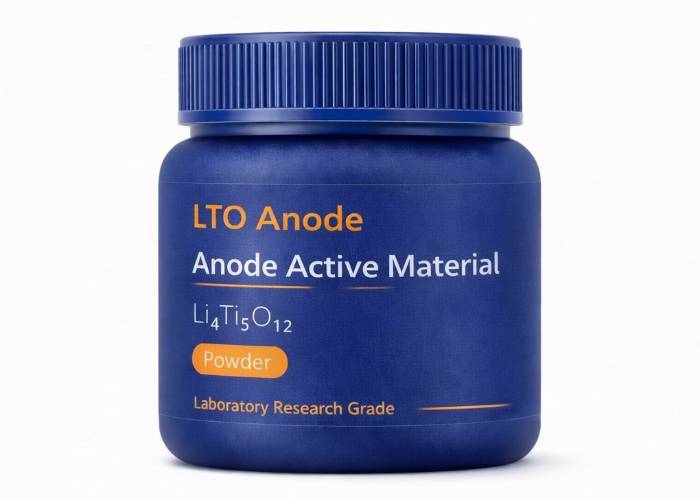
LTO Anode Active Material (Li₄Ti₅O₁₂) Powder
LTO Anode Active Material (Li₄Ti₅O₁₂) Powder
Overview
Lithium titanium oxide (LTO, Li₄Ti₅O₁₂) is a spinel “zero-strain” anode active material widely used for high-power and long-life lithium-ion batteries. Its Li⁺ intercalation occurs at ~1.55 V vs Li/Li⁺, which improves safety by reducing the likelihood of lithium plating during fast charge, while maintaining excellent cycling stability and rate capability.
Material options
TOB offers two research-grade LTO powder variants to match different electrode fabrication workflows:
- LTO-W (white, uncoated): carbon content 0%
- LTO-B (black, carbon-coated): carbon content 3–5% (enhanced electronic conductivity)
Key specifications (typical)
- Particle size (µm): D10 0.2–0.6; D90 ≤10
- D50 (µm): 0.7–1.5 (LTO-W); 0.8–1.6 (LTO-B)
- Purity: 99%
- Tap density: ≥0.9 g/cm³ (LTO-W); ≥1.0 g/cm³ (LTO-B)
- BET surface area: ≤16 m²/g (LTO-W); ≤6.0 m²/g (LTO-B)
- First capacity: ≥150 mAh/g; First efficiency: ≥93% (LTO-W) / ≥92% (LTO-B)
Compatibility and typical use
LTO powders are compatible with standard battery electrode processing (slurry mixing, coating, calendaring) using common binders (e.g., PVDF or water-based CMC/SBR). LTO-W typically requires added conductive carbon, while LTO-B integrates conductivity via coating—useful for high-rate testing.
Applications and why ScienceGears
Ideal for fast-charge cells, hybrid/EV power buffers, UPS, and stationary energy storage, plus academic half-cell benchmarking and impedance studies. ScienceGears supports AU/NZ researchers with local guidance and integration across the workflow—pair LTO electrodes with battery cyclers, potentiostats for EIS, and complementary cell hardware to accelerate reliable battery testing and publication-grade results.
Customer Reviews
Related Product
Explore our precision instruments designed for electrochemical research and energy applications



Still Wondering About Something?
Explore our FAQ for fast, clear answers to the most common questions—available 24/7.