
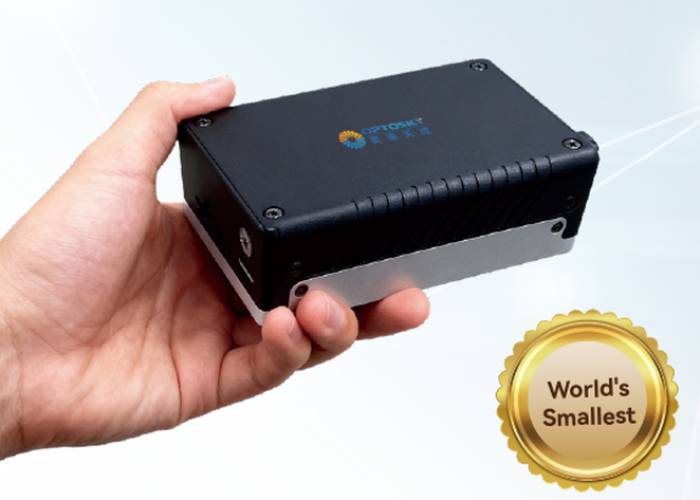
ATR1600 Series Ultra-Miniature Raman Analysers
Pocket-size 785 nm Raman identification with smartphone operation and configurable spectral libraries
Description
The ATR1600 Series is an ultra-miniature Raman identification platform designed for rapid material screening when minimum instrument size is a priority. The current 2026 portfolio uses 785 nm excitation with smartphone-based operation, rechargeable power and selectable spectral-library packages. It is intended for portable identification rather than high-resolution laboratory Raman research, allowing users to acquire a Raman spectrum and compare it against stored or user-developed reference data.
Product Overview
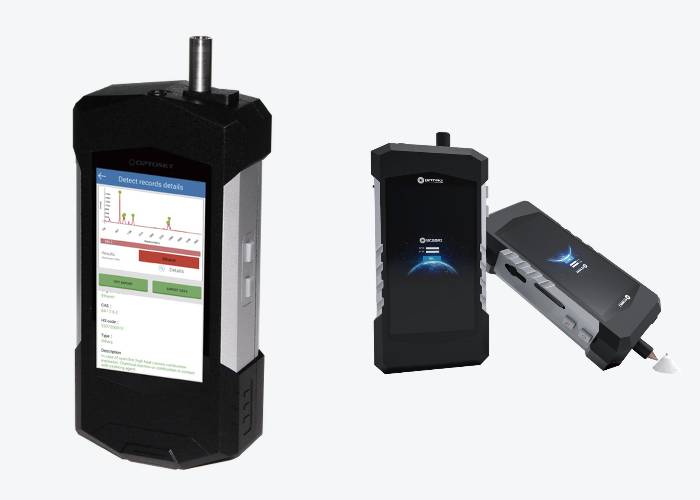
ATR1600 separates the optical measurement hardware from much of the user interface.
The handheld module contains the Raman optics, laser, detector, battery and communication hardware, while a compatible Android device provides the display and operating interface.
This keeps the instrument body small while still allowing result display, library matching and report generation.
How It Works
The user positions the instrument against or close to the sample and starts a measurement from the instrument or mobile application.
A 785 nm laser excites the sample. Raman-scattered light is collected, filtered and recorded by the internal spectrometer.
The measured spectrum can be displayed on the Android application and compared with installed reference spectra. Where the library contains an appropriate reference and the sample produces a usable Raman spectrum, the software can assist with identification.
Application Configurations
Current literature identifies:
- ATR1600 — user-built database / scientific research
- ATR1600DH — public-safety-oriented spectral library
- ATR1600PH — pharmaceutical raw-material library
- ATR1600GM — gemstone identification
- ATR1600IN — industrial materials
These designations primarily identify library/application packages rather than completely different optical principles.
Key Features
- Ultra-miniature handheld format.
- 785 nm excitation.
- Smartphone/Android operation.
- Bluetooth communication.
- USB Type-C.
- Rechargeable battery.
- 4–6 h documented operating time.
- User-expandable spectral database.
- Exportable result reports.
- Industrial enclosure protection.
Current 2026 Technical Specifications
| Parameter | 2026 catalogue value |
|---|---|
| Excitation | 785 ±0.5 nm |
| Standard Raman range | 300–2400 cm⁻¹ |
| Optional/custom Raman range | 200–3000 cm⁻¹ |
| Resolution | 18 cm⁻¹ |
| Dimensions | 184 × 52 × 32 mm |
| Weight | 210 g |
| Communication | USB Type-C, Bluetooth |
| Battery operation | 4–6 h |
| Operating temperature | −20 to 50 °C |
| Protection | IP65 documented in 2026 catalogue |
Applications
- field material screening
- pharmaceutical raw-material identification
- polymers and industrial materials
- gemstone screening
- chemical identification
- teaching demonstrations
- cultural-heritage field screening
- research reference-library development
Compatibility and Selection Guidance
ATR1600 is intended for identification and portability, not high-resolution Raman structural research.
For laboratories requiring a larger integrated touchscreen and more communications capability, ATR6500 may be more suitable.
For highly fluorescent samples, a 1064 nm ATR6600 family should be considered.
Library matching should not be treated as infallible. Sample mixtures, weak signals, fluorescence, packaging material and incomplete reference libraries can all affect the result.
Why Source Through ScienceGears
ScienceGears can help review the materials to be identified, required reference library and whether 785 nm is appropriate before the system is selected.
Frequently Asked Questions
Does ATR1600 need a smartphone?
The current architecture uses an Android application for control and display.
Can I add my own spectra?
The system supports user-built spectral databases.
Can it identify mixtures?
The software includes mixture-analysis capability, but performance depends on spectral quality and the composition of the mixture.
Is 785 nm suitable for every sample?
No. Strongly fluorescent materials may require 1064 nm excitation.
Is it a substitute for a research Raman microscope?
No. It is optimised for portable identification rather than microscopic or high-resolution Raman research.
How long does the battery operate?
The current documentation states approximately 4–6 h under manufacturer test conditions.
Contact ScienceGears
Contact ScienceGears with your target materials and required spectral library so the suitability of ATR1600 and the appropriate application package can be reviewed.
Customer Reviews
Related Product
Explore our precision instruments designed for electrochemical research and energy applications
Still Wondering About Something?
Explore our FAQ for fast, clear answers to the most common questions—available 24/7.