
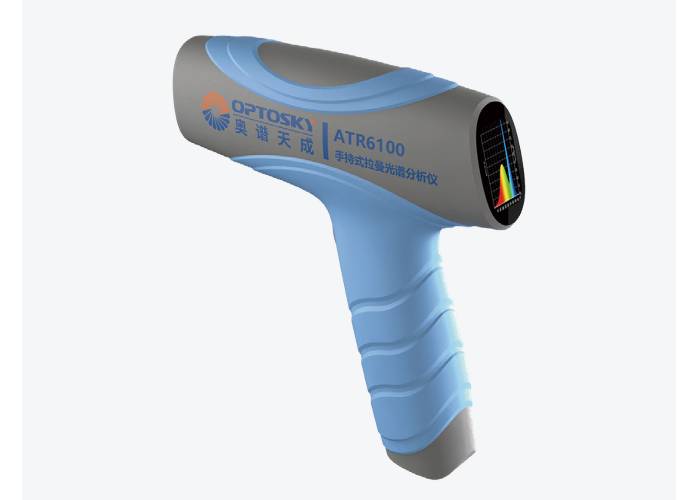
ATR6100 Series Compact Handheld Raman Analysers
Compact material identification with 532, 785 or 1064 nm excitation and mobile control
Description
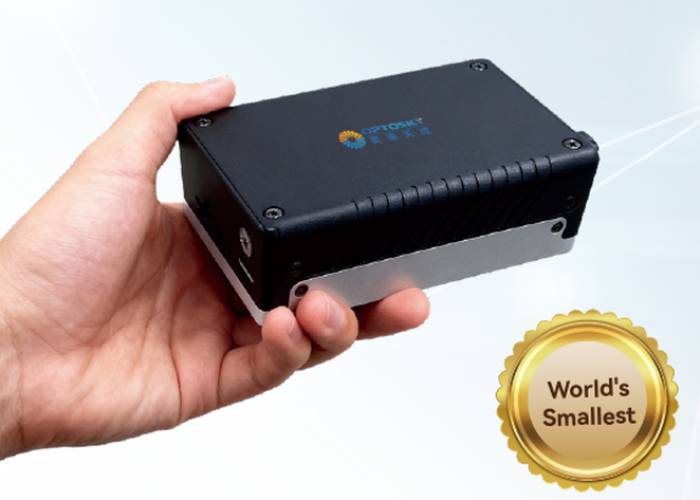
The ATR6100 Series is a compact handheld Raman identification family available with 532, 785 or 1064 nm excitation. It combines a small Raman measurement module, rechargeable operation, mobile application control and reference-library matching. The three excitation wavelengths allow the platform to be selected according to Raman signal strength and sample fluorescence rather than forcing every material into one fixed wavelength.
Product Overview
ATR6100 is designed for rapid material identification in a very compact format.
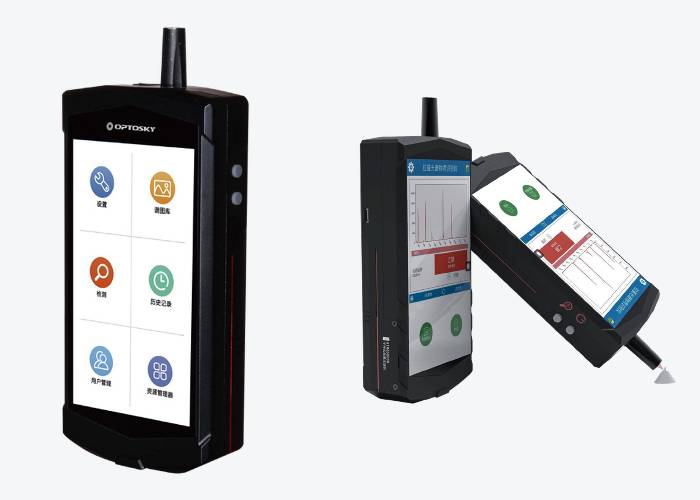
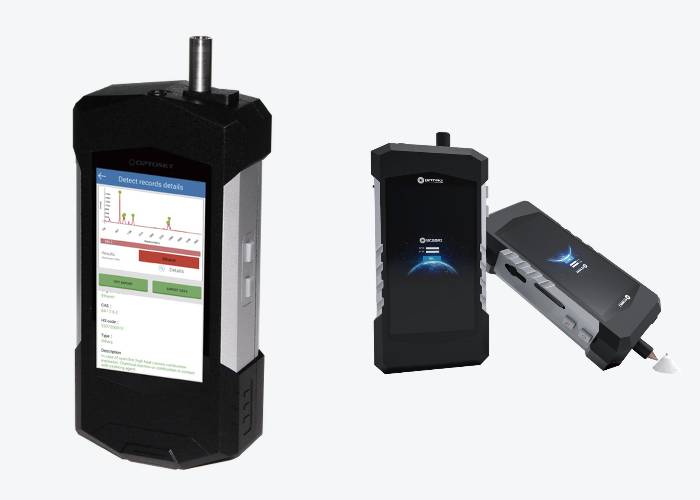
It is smaller than the fully integrated ATR6500/ATR6600 instruments and uses a connected mobile device as a major part of the user interface.
The current family comprises:
| Model | Excitation |
|---|---|
| ATR6100-532 | 532 nm |
| ATR6100 | 785 nm |
| ATR6100-1064 | 1064 nm |
Application-specific library variants can be configured for research, pharmaceutical, industrial and other identification workflows.
How It Works
The user positions the optical opening toward the sample and initiates measurement.
The laser excites the sample and the internal optical system collects the Raman-scattered light. The spectrometer measures the spectrum, which is transmitted to the connected mobile application.
The software can then display the Raman spectrum, compare it with stored references and generate an identification result where appropriate.
Choosing the Wavelength
532 nm
Produces relatively strong Raman scattering but may generate strong fluorescence in coloured or organic materials.
785 nm
A widely used compromise between Raman efficiency and fluorescence.
1064 nm
Useful for high-fluorescence materials but requires infrared-sensitive detection and generally has weaker Raman scattering.
This means wavelength choice should be made from the sample portfolio, not from instrument price or laser power alone.
Key Features
- Compact one-handed design.
- 532, 785 and 1064 nm options.
- Mobile application operation.
- Bluetooth connectivity.
- USB Type-C.
- Rechargeable lithium battery.
- Documented 4–6 h battery operation.
- Material-identification algorithms.
- User-expandable reference data.
- Result-report generation.
- Built-in sample-temperature measurement documented on current platform.
Technical Reference
| Parameter | Standard 785 nm platform |
|---|---|
| Excitation | 785 nm |
| Instrument mass | Approx. 280 g |
| Communication | USB Type-C, Bluetooth |
| Battery | Built-in rechargeable |
| Battery duration | 4–6 h documented |
| Operation | Mobile application + instrument control |
| Identification | Spectral-library based |
| Enclosure protection | IP65 documented |
Exact Raman range and resolution vary with wavelength configuration and should be confirmed on the selected model.
Applications
- research material identification
- polymers
- pharmaceuticals
- gemstones
- chemicals
- cultural-heritage screening
- industrial raw materials
- food-related identification methods
- rapid field screening
Compatibility and Selection Guidance
ATR6100 is appropriate when portability is a priority but more wavelength choice is required than ATR1600 provides.
For an integrated colour screen and more stand-alone operation, ATR6500 or ATR6600 may be preferable.
Do not assume that automatic library matching eliminates the need for method development. Unknown mixtures, poor spectra and samples outside the library can produce ambiguous results.
Why Source Through ScienceGears
ScienceGears can help choose between 532, 785 and 1064 nm according to representative materials and identify whether the required library should be research, pharmaceutical, industrial or customised.
Frequently Asked Questions
Can the laser wavelength be changed after purchase?
The wavelength is part of the configured optical instrument and should normally be chosen before ordering.
Which wavelength is the general-purpose option?
785 nm is commonly used for general material identification, although it is not appropriate for every sample.
When should I choose 1064 nm?
When fluorescence from the sample obscures Raman spectra at shorter wavelengths.
Can the instrument work without a mobile device?
Some controls are on the instrument, but the current platform uses the connected application for its main user interface and results.
Can users create custom libraries?
Yes, supported configurations allow user-added spectral data.
Is it suitable for quantitative concentration measurements?
Its primary use is identification. Quantitative Raman requires a separate validated calibration/model approach.
Contact ScienceGears
Contact ScienceGears with your target samples, preferred wavelength and library requirements so the correct ATR6100 configuration can be selected.
Customer Reviews
Related Product
Explore our precision instruments designed for electrochemical research and energy applications
Still Wondering About Something?
Explore our FAQ for fast, clear answers to the most common questions—available 24/7.