
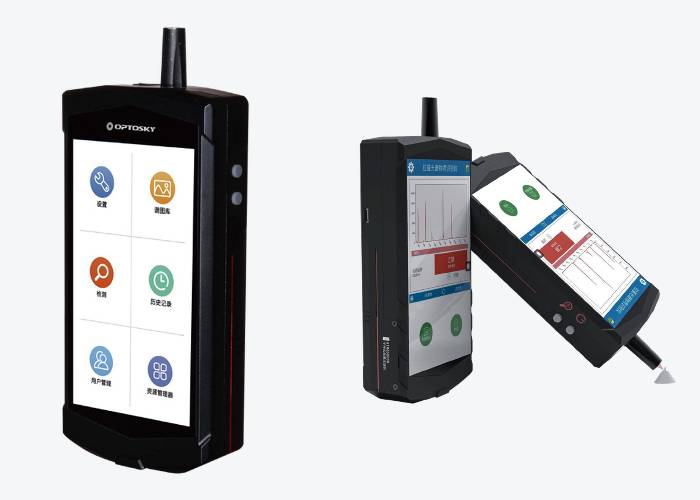
ATR6500 Series Handheld Raman Analysers
Integrated 532 and 785 nm Raman identification with touchscreen, camera and spectral libraries
Description
The ATR6500 Series is an integrated handheld Raman identification platform for rapid screening of compatible materials without requiring a separate computer or phone as the main interface. The family includes 785 nm and 532 nm excitation pathways together with a replaceable-battery ATR6500CH configuration. A colour touchscreen, camera, communications hardware and spectral-library software are built into the instrument for field and industrial identification workflows.
Product Overview
ATR6500 is intended for users who want a stand-alone handheld Raman instrument.
Unlike ATR1600 or ATR6100, the main screen and operating system are contained within the Raman analyser itself.
The current family includes:
- ATR6500 — 785 nm
- ATR6500CH — 785 nm, replaceable-battery architecture
- ATR6500-532 — 532 nm excitation
Application-specific software/library packages are available within the broader family.
How It Works
The instrument is positioned against or near the target material.
The integrated laser excites the sample, Raman-scattered light is collected and the internal spectrometer records the spectrum.
The software processes the spectrum and compares it with reference spectra stored within the instrument. The result can be displayed together with measurement information and, depending on configuration, a photograph or identification report.
Key Features
- Integrated handheld operation.
- Android operating platform.
- 5.5-inch touchscreen on standard ATR6500 documentation.
- 785 nm standard excitation.
- 532 nm alternative.
- Camera for sample documentation.
- Barcode/QR capability on supported systems.
- Wi-Fi, USB Type-C, Bluetooth and cellular communication functions on documented platform.
- GPS positioning.
- Rechargeable battery.
- Replaceable-battery ATR6500CH variant.
- User-created spectral libraries.
- Report export.
Standard ATR6500 Technical Specifications
| Parameter | Documented value |
|---|---|
| Excitation | 785 ±0.5 nm |
| Raman range | 200–4000 cm⁻¹ |
| Resolution | 10 cm⁻¹ |
| Display | 5.5-inch, 1920 × 1080 |
| Weight | Approx. 450 g |
| Communication | Wi-Fi, USB Type-C, Bluetooth, GSM |
| Battery duration | 4–6 h |
| Operating temperature | −20 to 50 °C |
ATR6500CH and ATR6500-532 have configuration-specific differences and should not automatically inherit every specification in the standard 785 nm table.
Applications
- raw-material screening
- polymers
- chemicals
- pharmaceutical materials
- gemstones
- incoming-goods identification
- research libraries
- forensic screening
- cultural-heritage material screening
- selected food-safety methods
Compatibility and Selection Guidance
Choose 785 nm ATR6500 as the general handheld pathway when fluorescence is manageable.
Choose ATR6500-532 where stronger visible Raman excitation is advantageous and fluorescence is low.
Choose ATR6500CH when replaceable battery operation is valuable.
For highly fluorescent samples, consider the 1064 nm ATR6600 Series instead.
Library content is also important. A handheld Raman analyser can only identify materials reliably when the sample spectrum is sufficiently characteristic and the reference library/method is appropriate.
Why Source Through ScienceGears
ScienceGears can review the sample portfolio, fluorescence risk, preferred excitation wavelength and required library/application package before the instrument is configured.
Frequently Asked Questions
What is the difference between ATR6500 and ATR6500CH?
Both use the handheld identification concept, while ATR6500CH provides a replaceable-battery configuration and updated field architecture.
When would I choose 532 nm?
Where the sample produces strong useful Raman scattering under 532 nm and fluorescence is not excessive.
Can I add my own spectral library?
User-created reference spectra are supported.
Does it automatically identify every unknown material?
No. Raman identification depends on spectrum quality, sample composition and reference-library coverage.
Can it analyse through containers?
Raman can sometimes measure through transparent containers, but the container's own Raman/fluorescence response must be considered.
When should I move to 1064 nm?
When fluorescence from coloured, biological or organic materials overwhelms the 785 nm spectrum.
Contact ScienceGears
Contact ScienceGears with the materials you intend to identify and your field workflow so the appropriate ATR6500 configuration and spectral-library package can be reviewed.
Customer Reviews
Related Product
Explore our precision instruments designed for electrochemical research and energy applications
Still Wondering About Something?
Explore our FAQ for fast, clear answers to the most common questions—available 24/7.