

ATR8700 Series Modular Confocal Raman Microscopes
Modular true-confocal Raman microscopy with deep cooling, rotating gratings and flexible optical integration
Description
The ATR8700 Series is a modular true-confocal Raman microscopy platform for research groups requiring greater optical flexibility than a fully integrated Raman microscope. Its split architecture separates the microscope and spectrometer modules, enabling a wider range of detector, spectrograph, laser and experimental-interface configurations. The system combines adjustable confocal optics, deep-cooled detectors, automated mapping and multiple excitation wavelengths for advanced materials and microscopic chemical analysis.
Product Overview
ATR8700 is designed around modularity.
In an integrated Raman microscope, the spectrometer, microscope and laser paths are tightly packaged within one fixed architecture. That is convenient but can be restrictive when researchers want to connect specialised sample stages, external optical equipment or other experimental hardware.
ATR8700 separates the main microscope and spectrograph functions while maintaining an integrated Raman workflow. The spectrometer module can also be used independently in suitable configurations.
How It Works
The Raman laser is directed through the microscope and focused onto the sample. Raman-scattered light is collected through the objective and directed through the confocal pinhole.
The spatial aperture suppresses more out-of-focus signal before the light reaches the spectrograph. A software-controlled grating then separates the Raman wavelengths and the cooled detector records the spectrum.
The motorised stage and autofocus system can acquire spectra over a programmed area to generate Raman chemical images.
Configuration Options
Current product documentation identifies:
- 532, 638, 785 and 1064 nm excitation
- up to three excitation wavelengths in one configuration
- 210, 350, 510 and 810 mm spectrograph focal-length options
- several deeply cooled area-array detector choices
- InGaAs detection for longer wavelengths
- adjustable confocal pinhole arrangements
- automated focus and mapping
Key Features
- Split, modular Raman microscope architecture.
- True-confocal pinhole optical system.
- Spectrograph can be used independently in appropriate configurations.
- Deep detector cooling down to −70 °C on a documented detector option.
- Multiple spectrograph focal lengths.
- Rotating/software-controlled gratings.
- Up to three excitation lasers documented.
- Automated focus and scan.
- Raman chemical mapping.
- 5-megapixel microscope camera.
- USB 3.0 interface.
- Large-area mapping and image stitching.
Technical Specifications
| Parameter | Documented value |
|---|---|
| Excitation wavelengths | 532, 638, 785, 1064 nm |
| Number of configured lasers | Up to 3 |
| Raman range | Up to 50–10,000 cm⁻¹, configuration dependent |
| Spectral resolution | 0.5–2.7 cm⁻¹ documented across configurations |
| Focal lengths | 210, 350, 510, 810 mm |
| Detector options | Cooled CCD and cooled InGaAs configurations |
| Deepest documented cooling | −70 °C on selected detector |
| Microscope camera | 5 MP |
| Standard objectives | 4×, 10×, 20× |
| Optional objectives | 50×, 100× |
| Interface | USB 3.0 |
| Spatial resolution | Better than 2 µm X-Y and 5 µm Z documented |
Applications
ATR8700 is particularly relevant when a laboratory needs Raman microscopy together with custom experimental integration:
- advanced materials
- semiconductor research
- nanomaterials
- electrochemical and in-situ sample environments
- temperature-controlled stages
- pharmaceuticals
- biological samples
- interfacial science
- coatings
- minerals
- weak-signal Raman research
Compatibility and Selection Guidance
ATR8700 should be considered when flexibility matters as much as Raman performance.
The modular architecture is useful when researchers anticipate integrating specialised stages or experimental cells. However, the actual optical compatibility of any external device must be confirmed before ordering.
Choose the detector after the laser wavelength has been selected. Then select focal length and grating according to required Raman range and resolution.
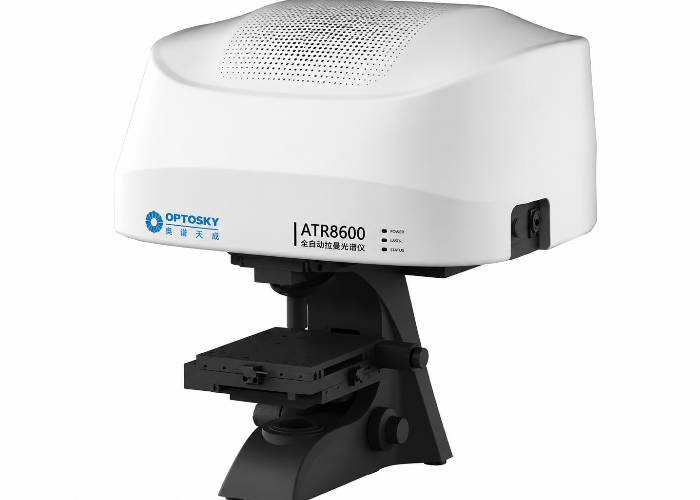
If laboratory space and integration simplicity are more important than modularity, ATR8600 may be a better fit. If the project requires the broadest research-grade wavelength and detector configuration, ATR8800 should also be considered.
Why Source Through ScienceGears
ScienceGears can review proposed in-situ stages, sample environments, laser wavelengths, spectral range, detector cooling and mapping requirements and coordinate a configuration that matches the intended experimental platform.
Frequently Asked Questions
What does “modular” mean for ATR8700?
The microscope and spectrometer are separate functional modules, allowing more flexibility than a fully enclosed integrated system.
Can the spectrometer be used without the Raman microscope?
The manufacturer describes independent spectrometer use as part of the modular concept, but the required optical connections should be defined for the intended experiment.
Why cool a detector to −70 °C?
Deep cooling reduces detector dark current, which can improve weak-signal measurements and long integrations.
Can the system use three laser wavelengths?
Up to three excitation wavelengths are documented for configured systems.
Can it integrate with an in-situ cell or heating stage?
The modular architecture makes such integration plausible, but geometry, working distance and laser/sample access must be checked for the exact stage or cell.
Does it support automated chemical mapping?
Yes, autofocus and scanning/mapping are documented functions.
Contact ScienceGears
Contact ScienceGears with your proposed sample environment, laser wavelength, resolution, detector, mapping and integration requirements so the modular ATR8700 configuration can be assessed.
Customer Reviews
Related Product
Explore our precision instruments designed for electrochemical research and energy applications



Still Wondering About Something?
Explore our FAQ for fast, clear answers to the most common questions—available 24/7.