
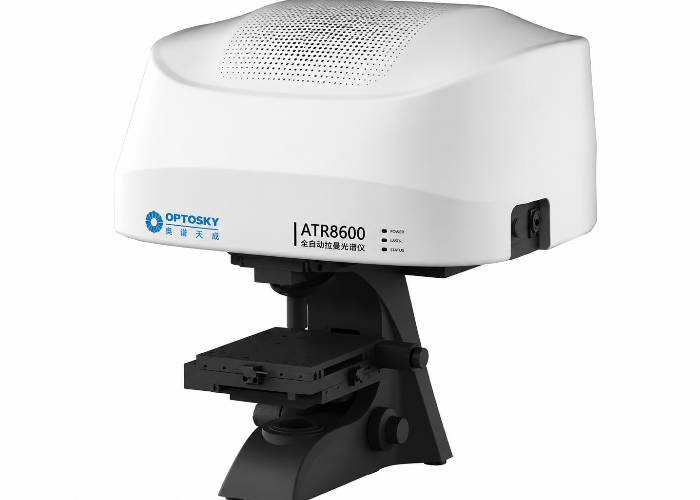
ATR8600 Series Compact Confocal Raman Microscopes
True-confocal Raman microscopy with compact architecture, rotating gratings and automated imaging
Description
The ATR8600 Series is a compact true-confocal Raman microscope for laboratories that require better spatial discrimination than conventional micro-Raman while retaining a relatively integrated instrument format. The platform combines pinhole-confocal optics, microscope imaging, rotating-grating spectroscopy, cooled-detector options and automated mapping. It can be configured with multiple excitation wavelengths and different spectrograph focal lengths to balance spectral resolution, fluorescence behaviour and measurement range.
Product Overview
A conventional microscope-based Raman system focuses a laser onto a small sample area, but Raman signal can still originate from material above or below the ideal focal plane.
A confocal Raman microscope uses a spatial aperture, or pinhole, to reject more out-of-focus light. This improves spatial discrimination and can support depth-resolved measurements when the optical configuration and sample permit.
ATR8600 incorporates the confocal system together with the microscope, spectrograph and camera in a compact architecture intended for research laboratories.
How It Works
The excitation laser is focused through the objective onto the sample. Raman-scattered light is collected back through the microscope and passes through the confocal spatial filtering system.
The pinhole reduces light from outside the selected focal volume. The remaining Raman light reaches the spectrometer, where one of the selected gratings disperses it onto the detector.
During mapping, the stage moves across the sample while autofocus and Raman acquisition are coordinated through software.
Configuration Options
The current exact product page documents:
- FL210 and FL350 spectrograph pathways
- multiple detector options
- deep-cooled CCD configurations
- InGaAs detector options for longer-wavelength excitation
- up to three excitation wavelengths in a configured system
- 532, 638, 785 and 1064 nm excitation among the documented choices
- automated mapping and autofocus
Key Features
- True pinhole-confocal architecture.
- Rotating-grating spectrograph.
- Compact integrated microscope layout.
- Multiple laser wavelengths.
- Deep-cooled detector options.
- Autofocus and automatic scanning.
- Raman mapping.
- 5-megapixel microscope camera.
- USB 3.0 interface.
- Interchangeable microscope objectives.
- Large-area scanning and image stitching.
Technical Specifications
| Parameter | Documented value |
|---|---|
| Spectrograph focal length | 210 or 350 mm |
| Spectral range | Up to 50–10,000 cm⁻¹, configuration dependent |
| Excitation | 532, 638, 785, 1064 nm and configured alternatives |
| Maximum configured lasers | Up to 3 documented |
| Spectral resolution | Configuration dependent; FL210/FL350 selection tables available |
| Microscope camera | 5 MP |
| Interface | USB 3.0 |
| Standard objectives | 4×, 10×, 20× documented |
| Optional objectives | 50×, 100× documented |
| Spatial resolution | Better than 2 µm X-Y and 5 µm Z documented |
| Working environment | 25 ±2 °C, 50 ±10% RH documented for specified performance |
The exact resolution varies with laser, spectrograph focal length, slit and detector and should therefore be assessed from the selected configuration.
Applications
- semiconductor materials
- nanoparticles and nanostructures
- battery materials
- coatings and interfaces
- biological microstructures
- pharmaceutical crystals
- minerals
- polymers
- two-dimensional materials
- Raman depth profiling and chemical mapping
Compatibility and Selection Guidance
Choose ATR8600 when true-confocal Raman is required but a compact integrated platform is preferred.
The focal-length decision should be linked to spectral-resolution requirements. Detector selection should be linked to excitation wavelength and signal level.
For laboratories requiring a highly modular system where the spectrometer can be separated and used independently, ATR8700 may be preferable. ATR8800 is the higher-tier pathway where more laser wavelengths and more extensive spectrograph options are required.
Why Source Through ScienceGears
ScienceGears can help review the required spatial resolution, excitation wavelength, detector cooling, spectrograph focal length, microscope objectives and mapping area before the system is configured.
Frequently Asked Questions
What is the advantage of true-confocal Raman?
Confocal spatial filtering reduces out-of-focus signal and improves localisation of the Raman measurement volume.
Can ATR8600 perform depth profiling?
Confocal optics and Z positioning can support depth-resolved work where sample transparency and optical properties are suitable.
Why are there different detector options?
Detector response and noise vary strongly with wavelength. A detector suited to 532 or 785 nm is not necessarily the correct detector for 1064 nm.
Does it support automated mapping?
Yes, mapping/autofocus configurations are documented.
Which focal length should I choose?
That depends on the spectral resolution and Raman range required. The choice should be made together with grating and excitation wavelength.
How does ATR8600 differ from ATR8300Pro?
ATR8600 is positioned around a true-confocal pinhole architecture, whereas ATR8300Pro focuses on configurable high-resolution micro-Raman imaging.
Contact ScienceGears
Contact ScienceGears to discuss your spatial-resolution requirements, sample fluorescence, excitation wavelength, focal-length configuration and mapping needs before selecting an ATR8600 system.
Customer Reviews
Related Product
Explore our precision instruments designed for electrochemical research and energy applications


Still Wondering About Something?
Explore our FAQ for fast, clear answers to the most common questions—available 24/7.