

ATR8800 Series Scientific-Grade Confocal Raman Imaging Microscopes
Research confocal Raman imaging with multi-laser excitation, high-resolution spectrographs and advanced detectors
Description
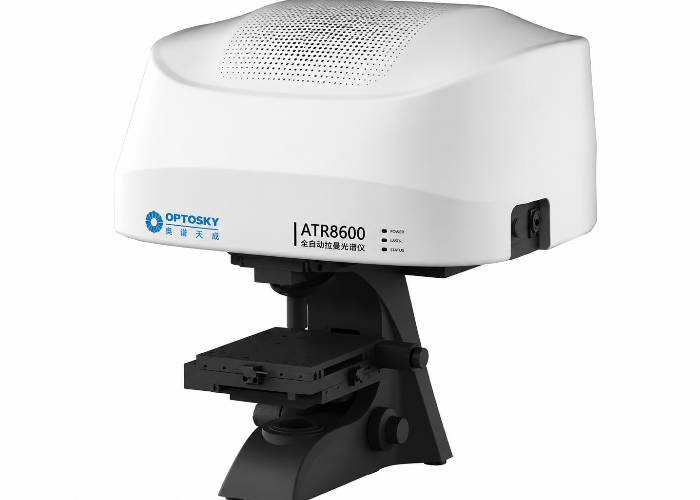
The ATR8800 Series is the research-oriented true-confocal Raman platform within this portfolio, designed for laboratories requiring a broad choice of excitation wavelengths, high spectral resolution, advanced detector configurations and automated Raman imaging. Configurable 350, 510 and 810 mm spectrographs can be combined with autofocus, mapping, deep-cooled or EMCCD detection and multiple excitation lasers, allowing the instrument to be tailored for demanding microscopic chemical and structural studies.
Product Overview
ATR8800 is intended for applications where a conventional Raman microscope no longer provides sufficient flexibility.
The system combines:
- true-confocal microscopy
- automated focusing
- scanning Raman imaging
- multiple spectrograph focal lengths
- multiple excitation wavelengths
- several detector technologies
- low-wavenumber configuration options
This allows one platform to be configured for very different experiments, from routine material mapping to weak-signal microscopic Raman research.
How It Works
The microscope focuses the selected excitation laser onto the sample and collects Raman-scattered light from the illuminated region.
A confocal pinhole suppresses out-of-focus signal, improving localisation. The Raman light is then dispersed by the chosen grating and detected by the configured CCD, EMCCD or infrared detector.
During Raman mapping, the sample is moved relative to the laser spot and a full Raman spectrum is acquired from each selected point. Software then converts these spectra into maps of chemical or structural information.
Spectrograph Configurations
The current selection guide documents:
- ATR8800-FL350
- ATR8800-FL510
- ATR8800-FL810
The achievable resolution depends strongly on both excitation wavelength and focal length.
For example, the current exact-product documentation reports substantially higher resolution on the FL810 configuration for visible excitation than on the shorter focal-length configurations.
Detector and Automation Options
Documented configuration suffixes include:
- BS - base
- AF - autofocus
- MP - mapping and autofocus
- LT - deep-cooled detector / long integration
- EM - deep-cooled area-array EMCCD
- UV - related configurations in selected product documentation
The current family supports ultraviolet, visible and near-infrared laser pathways including 266, 325, 532, 638, 785 and 1064 nm in the documented selection table. Not every wavelength should be assumed to be simultaneously installed.
Key Features
- True-confocal Raman microscopy.
- 350, 510 and 810 mm spectrograph configurations.
- Multiple software-controlled gratings.
- Visible, UV and NIR excitation pathways.
- Multi-laser configurations.
- Autofocus.
- Raman mapping.
- Deep-cooled detector options.
- EMCCD detector option.
- Low-wavenumber Raman configurations.
- Sealed sample chamber.
- Micron-scale laser spot.
- Long-integration capability on LT configurations.
Selected Configuration Data
| Focal length | Example 532 nm resolution | Example 785 nm resolution |
|---|---|---|
| FL350 | 1.4 cm⁻¹ | 2.1 cm⁻¹ |
| FL510 | 0.9 cm⁻¹ | 1.4 cm⁻¹ |
| FL810 | 0.45 cm⁻¹ | 0.86 cm⁻¹ |
These are manufacturer-selected standard configuration values and depend on slit, grating, Raman range and optical configuration.
Applications
- two-dimensional materials
- stress and strain mapping
- semiconductor devices
- battery and energy materials
- nanomaterials
- pharmaceutical polymorphs
- biological microstructures
- glass and ceramics
- thin films
- minerals
- low-wavenumber Raman
- chemical mapping of complex materials
Compatibility and Selection Guidance
ATR8800 should be configured from the scientific problem backwards.
First choose excitation wavelength based on fluorescence and sample optical behaviour. Then define the Raman shift range. Next determine the spectral resolution required to distinguish the bands of interest. Only then should focal length, grating and detector be selected.
The highest-resolution configuration is not automatically the best. Throughput, acquisition time and spectral coverage must also be considered.
For weak signals or long integrations, LT or EM detector pathways may be relevant. For routine micro-Raman work, the lower-complexity ATR8300/ATR8500 platforms may be more practical.
Why Source Through ScienceGears
ScienceGears can help laboratories translate application requirements into a complete ATR8800 configuration, including excitation wavelength, low-wavenumber requirements, focal length, detector, microscope objective, autofocus and mapping.
Frequently Asked Questions
What is the difference between FL350, FL510 and FL810?
They are spectrograph focal lengths and provide different resolution/throughput trade-offs.
Can the ATR8800 have four lasers?
The platform is marketed with multi-wavelength configurations up to four excitation bands, but the exact combination must be confirmed at quotation.
What is EMCCD used for?
Electron-multiplying CCD detection can be valuable for very weak optical signals where detector read noise is important.
What is low-wavenumber Raman?
It refers to Raman shifts closer to the excitation laser than conventional fingerprint measurements and can provide information on lattice modes and other low-frequency vibrations.
Can ATR8800 perform Raman stress mapping?
Yes, Raman peak shifts can be mapped where a validated relationship exists between peak position and stress for the material.
Should every research laboratory buy FL810?
No. Required resolution should be matched to the bands being measured. FL350 or FL510 may be more suitable where throughput or range is more important.
Contact ScienceGears
Contact ScienceGears with the Raman bands, sample type, excitation wavelength, resolution and mapping requirements so the appropriate ATR8800 spectrograph and detector configuration can be reviewed.
Customer Reviews
Related Product
Explore our precision instruments designed for electrochemical research and energy applications



Still Wondering About Something?
Explore our FAQ for fast, clear answers to the most common questions—available 24/7.